I love Audio Hijack. I use it almost every day. I use it for podcasts, yes, but it’s far more than a recording tool. Yes, it can capture audio from different input devices and apps on your Mac, and record them. It can also live stream them, broadcast them to YouTube, or re-route them to a different audio output device. It can apply a manual EQ, automatically boost quiet audio, filter out hums, dynamically duck one signal under another, and use any other Audio Unit effects you might have installed.
And it’s automatable, with a built-in JavaScript library of commands and support for Shortcuts. I’ve buit complex automations that let me switch between multiple states for a podcast production, all by pressing a single button on a Stream Deck, using Audio Hijack and Shortcuts.
Basically… if you need to do just about anything with audio involving your Mac, Audio Hijack will let you do it. It’s updated regularly with great new features, like the new Speech Denoise feature that uses machine learning to dynamically remove background noise.
Through the end of June, Six Colors readers can save 20% when you purchase with coupon code COLORS20. Learn more and download a free trial on the Audio Hijack site.
New Macs, game porting, and betas
Apple silicon is boring in the right way, why PC games might (or might not) come to the Mac, and we begin our summer beta planning.
Christina Warren, writing at Inverse, has a good overview of Apple’s impressive Game Porting Toolkit:
It turns out that Apple added DirectX 12 support via something it is calling the Game Porting Toolkit, a tool Apple is offering to developers to see how their existing x86 DirectX 12 games work on Macs powered by Apple silicon. That toolkit largely takes place as a 20,000 line of code patch to Wine, a compatibility layer designed to bring support for Windows games to platforms such as Linux, BSD, and macOS. Wine, which is primarily supported by the company CodeWeavers (which also makes a commercial version called CrossOver), works by converting system calls made to Windows APIs into calls that can be used by other operating systems. It isn’t emulation, but translation (an important semantic difference).
I’ve been meaning to write something about the significance of this game porting toolkit, but Christina has done a great job of summing up not only why it’s technically impressive, but also what the possible ramifications are.
Gaming on the Mac has been a fraught experience for decades, and it’s certainly possible that this toolkit will follow in the footsteps of other failed appeals to the gaming market. But one significant difference is that all of this technology is here, now and already works. You can, as numerous YouTube videos prove, download and run a recent Windows title and have it play surprisingly well. Will this entice developers to the previously untapped Mac market? Unclear, of course, but you can’t say Apple hasn’t made it easy for them.
Whether we’re installing Apple betas, Tim Cook offers us a free product, how the Reddit blockout have affected us, and what we were disappointed not to see at WWDC.
Hardware was by no means in short supply at this year’s Worldwide Developers Conference—not only did Apple launch three new Mac model, but there was also that little matter of a revolutionary spatial computer. But just as the company uses its annual gathering to show off what software features are coming down the road for its platforms, it turns out that it’s also the ideal occasion for Apple prognosticators to read between the lines and see what additional hardware devices might lie just beyond the horizon.
This year, more than most, shed some light on a few places that Apple might be looking to expand its footprint—notably in the home. That’s a market where Apple has staked a few meager claims in the past, but hasn’t really invested in expanding over the past several years. But if this year’s software news is any indication, that may be about to change.
I’m going to be direct with this story. My 30-minute demo with Vision Pro last week was the most mind-blowing moment of my 14-year career covering Apple and technology. I left the demo speechless, and it took me a few days to articulate how it felt. How I felt.
It’s not just that I was impressed by it, because obviously I was. It’s that, quite simply, I was part of the future for 30 minutes – I was in it – and then I had to take it off. And once you get a taste of the future, going back to the present feels… incomplete.
I spent 30 minutes on the verge of the future. I have a few moments I want to relive.
Apple has an ambitious view on what the baseline user experience for this device must be and then built a device which is able to meet those expectations. As a result it is more expensive than many folks would like or expect, but that price is justified by the user experience it can deliver. In this case a lesser/cheaper version of this product would likely cross a point where it becomes pointless. If you can’t perfectly recreate reality in minute detail and responsively let the user navigate their new world, the whole product feels meaningless. It has to be this good in order to be useful at all, so the price is high.
This was the blending of AR and VR in a way that I’ve not experienced before. I don’t think anyone else can do it. You feel like this dinosaur’s in the room with you, because it looks like the dinosaur is in the room with you. We don’t need to make you feel like you’re in this VR experience, completely immersed in this lava field, because we’re able to show you this blending of these two things.
It was unbelievable. The quality of the visuals was so good. This is one of those things I will remember, that feeling of that dinosaur trying to bite me—it was just mind-blowing. And then they sit me down, and they’re like, “we’re done now,” and I take it off and I was speechless. I was flabbergasted. Then they take you out [and tell you to] ask questions to this person from the product team. And [I said], I have no questions. I’m not even in the real world. I realized halfway through the conversation that I left my backpack in that room, because I just stood up and left it there. I was on another planet at that moment….
It was magical. They’ve nailed it. This thing costs $3500, and if they put out a card machine I’d buy it. I’m in. I cannot wait for this thing. I’ve now tasted the future and I can’t shake it.
Or if you’d prefer a more cynical take, Wired published a thing literally slugged “apple-vision-pro-doomed.”
Of course, Stephen Hackett at 512 Pixels has the details about Apple’s re-use of the “Apple Vision” name:
Apple has had other products with “vision” in their names over the years. Seven products, to be exact, and all of them are long-forgotten CRT displays:
This was very early in my Mac career, but I do remember these monitors. Apple has proven remarkably adept at re-using names from its past when it suits them. This is the perfect opportunity for AppleVision—sorry, Apple Vision—to ride again.
Jason and Myke discuss their experiences using the Apple Vision Pro and what they’re thinking about the product now that they’ve used it. Also there’s a lot of WWDC follow-up, and Jason reviewed new Macs! And it’s all coming to you live from Jason’s garage.
The M1 Mac Studio arrived last year with a shock, an entirely new class of Mac that debuted as the fastest Mac around. But with the Mac Pro presumably coming down the road, what role (if any) would the Mac Studio fill in the long-term future of high-performance Mac desktops?
With the release of the new M2-based Mac Studio, we have our answer, and it’s a pretty good one: At least for now, even with the arrival of the first Apple silicon Mac Pro, the Mac Studio is the fastest Mac around. Or, at the very least, in a dead heat with the Mac Pro. In the long run, it seems hard to believe that most pro-level Mac users will need a Mac Pro, with its high price tag and large set of PCI slots. With its M2 Max and M2 Ultra processor options, the Mac Studio provides enormous processing power to serve almost any pro user’s needs.
For this review, I was able to spend a few days running an M2 Ultra Mac Studio with 24 CPU cores, 76 GPU cores, and 128GB of memory. And what can I say? This new Mac Studio has all the benefits of the M1 model but with boosted performance. As someone who has spent the last year using an M1 Max Mac Studio as my primary Mac, I highly recommend the Mac Studio lifestyle to anyone who needs pro performance on (or, in my case, just beneath) the desktop.
Presenting the M2 Ultra
The new M2 Ultra chip is, like its predecessor, essentially two Max chips connected by Apple’s UltraFusion technology. The result is that it’s got twice of everything the M2 Max has—24 cores instead of 12, a maximum of 76 GPU cores instead of 38, and 32 Neural Engine cores instead of 16.
As with the last generation, choosing Ultra over Max will not necessarily double the speed of the computer—the M1 Ultra Mac Studio was between 50 and 90 percent faster than a comparable M1 Max Mac Studio. And while I couldn’t test a Mac Studio with the M2 Max processor, the speed gap between the M2 Ultra and a MacBook Pro with an M2 Max processor was pretty similar.
Of course, you’ll pay for the privilege. A base-model Mac Studio with an M2 Max processor costs $1999. The M2 Ultra versions start at $3999. Twice the chip, twice the price.
Overall, the M2 generation of Ultra takes advantage of extra processor cores, each of which is also a bit faster on its own, to be a bit faster than the last generation. If you already have an M1 Ultra Mac Studio, it’s probably not worth the upgrade—the improvement is real, but it’s incremental. The M2 Mac Studio is a much better buy for people who have a slower M1-based Apple Silicon device or who are very patient types still waiting to jump from Intel. I also know several people who bought MacBook Pros recently, mostly leaving them docked to displays—and those people should think very hard about selling those underused laptops and embracing the Mac Studio desktop life.
A sound decision
One of the more puzzling aspects of the design of the M1 Mac Studio was the fact that it had a new cooling system that seemed to make noise even when the system was idle. As I wrote last year:
It’s very quiet, throwing out low-level white noise that I couldn’t hear unless I sat in my office when it was completely quiet. But the sound is very much there, in a way my iMac Pro fan never was, and if you’re ultra-sensitive to fan noise in quiet environments, you will notice it.
In the end, I solved the problem of the audible fan noise by mounting the M1 Mac Studio underneath my desk, where it’s completely inaudible. (Yes, I liked the M1 Mac Studio so much that I bought one.)
I’m happy to report that Apple has rejiggered the cooling system in the Mac Studio. I could only hear the fan blowing when I turned the Mac Studio around so that its vents were pointing right at me, and even then, it was pretty quiet. When I properly oriented the computer on my desk, I couldn’t hear the fan. I placed my M1 Mac Studio on a nearby table and could still hear it blowing, in fact.
I wouldn’t call the M2 Mac Studio silent, but it’s noticeably quieter than the M1 model, and if you were to keep it on top of your desk, you probably wouldn’t hear it.
The ultimate Mac
So here we are. The Mac Studio is still the fastest Mac you can buy, though it’s now tied with the Mac Pro for that honor. While people who want the absolute best that Apple offers will want the M2 Ultra configuration, I can say from personal experience that the lower-cost Max-class chip configuration is a pretty great combination of speed and value.
I’m thrilled that Apple has embraced the Mac Studio and updated it for a new chip generation. For users who have more expansive needs than the Mac mini can fulfill, the Mac Studio offers the two fastest chips in Apple’s current Mac offerings—and it still does so in a compact package. Yes, there’s an Apple silicon Mac Pro now, but the Mac Studio is still the champion.
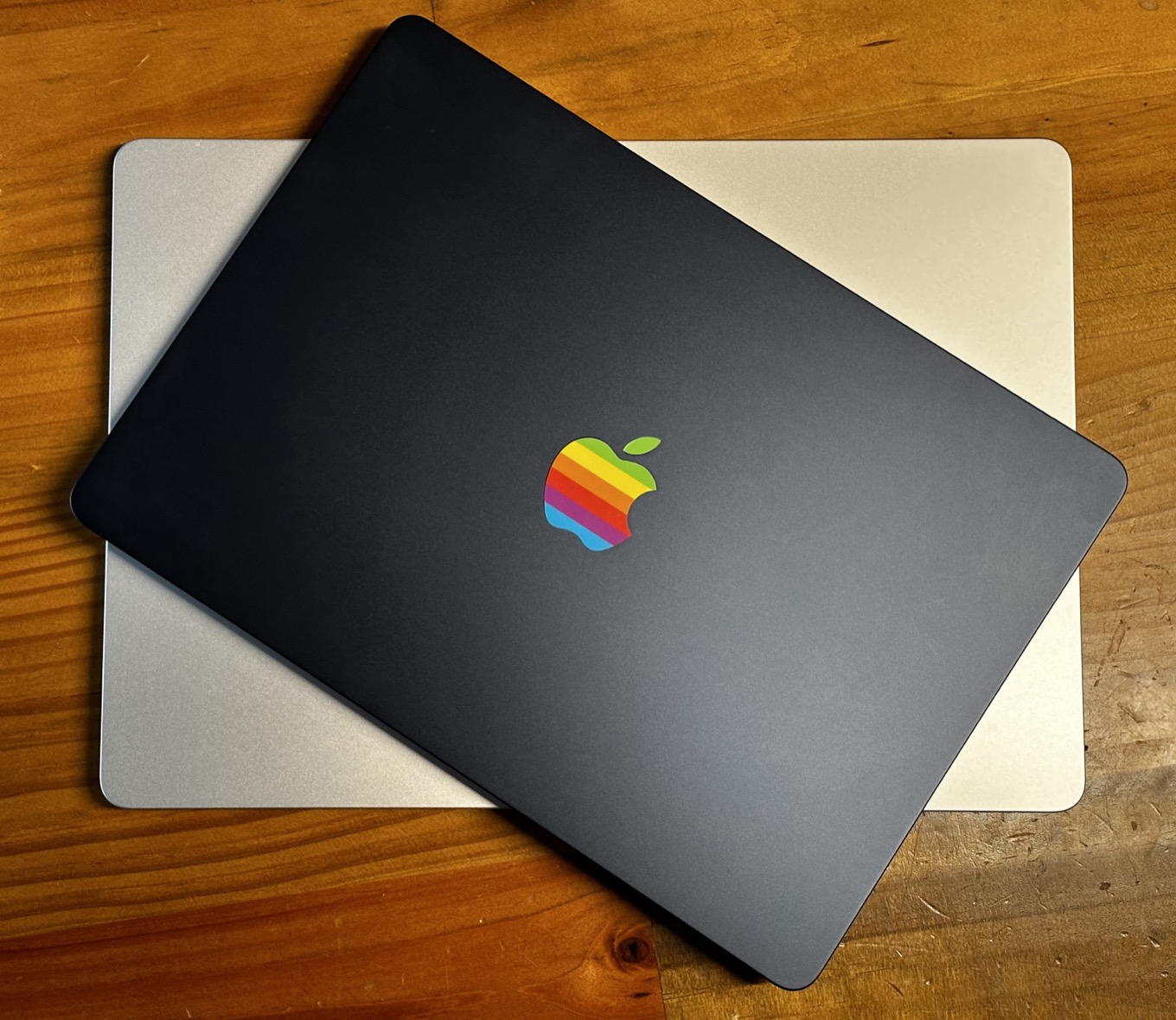
The 15-inch MacBook Air (bottom) is larger than its 13-inch sibling, but otherwise almost entirely identical.
One of the lessons to be taken from the Apple silicon era is that the chips are what they are. An M2 performs more or less the same whether it’s in a Mac mini or MacBook Air or iPad Pro. So when I say that Apple’s new 15-inch MacBook Air is more or less identical to the 13-inch M2 MacBook Air, I really mean it—at least in terms of how it works.
Instead, this new Air expands the definition of what a MacBook Air can be. With a 15.3-inch diagonal Liquid Retina display, it’s got the biggest screen of any consumer-targeted laptop in modern Apple history1. For the first time in ages, potential buyers won’t be forced to choose between a smaller screen and a much more expensive pro-level laptop.
Until now, if you wanted to buy a Mac laptop with a screen larger than 14 inches, the starting price was $2499 (for the 16-inch MacBook Pro). Now it’s almost half that price because the 15-inch Air starts at $1299. Of course, if you buy an Air you lose a lot of the high-end features of the MacBook Pro: more ports, a spectacular screen, and a more powerful processor. But if all you care about is the size of the display and perhaps weight—at 3.3 pounds, the Air is 70 percent of the weight of the MacBook Pro—you can save $1200. That’s a spectacular change in the economics of buying a Mac laptop.
Apple clearly thinks that the 15-inch MacBook Air will appeal to PC-using switchers who haven’t previously considered buying a Mac for this very reason. If they choose to pop into an Apple Store and look at one, they’ll find all the things that made the original M2 MacBook Air so great. It’s got an adorable curved flat design (available in the same color options of Silver, Space Gray, Starlight, and Midnight). The M2 processor is powerful enough for almost everyone. It’s thin and light, with no cooling fan required. It’s just got a bigger screen! That’s it.
Well… that’s almost it. To counteract the extra power draw of the bigger screen, Apple has increased the size of the Air’s battery, but all that does is make the battery life of the two models identical. There’s also a bit extra space in the 15-inch model’s case for a more expansive speaker system. (When I compared it to the 13-inch model, I noticed some differences, but they were extremely subtle.)
There are a few other tiny differences between the new models. The base-model 15-inch Air’s M2 chip has ten graphics cores. The base-model 13-inch Air only has eight graphics cores. When the two models are configured identically, the difference in price between them is $100, not $200.
Similarly, the $1099 13-inch Air comes with a pretty plain 30-watt power adapter. The 15-inch Air, like the more expensive configurations of the 13-inch model, comes with the 35-watt adapter with two USB-C ports that Apple introduced last year, but online orders can opt to swap it for a single-port 70-watt adapter that enables fast charging, at no extra cost.
Still no vibrant colors, alas.
I wish I had more to say about the new 15-inch MacBook Air, but really, the best compliment I can give it is that it’s just as great as the 13-inch model I reviewed last summer. I liked that laptop so much that I bought one for myself. Now Apple sells that same computer but with a 15.3-inch display. If you’ve hesitated to consider buying a MacBook Air because its screens always seemed a bit too cramped, you now have another option. If you’ve always wanted a bigger display but didn’t want to pay more than $1000 for the privilege, your time is now.
This laptop has literally everything that made the M2 MacBook Air great. It’s just bigger. Sometimes, bigger is better.
Apple’s last foray into this world was the 14-inch iBook, which offered a bigger display than its 12-inch counterpart, but with the same resolution! The new 15-inch Air offers more than a million extra pixels than the 13-inch model. ↩
The Apple Vision Pro is here! Well, not yet. And you can’t afford one. So is it really here? No. But the new Macs are! And soon the feature we’ve all been waiting for.
Zuckerberg aside, there seems no doubt that Vision Pro is incredibly well made and an amazing experience. It’s also really expensive and is making people as uncomfortable as a pair of well-starched underpants.
Many people thought Apple really missed a step in its demo, particularly the part where it showed a father recording a precious family moment while wearing Vision Pro… and then watching it later by himself. Presumably this was after his family has left him. Or have they? Can he even tell unless they get close enough to fade into his view?
“I love my family. I wonder where they are. I’ll go look after I watch a movie on Mt. Hood. You know, like you do.”
Apple rightly recognized that, to-date, XR headsets are isolating, both from your environment, which can be dangerous, and other people, which can be tragic. In attempting to provide a solution to that problem, the company appears to be saying “What if you could be both immersed and present at the same time?!” And after years of dealing with smartphones and their distractions, people seem to be reacting “GIRL, DON’T EVEN WITH THAT.”
Apple has time to sort out its product story. The Watch introduction also featured lavish explanations of features—sending a heartbeat or a touch—that most Watch owners now probably aren’t even aware are there. The first generation Vision Pro isn’t going to ship until next year and at $3,499 it’s not going to get wide adoption.
At least the company didn’t show people wearing them while walking down the street. You know it’s going to happen, but at least Apple’s not promoting it.
The correct intel on the new Macs
Kudos to Mark Gurman for correctly predicting Apple would announce two new Macs with M2 Max and Ultra chips in addition to the new 15-inch MacBook Air. Jason has declared the Mac the bigger winner of WWDC and it’s hard to argue with that. At least you can actually order these machines now.
We may now (finally) welcome the Mac Pro to the family of Apple-silicon-based Macs. Apple will surely sell dozens of them. They are certainly the most expandable Macs (a lot of) money can buy, but are they expandable in the kind of way that the people who typically buy Mac Pros really care about? After all that talk about users might be able to add GPUs, you can’t add GPUs.
Apple Bill Gates says “An Apple silicon GPU should be enough for anyone.” Apple mom says “We have GPUs at home.”
Given the continued existence of the Mac Studio, the new Mac Pro is fine, really. While there are certainly pro users who need and use these machines, their real effect may be more aspirational, existing more as a Platonic ideal of a Mac, an ultimate form that can be conceived but never attained.
Certainly not at those prices.
One more thing
So, we’ve talked about Vision Pro, we’ve talked about the new Macs… let’s get to the real meat of the keynote. Because according to Apple…
Are you sitting down?
…autocorrect is fixed in iOS 17.
Talk about burying the lede.
In its one big announcement that had anything to do with AI, Apple said that iOS 17 will use an on-device language model that learns how you type, instead of relying on how a weirdly statistically large sample of poor spellers and duck fanatics type.
Honestly, Apple could have just announced a fixed autocorrect and multiple timers on iOS and WWDC would have been declared a tour de force. Craig Federighi would have been carried off on the shoulders of the gathered developers and press, and a tub of Gatoraide would have been dumped on Tim Cook.
If that’s not how all WWDC keynotes end anyway. I don’t know, I’ve never been to one.
[John Moltz is a Six Colors contributor. You can find him on Mastodon at Mastodon.social/@moltz and he sells items with references you might get on Cotton Bureau.]
Jason reports back on his firsthand time with the Apple Vision, we ponder the future of the category, and we save a little praise for Apple’s understated new Mac releases.
My thanks to BZG Apps for sponsoring Six Colors this week. BZG makes Unite 4, which allows you to turn any Website into a Mac app. Using a lightweight, WebKit powered browser as a backend, you can easily create isolated, customizable apps from any site.
Unite 4 includes dozens of new features, including support for native notifications, new customization options, and M1 support. Unite apps also serve as a great alternative for resource-hogging Electron apps or half-baked Catalyst apps.
Six Colors readers get 20% off this week when you purchase Unite 4 at bzgapps.com/sixcolors or when using the promo code SixColors at checkout. There’s also a 14 day free trial, and the app is included in Setapp for subscribers.
Apollo Developer Christian Selig, who has been trying to find a way to keep his app alive despite an enormous new charge for connecting to Reddit, has given up:
June 30th will be Apollo’s last day. I’ve talked to a lot of people, and come to terms with this over the last weeks as talks with Reddit have deteriorated to an ugly point.
Apparently in a conversation with moderators, Reddit CEO Steve Huffman alleged that Selig was attempting to threaten the company into paying him millions of dollars. Unfortunately for Huffman, Selig has receipts—namely recordings of all his dealings with Reddit.
I gotta be honest, this Huffman guy sure looks like a lying creep, and all of Reddit’s public statements about honoring third-party apps seem like an attempt to lie to Redditors so they don’t look like the bad guys. But the bottom line is that Reddit repriced its API in order to bankrupt third-party apps. (Selig says he’ll lose $250,000 in the shutdown.)
Following the trail blazed by Tweetbot and Twitterrific, Apollo users will be offered the opportunity to request a pro-rated refund or decline the refund, reducing Selig’s losses.
It’s a sad situation made worse by Reddit’s dissembling. Turns out they’re doing exactly what Twitter did to third-party clients—they just saw how badly it went for Twitter and decided to try to shield themselves from the worst of it. Whoops.
I get it. You’re excited and/or angry about the $3500 headset Apple might sell you next year if you’re in the right country. It’s worth getting excited about. But in terms of real-world, right-now impact, the surprise winner of the WWDC 2023 keynote is… wait for it… the Mac!
I would never have imagined it beforehand, but it’s true: Apple’s Mac announcements on Monday were huge news, despite being overshadowed by shiny future products and platforms that won’t let anyone do anything until 2024.
Apple announced plenty of new features at WWDC this week, but it’s bundled up a few services-related announcements in a new press release, some of which have been hitherto unknown.
In iOS 17, businesses will now be able to use Apple Wallet IDs for age and identity verification.
Apple Music, for example, will now feature credits for music, letting you see the various artists on a track. And all Apple Music radio shows will now be available in Apple Podcasts as well. On the Apple TV, you can use the Continuity Camera support in connect with Apple Music Sing to see yourself onscreen during karaoke.
The previously mentioned crossword puzzles in Apple News+ will include both a daily crossword and mini-crossword, which is being produced by The Puzzle Society.
Apple Podcasts gets a refreshed Now Playing design, better queue controls, and the ability to show episode-specific art. In addition, podcasts will be able connect subscriptions between apps and podcasts—so, for example, Bloomberg subscribers may be able to get access to specific podcasts.
There’s a new series page available in Apple Books, which gathers various titles together and shows both ebook and audiobook editions, as well as related suggestions.
Apple Cash will now feature both recurring payments (weekly, biweekly, or monthly) and the ability to automatically top up your balance when it’s low.
IDs in Apple Wallet will be available to businesses for age and identity verification. You get to see what information is being requested before you agree to share it, as well as if it’s being stored, and then authenticate with Face ID or Touch ID. Apple says this will work without the need for new hardware.
Location sharing will now be available via both Messages and Maps via Find My, letting users share their location or request to see someone else’s location, so that you can get directions to them.
These features are part of iOS 17, iPadOS 17, macOS Sonoma, tvOS 17, and watchOS 10, to be released later this fall, though it’s not currently clear whether all of these will be available at the time of their release.
[Dan Moren is the East Coast Bureau Chief of Six Colors, as well as an author, podcaster, and two-time Jeopardy! champion. You can find him on Mastodon at @dmoren@zeppelin.flights or reach him by email at dan@sixcolors.com. His next novel, the sci-fi adventure Eternity's Tomb, will be released in November 2026.]