Six Colors
Six Colors

Apple, technology, and other stuff

Support this Site

Become a Six Colors member to read exclusive posts, get our weekly podcast, join our community, and more!

By John Moltz

This Week in Apple: A stopped Watch

Is the Apple Watch about to become as scarce as woke liberal elites at Elon Musk’s birthday party? Meanwhile rumors about the iPhone 15 and the Apple headset are heating up, hopefully not like the devices themselves.

Apple Watch fracas

Like squirrels storing nuts, is it time to buy up and stash away Apple Watches?

Well, that’s one strategy. A strategy employed by rats with good hair style. If you want to go that way. I’m not here to judge your role models.

If things continue apace, the U.S. International Trade Commission could ban imports of most Apple Watch models due to a patent ruling in favor of a company that makes electrocardiogram technology. ECG technology is in every currently shipping Apple Watch model except the SE.

Is this game over for the Apple Watch, one of the most successful Apple flops ever?! Before we even get the recently rumored blood glucose testing?! Say it isn’t so!

OK, I’ll say it. It’s probably not so.

Consider the fact that Apple spent $9.4 million on lobbying the U.S. government in 2022, an amount that John Gruber points out is about what the company makes in profit every hour. There is a way to solve this impasse and that way is sweet, sweet lucre. You know it, you love it, it’s the thing that sadly makes the world go ‘round.

I’m not saying AliveCor, the company holding the patent Apple has been charged wth infringing, is solely in it for the money. But this is capitalism we’re talking about, so they’re probably north of 95 percent in it for the money, just like Apple is. Expect a deal to be struck, the details of which will not be made public.

It’s possible Apple will let it drag out and maybe Apple Watch supplies will get tight for a while, but don’t bother stashing any in a tree. Because I’m not sure if that’s covered by AppleCare.

iPhone 15 rumor time

When the iPhone 15 comes out, you can have any size screen as long as the screen is larger.

According to CAD files obtained by 9to5Mac, the next iPhone Pro will have a 6.2-inch display rather than the 6.1-inch display on the iPhone 14 Pro.

A tenth of an inch isn’t a lot and 9to5Mac doesn’t reveal whether or not the iPhone 15 gains the increase through reducing the bezel size even further or increasing the size of the body.

The iPhone’s body, not yours. You can increase the size of yours the old fashioned way, if you’re so inclined.

Either way, as the #1 iPhone mini superfan, it’s going to be too big for my tastes.

Speaking of the body (again, the iPhone’s), another rumor indicates that the iPhone 15 could come in new colors: a dark red as well as pink and light blue. Given Apple’s predilection for making these colors just barely noticeable, I wouldn’t expect a real blood red. Most of their Pro colors are like someone softly whispered the name of a color at you from across a field.

“Bluuue.”

“WHAT? I CAN’T HEAR YOU. DID YOU SAY ‘SHOE’?”

Ming-Chi Kuo also weighs in to tell us that the 15 Pro models will have an improved LiDAR scanner which is more power-efficient. That sounds great, but I wish someone would tell me what I’m supposed to do with the LiDAR camera I already have in my iPad. I saw a Nova episode where they used them to find evidence of ancient civilizations in the rainforests of South America, but so far I haven’t found any in my backyard. Maybe I’m holding it wrong.

Don’t let it go to your head

For a device that hasn’t been announced yet, there sure are a lot of rumors about the upcoming Apple headset.

Excuse me. Headsets.

Yes, Apple is expected to announce two high-end headset models this year, with guesstimated high-end price points between $3,000 and $5,000. Foxconn is now reportedly already working on two cheaper models with price points, uh, lower than the high-end models. These cheaper models could arrive in 2024 or 2025. Apple will reportedly make the devices more affordable by using cheaper components such as “lower-resolution lenses”.

I will have to remember to stock up on dramamine.

Maybe the company can also cut back on the number of cameras in the device, as the high-end models are expect to have a dozen. And here’s me, already not knowing how to make use of the cameras I have.

[John Moltz is a Six Colors contributor. You can find him on Mastodon at Mastodon.social/@moltz and he sells items with references you might get on Cotton Bureau.]


Blood glucose monitoring and machine learning

With Jason off on assignment, Dan recruits his Clockwise co-host Mikah Sargent to talk about reports of Apple’s latest medical device and how the company uses machine learning.


How we listen to digital music, would we pay for increased account security, keeping our devices clean, and Apple’s pricey upgrade costs.


Report: Apple working on non-invasive glucose testing device

Bloomberg’s Mark Gurman says that Apple is working on a “moonshot” project for continuous non-invasive blood glucose testing, and that it’s looking promising:

Apple is taking a different approach, using a chip technology known as silicon photonics and a measurement process called optical absorption spectroscopy. The system uses lasers to emit specific wavelengths of light into an area below the skin where there is interstitial fluid — substances that leak out of capillaries — that can be absorbed by glucose. The light is then reflected back to the sensor in a way that indicates the concentration of glucose. An algorithm then determines a person’s blood glucose level.

Rumors of Apple working on this have been around for at least as long as the Apple Watch, and it meshes nicely with the company’s focus on health.

But there are a lot of challenges still to overcome. Gurman mentions that the prototype is likely to be the size of an iPhone and will be strapped to the user’s bicep. Obviously, the company will probably want to get it smaller (and less obtrusive) than that over time. In an ideal world, I’m sure they would like it to be simply a feature of the Apple Watch, but I wouldn’t be surprised if the first version is an accessory.

The bigger challenge is probably regulation. Apple can get away with saying that the Apple Watch’s blood oxygen sensor is “not intended for medical use” and “only designed for general fitness and wellness purposes.” That’s not going to cut it with glucose monitoring, where an inaccuracy could have significant damaging consequences to those who rely on it. This tech needs to be absolutely rock solid before the company can deploy it, which suggests that it may still be many years before it’s ready for consumer use.


By Joe Rosensteel

Music to no one’s ears

Look, I’ve been hoping that at some point, the rocky transition from iTunes to the Music app would be over and we’d all look back on it and say, “Wow, I can’t believe that was so brief.” But it isn’t over. Here I am, in the year 2023, and I have the same problems using the app that I’ve had for about half a decade at this point. And yes, many of these problems are tied to changes made for the Apple Music service.

Apple Music's Listen Now screen
Somehow, none of these things are what I want to actually listen to now.

When launching the Music app on macOS, you always start off at the Listen Now section of the app. It doesn’t matter what I was previously listening to in the app—that information has been lost to the sands of time. I can’t resume playback of anything I was listening to on this device, or any other. Anything I was looking at in the interface is wiped away too. I can, instead, see the four things that Apple thinks I want immediate access to. Those are “Joseph Rosensteel’s Station” in Apple Music, a new EP from Mariah Carey (sorry, Mariah, this is not one thing I need), the opportunity to revisit Beyonce’s Super Bowl performance, and the new album from Orbital (I know, we’re all surprised they’re still releasing albums, but I listened to this several weeks ago so it’s not new to me at this point).

What’s so bad about that, Joe? Well, the “station” Apple Music compiles for me—and, anecdotally, every Apple Music user I’ve spoken with—is trash. A churning abyss of things I’ve tangentially listened to that spans every genre, tempo, style, etc. Listening to it is unlike listening to a radio station; it’s more like an angry jukebox out to shuffle in some random thing and kill whatever vibe you had from the previous song. As a rule I don’t bother even listening to it, so for it to always be the number one thing here is ridiculous.

Surely, the section under it, Recently Played, is exactly what I want? No, I want what I was last listening to, where I was last listening to it, tied directly to the play button. Recently Played only provides the entire song, album, or playlist I was listening to from its start.

If I scroll down, I get more recommendations. It’s good that they’re further down, because if I’m not in the mood, I can just stop scrolling, but that first chunk of the interface is irritating because I want to resume what I was listening to. Even if I quit and reopen the app instantly, it all resets.

Let’s say I start listening to Flowering Jungle by Monster Rally on my Mac, but I realize that I need to go downstairs. There’s no way to transfer where I currently am in my Mac’s Music app to my iPhone’s Music app. My iPhone says “Not Playing”, so it has no playback history of its own to even resume from at this moment. Instead, the iPhone’s Music app presents me with the same Listen Now options, where I can go to Recently Played, navigate into the album, and pick the song, and then offset the time to match roughly where I was on my Mac. Convenient!

If only there was some way to do, oh I don’t know, let’s call it a hand-off between the two devices that are both made by the same company, running software by the same company, and using the same music service that knows exactly what I am streaming from it. Something with a little continuity. What a concept.

But I still haven’t found what I’m looking for

The other thing that’s really irked me is searching, which is usually the other thing I want to do when I open the Music app, if I’m not resuming what I was previously listening to.

The search field in macOS used to have a little toggle at the top that let you choose whether it was finding results in your library or Apple Music. That’s moved to the browse page and the search results page, which changes the behavior of the search text field, even though those buttons are not even in the same ZIP code. For a while I thought they’d just removed the library search, but it’s still there…if you want to do more work to use it.

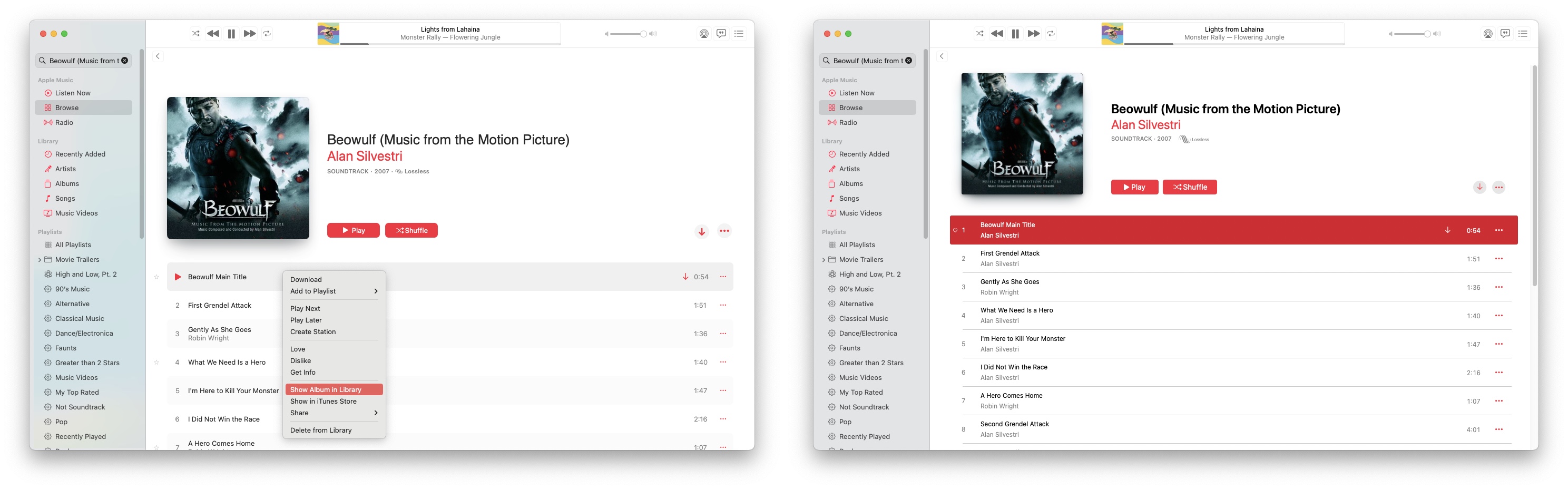
You can also search in Apple Music and then go to your library version of an album or song by right-clicking on the tracks and picking “Show Album in Library” which also does a neat thing where you can see that whatever they use to style the album interface is different between the two for no good reason at all.

Two screenshots of the album view in Music on the Mac, from a music library and from Apple Music.
The same album viewed in Apple Music (left) and the Music.app library (right). Enlarge

If you want your own version of the album and isn’t exactly what Apple Music has, then you must use the toggle in the browse interface before searching. I have a version of the Tron: Legacy soundtrack that I bought from Amazon because it had an exclusive track. It’s in my library and I can manually navigate to it, but I can’t use Apple’s search to get to it at all, only the versions of the album in Apple Music. Doesn’t seem like a huge deal, right? Well at some point I “loved” a track in Apple Music from this album, and now I have a version of the Tron: Legacy soundtrack in my library that has one track in it.*

Look at the stars, look how they shine for you

Speaking of “loving” music, some of us prefer a more nuanced system for rating music. Sure, five stars is overkill and most people are either ranking their music either zero stars or five stars, but there are those of us with a rating system that we’d like to keep using because we were using it already. Even though the stars have been eradicated from the interface, you can still right-click on a track to see its star rating metadata or to even to rate it. Like when you go two levels deep in Windows’ Settings and you get that Windows 95-looking dialog about a network adapter—that’s where your stars are buried.

Some of my albums have had their star ratings wiped out, which I can only assume is from some iCloud Library sync issue at some point in the last eight years, so it’s no longer something I can reliably use or invest additional time in. It does, however, drive some of the features I like to use, like Smart Playlists.

What, you’ve never heard of Smart Playlists? Gather ’round, kids and let me regale you with how they work: They’re basically saved searches that filter your music library by the file metadata, and they’re super neat. Unfortunately, having a library is kind of the enemy of using a music streaming service. Apple would much rather you use stations or their human-curated playlists, but I don’t like to rely on those because at any point the human-curated playlist could be changed by a human who isn’t me. It’s not versionable and it’s not mine—it’s the service’s.

C’est la vie! I can make my peace with Apple product managers who the stars made sad, but not so much with the slow erosion via data loss of something that I use to play the music I want.

You’re getting closer to pushing me off of life’s little edge

As a long time user of iTunes, and now the Music app, I’m at a loss for why all of this is so bad, other than that Apple makes too much money to care. Why is this a streaming-first experience that is executed like a standalone music player? Why does my library even exist if I’m not really supposed to use it?

There are a thousand other things I could needle Apple Music product managers about, but let’s just start with playing what I want. A high bar.

[Joe Rosensteel is a VFX artist and writer based in Los Angeles.]


Susan Wojcicki steps down as YouTube CEO, what will her legacy be? Ant-Man performs well at the box office, but do reviews indicate ‘Marvel Fatigue’? And guest-host Myke Hurley quizzes Julia on why he has to wait for shows to premiere in the UK.


By Dan Moren for Macworld

If Apple is making a bigger MacBook Air, why not a smaller one too?

A wise green puppet once contended that “size matters not.” Obviously he never had to contend with navigating Apple’s product lineups.

Recent reports suggest that Cupertino might soon be releasing a MacBook Air with a larger 15-inch screen. Strategically, that makes a lot of sense: the MacBook Air is Apple’s best-selling Mac, and for it to only be available in a single size is a missed opportunity. Yes, there are upsell opportunities for those who want a larger display above all else, but given that currently entails a jump all the way from $1200 to $2000, many customers won’t take the leap—especially if they don’t need the power or performance of a MacBook Pro.

Screen size has proven to be a key differentiator in many of Apple’s other product lines, and even the MacBook Air was itself available in multiple sizes in its past incarnations. But I say why stop there? There are plenty of other Apple products where another screen size might make a big (or small) difference.

Continue reading on Macworld ↦


With Jason on vacation, Myke is joined by David Smith. They discuss a potential delay for Apple’s headset and what that may mean for WWDC. Also, David’s AI-powered podcast transcription website, and the introduction of ‘Ask Underscore’.


By Dan Moren

Setting up iOS’s two-factor authentication for Twitter

Note: This story has not been updated since 2023.

If you’re already using two-factor authentication on your Twitter, account, great! But with the company’s announcement Friday evening1 that it would be discontinuing two-factor authentication via SMS for all but its paying Twitter Blue subscribers, you may suddenly find yourself wondering what a person’s to do if they want to keep their Twitter account secure?

Have no fear: while these changes were perhaps hastily and questionably enacted, there is a silver lining here. Two-factor authentication via an authentication app is more secure than using SMS, and, better yet, if you’re using a recent version of iOS, iPadOS, or macOS, then not only is the ability to set up that feature baked right into the operating system, but the system will even autofill the password for you every time you login.

Here’s how to set it up:

First, fire up Twitter, either on the web or in the app. In the toolbar on the left, tap the More button (the one with the three dots), and then tap Settings and Support; under the menu that appears there, tap Settings and Privacy.

This will take you to the account section of your Twitter Settings; tap the entry for “Security and account access” and then, on the right hand side of the screen, tap Security.

You’ll see an entry for “Two-factor authentication”: tap that and you’ll get options for the various ways to secure your account. Tap the checkbox for “Authentication app” and a dialog will appear prompting you to get started.

Twitter Security Settings

Fun so far, right?

Here’s where it gets a little tricky, depending on what device you’re using. To set up the two-factor codes, you’ll get a QR code. While in some apps and websites, macOS/iOS can actually detect the QR code being show onscreen, allowing you to tap and hold on it to set up the feature, that didn’t happen for me on Twitter on the iPad. That leaves two other options for configuring this feature.

Twitter 2FA Setup
Scan this QR code with another iOS device to setup two-factor authentication.
Scan QR code

If you happen to have an iOS device handy, you can point its camera at the QR code on your screen. In the Camera app, as you hover over the QR code, you should see a yellow bubble pop up that says Add Verification Code to Twitter.com. Tapping that will open the Passwords section of iOS, and prompt you to add the verification code to an existing account. Search for your Twitter login, tap it, and you should be prompted to save the verification code there.

If you don’t have an iOS device handy, you can do the process manually. Tap the “Can’t scan the QR code?” in the dialog box, and you’ll instead be prompted with a long string of characters. Copy this and go to the Passwords section of System Settings, where you’ll need to authenticate with your passcode or biometrics. Then search for your Twitter login, tap on it, and select the Set Up Verification Code button. You’ll be prompted to either scan the QR code or Enter Setup Key—choose the latter, paste in the string you just copied, and hit OK.

You should now see a new section showing a six-digit code along with a timer counting down. Copy that code and return to the Twitter website to paste it in. (The OS should also offer to autofill it for you when you tap on the verification code feature.)

That’s it! The hardest part is over and now whenever you log in to Twitter in the future, the OS should autofill the two-factor code just like it does for your username and password.


  1. If you have any question that this decision was bad news, couched as it was, then just remember that they put out this news at the end of Friday. 

[Dan Moren is the East Coast Bureau Chief of Six Colors, as well as an author, podcaster, and two-time Jeopardy! champion. You can find him on Mastodon at @dmoren@zeppelin.flights or reach him by email at dan@sixcolors.com. His next novel, the sci-fi adventure Eternity's Tomb, will be released in November 2026.]


By John Moltz

This Week in Apple: Delayed gratification

The Air might be getting bigger up here, this Mastodon deal keeps getting better and better, and the Apple headset get kicked down the road (disclaimer: kicking an Apple headset down the road will void your warranty).

Serious Air time

How big can a MacBook Air get before it’s no longer able to achieve lift? Asking for a rumored 15-inch Air, possibly coming as soon as April.

15-Inch MacBook Air Rumored to Launch in April as Display Production Begins

15-Inch MacBook Air Will Reportedly Have M2 Chip

Speaking personally, I’m happy with my 13-inch Air and, if anything, a return of an 11-inch Air would be more likely to tempt me. Still, this is a smart move by Apple. Plenty of non-pro users want more screen real estate.

It you’re a fan of smaller laptops, however, you can hang your hat on still other rumors that have the company returning to the 12-inch form factor.

“Apple May Still Be Planning to Reintroduce 12-Inch MacBook”

I wouldn’t use a hat you particularly like all that much, though.

In 2022, Apple analyst Ming-Chi Kuo said that he hadn’t heard of any plans for a new 12-inch MacBook model. Display analyst Ross Young similarly expressed “skepticism” about Apple launching new MacBooks with display sizes below 13-inches.

Presumably such a device would be another one-port wonder like the previous 12-inch MacBook (although probably with a MagSafe port) but such a device has more the… air… of Jony Ive than today’s Apple.

From Musk to dawn

Let us rejoice, for Tapbots has released a beta for Ivory for the Mac, rounding out the Mastodon user experience on Apple platforms for those lucky enough to click the TestFlight link fast enough.

Further, when the beta for iOS 16.4 was released, Mastodon aficionados were treated to another pleasant surprise: Apple has added rich content previews for Mastodon posts to the upcoming operating system release. So, pretty soon Mastodon will be a full-fledged replacement for whatever the name of that social media site we used to use was.

Look at our little pachyderm! All grown up!

OH, MY GOD, RUN! IT’S STAMPEDING!

Meanwhile, on that other site, sentient mid-life crisis Elon Musk has had quite the week. First he fired an engineer for the high crime and misdemeanor of informing him that his reach on the site he spent $44 billion to buy is dropping. Not to worry, Muskstanistas, your very stable genius reacted quickly by ordering changes to the algorithm so his tweets will now get shoved into peoples’ timelines like ground organ meats into a sausage casing.

Problem fixed.

Things are going equally well for the dullest edgelord in the drawer at his other company as Tesla has fired dozens of workers in retaliation for trying to unionize. Free speech is super cool when it’s about harassing people and stuff but not when it’s about collective bargaining. Important distinction. Also great news for Musk is that the company has had to issue a recall for hundreds of thousands of vehicles because… let me just pretend to put on my reading glasses here… they might kill a whole bunch of people.

“Tesla recalls 362,758 vehicles, says Full Self-Driving Beta software may cause crashes”

“May cause crashes” is not a great side-effect to have to list at the end of a car commercial. Ideally you wouldn’t be listing any side effects because it’s a car commercial.

It might be slightly less bad if Musk hadn’t claimed for years that fully autonomous driving that would be safer than humans was just around the corner. A corner his company’s cars apparently couldn’t navigate, causing them to crash through a guardrail and explode dramatically over Reality Gulch. Earlier this year, the SEC decided to investigate these claims, so this hasn’t been a great start to 2023 for Musk.

Headset headwinds

As a long time follower of Apple rumors, this is one of my favorite tropes: that thing that Apple hasn’t even announced yet is “delayed”.

“Apple Delays Debut of AR/VR Headset Until June”

Based on a report by Mark Gurman, the device has experienced another “setback”, which is probably just as well because I only got about $1.24 out of the couch cushions and $100 for my paper route, leaving me a little shy of the $3,000 it’s supposed to cost.

It’s still mind-bending to try to imagine the kind of causality loop that results from delaying something that doesn’t have a release date yet. Likewise I must sadly announce the delay of me winning the Lotto. I had expected it to be this week but there was an unfortunate setback.

I didn’t win.

That was the setback.

Are there internal dates that Apple has to get these things out? Sure. But the reason it doesn’t announce them to the world and say “The Apple Car will be available on March 1st, 2025! Put it on your calendar!” is because stuff happens. Anyone’s who’s worked in project management knows there’s a reason OmniPlan and MS Project exist, and that’s to help you manage changes in deadlines.

But take it from applecarfan69 on Reddit, the Apple Car is totally coming on March 1st, 2025.

Unless it gets delayed.

[John Moltz is a Six Colors contributor. You can find him on Mastodon at Mastodon.social/@moltz and he sells items with references you might get on Cotton Bureau.]


Packing for vacation, Mac Pro, beta updates

Jason’s counting out socks and packing his bags. Dan’s planning on keeping the lights on. Also we discuss the Mac Pro and HomePod a bit more, and Apple released some beta updates with interesting small new features.


Windows on ARM comes to the Mac… officially

Microsoft Edge for Windows running in Coherence mode on my Mac Studio.

Parallels announced on Thursday that Microsoft has officially authorized running Windows 11 Pro for ARM processors on M1 and M2 Macs via the Parallels Desktop app for Mac.

Previously, users of Parallels Desktop and VMWare Fusion have found success virtualizing Windows for ARM by downloading and installing prerelease versions, but it was never approved by Microsoft and only unofficially supported by the makes of those VM apps.

But as of now, it’s all on the up-and-up. Earlier today I downloaded the Parallels Desktop installer, used the app to install Windows 11 Pro directly from Microsoft, bought and entered a Windows product key, and I was off and running.

While Windows itself runs at near-native speeds on M1 and M2, if you want to run Intel binaries on Windows, they’ll run using Microsoft’s code-translation layer—the Windows equivalent of Rosetta—and things will slow down.

Whether Apple and Microsoft will ever make the effort to bring Boot Camp to Apple silicon remains to be seen, but at least running Windows on M1 and M2 Macs is now not just a sneaky workaround but an entirely legal and supported option for Mac users who need to run Windows 11 Pro on Apple silicon.


New Apple betas bring new emojis

new Apple emojis
Five of the new Apple emojis.

Keith Broni at the Emojipedia blog:

New emoji designs have arrived on iOS as part of the first iOS 16.4 beta, including the shaking face, two pushing hands, and the much-requested plain pink heart emoji.

The two pushing hands enable digital high-fiving, and there’s also a Wi-Fi symbol at last. New animals include donkey, moose, goose, and jellyfish. And for those of us who love ginger, there’s good news—the ginger emoji has also finally made it!

The final Apple OS releases are probably a month or two away, but when they arrive, the new emoji will come along for the ride.


How we’d add AI technology to our tasks, our non-starter factors for buying an electric car, the device screen sizes we think Apple should consider, and how we’re using climate data to automate our smart homes.


By Jason Snell for Macworld

Is Apple making a Mac Pro nobody wants?

It’s been a rough decade for the Mac Pro. In 2013, Apple released a weird cylindrical model that didn’t meet the needs of most of Apple’s pro customers and wasn’t really upgradeable. In 2017, Apple called a bunch of tech journalists into a room and reaffirmed their commitment to the Mac, promising a new Mac Pro. That Mac Pro shipped in 2019… right before Apple made the announcement that it was shifting the Mac off of Intel and onto its own processors.

Just short of the tenth anniversary of that first Mac Pro misstep, Apple is now late in concluding its processor transition by shipping the first Apple silicon-based Mac Pro. What’s worse, reports from Bloomberg suggest that the company has ditched the next Mac Pro’s highest-end processor, calling the computer’s entire purpose into question.

Is Apple rethinking its commitment to the Mac Pro? And, given the many powerful characteristics of Apple Silicon Macs, should it?

Continue reading on Macworld ↦


Jason has released the 2022 Apple Report Card, and now it’s time for him and Myke to once again share their grades for Apple for the year gone by. Also, Tim and Eddy go to the Super Bowl, and Apple gets a new Chief People Officer.


By Jason Snell

HomePod (second generation) review: More of the same

Note: This story has not been updated since 2023.

HomePod 2

The new, second-generation HomePod is a funny product. So many of us assumed that the original model was discontinued because it was a sales flop, but here it is: reincarnated, and not as some sort of Hollywood-style reboot, but more like a faithful remake of the original, right down to the $299 price tag1.

I guess it wasn’t such a flop after all, since Apple brought it back. The new HomePod is not quite the same as the original model, but it’s similar in bad as well as good ways. It’s better in a few small areas, but is this progress? More than anything, it seems to call Apple’s lack of progress in the smart home category over the intervening five years into sharp relief.

Let’s start with what forward progress there is: The new HomePod’s basically picked up a bunch of technology from the HomePod mini. Like the mini, its brain is an Apple Watch chip, though a slightly newer model. It’s been outfitted with a Thread radio and can act as a home hub, which will be great when the Matter smart home standard finally materializes. And it’s got temperature and humidity sensors, which show up in the Home app and could theoretically be used by intelligent automations in your house. Theoretically.

Now for what hasn’t changed much. The new HomePod has two fewer tweeters than its predecessor, but the truth is that the two speakers sound remarkably similar. No, they’re not the same—the new HomePod offers more clarity in the mid-range (most notably, it feels like vocals were generally clearer on the new HomePod) but doesn’t quite offer the same oomph when it comes to big bass. (Given that the original HomePods were so bass-heavy that Apple had to add a “reduce bass” preference, it’s not that big a deal, but it is noticeable at loud volumes.)

But if I had to boil it down, I’d say that both the new and old HomePods sound really good. If a (bizarrely generous) burglar broke into the house of someone who had old HomePods and swapped them out for new models, they probably wouldn’t notice. (There are slight physical differences—a slightly recessed top panel and detachable power cable, most notably—but only someone with Sherlockian powers of observation would notice at a glance.)

I also compared the HomePods (old and new) to the $99 HomePod mini and the $199 Sonos One. Sorry to be boring, but at least among these products, you get what you pay for. The HomePod mini is half the price of the Sonos One but doesn’t sound as good. The Sonos One is much larger than the mini—it’s roughly the size of the HomePod—and while it definitely outpaces the mini, it is definitely inferior to both old and new HomePods.

Now double the prices in order to get a stereo pair of these speakers. Your choices are now $200 for HomePod minis, $400 for Sonos Ones, or $600 for HomePods. The HomePods sound remarkably good for the compact space, and they look good on a shelf or countertop, but they sure aren’t cheap. (I’ve used a pair of Sonos Ones in my office for the last few years and feel like I found a decent balance between quality and price.)

My biggest disappointment with the new HomePod is that it’s too much like its predecessor. The touch-sensitive top panel is easy to brush accidentally and can’t be seen easily if the speaker is placed up high—which I suppose is okay since the little light show it plays when it’s listening to a Siri command or playing music is completely pointless. Worse, the volume up/down controls (which were already hard to see on the original model since they didn’t light up until you touched the surface) now don’t light up at all, making changing the volume via touch a frustrating guessing game at times. Apple would’ve been better off dumping the “screen” and just putting a few physical buttons up top.

And then there’s Siri and AirPlay, which should be the highlights of all of these products—and instead are their greatest liability. When the wind is blowing right, and the moon is in the right part of the sky, Siri can be solid, responding to your questions quickly and playing music with ease. When it falls over, it’s incredibly frustrating, and it still falls over far more often than it should.

As for AirPlay, like Siri, it’s great when it works, but it doesn’t work reliably enough. In testing for this article, I AirPlayed from a Mac, an iPhone, and an iPad to all four speaker pairs at various times. AirPlay failed far too often, especially if I tried to play from more than one speaker at a time. Several times I ended up in a situation where only one speaker in the pair would play or only one speaker would respond to commands.

To be fair, this isn’t just about AirPlay—it’s also about the fundamental instability of the HomePod stereo pair. I also encountered multiple situations where one HomePod would simply stop playing audio, even though it was listening for audio commands, and I could pause or change the volume on its opposite pair from its controls. So strange. But then, the first-generation HomePods in my living room also sometimes go off on their own. It’s a thing HomePod stereo pairs do.

My point is that the new HomePod doesn’t appear to address any of the underlying stability issues with the original model, and both Siri and AirPlay are frustratingly inconsistent. At $299, this is a premium audio product that can live up to that price when it’s working flawlessly—but the bugs and errors and quirks are so great that I can’t in good conscience recommend them to anyone who isn’t well-versed in troubleshooting misbehaving Apple technology.


  1. The original HomePod premiered at $349, but by the end of its life, it was re-priced at $299. 


Search Six Colors