The iPad Air’s place in Apple tablet lineup, how we avoid succumbing to the news 24/7, our dreams of being radio DJs, and what one thing we’d change about Apple’s new display.
It’s not every day that Apple announces an entirely new Mac model, as it did Tuesday with the unveiling of the Mac Studio. And everyone knows that Apple’s track record on releasing standalone displays has been sketchy in recent years. But on Tuesday, Apple also did something it has never done before, namely announcing a wide-ranging deal with a major sports league. According to Mike Ozanian of Forbes, the deal is worth $85 million annually over 7 years ($595 million in total) with opt-outs after the first and second years.
For years, there have been rumors that Apple was building out a live-sports infrastructure. Streaming live video is not the same as streaming on-demand video; while prerecorded content can be loaded up in advance on wide-ranging content-delivery networks, live content is coming down in the moment, and must be relayed to everyone watching. And of course, even the most popular on-demand content is viewed asynchronously across hours, or days, or even weeks, while live sports are almost entirely viewed right then, meaning that streamers have to support much higher concurrent viewers.
Major League Baseball was actually a pioneer in this space, building up MLB Advanced Media, which was sold to Disney and is the bedrock of Disney’s streaming strategy (including ESPN). And now here comes Apple, with the first of what is likely to be multiple sports deals to increase the value of an Apple TV+ subscription. (The company is rumored to be bidding on the NFL Sunday Ticket out-of-market game package, and has also been named in various reports involving college conferences including the Pac-12.)
Here are my quick-hit reactions to Apple’s March 8 event, at which the company updated the iPhone SE and iPad Air, rolled out a brand-new Mac and external display, and made a few other assorted announcements.
The home button’s last hurrah
The new iPhone SE continues to be a modern take on the iPhone 8. One of these days, this design will fade into oblivion like the original iPhone SE design (based on the iPhone 5). But Tuesday was not that day.
With an A15 processor inside, I’d imagine this SE will be on sale for a couple of years at the very least. But I’m going to call it now: The next time the iPhone SE gets updated, it will be to a different design, and it will not have a home button. (The home button—and the enormous bezel around the screen that it requires—already feel old.)
I wouldn’t be surprised if the next iPhone SE, in 2024 or 2025, resembles the current iPhone minis. We’ll see. Failing that, at the very least, I’d expect Apple to repurpose the “sleep/wake button as Touch ID sensor” concept from the iPad Air into a future low-cost iPhone.
The iPad Air and the joy of re-using hardware
Tuesday’s iPad Air update was anything but surprising. Other than the iPad Air getting an M1 processor instead of an A15, it feels like it’s marching in lockstep with the iPad mini. The iPad Air got 5G cellular and support for Center Stage, which the iPad mini already had.
I’m more struck by the fact that the iPad Air’s specs show just how efficient Apple can be about standardizing hardware and re-using it across multiple devices. Its 12-megapixel wide-angle camera (with Center Stage software) is now available on every single iPad as well as the new Apple Studio Display. Its M1 processor is in every iPad Pro plus the iPad Air, the MacBook Air, the 13-inch MacBook Pro, the 24-inch iMac, and the Mac mini.
I’m not saying Apple is like Taco Bell, making many different meals out of the same ingredients. But… maybe a little? Anyway, I’m hungry. Did someone mention tacos?
The mystery of the iMac
As Dan pointed out earlier, Apple chose Tuesday to remove the 27-inch iMac from sale. It’s a curious decision since the Mac Studio doesn’t really serve as a one-to-one replacement—especially when you add in the cost of an external monitor.
There’s a lot going on here. For more than a decade, Apple has pushed up the price of the Mac Pro, driving a lot of what we used to call “power users” to instead buy specced-up versions of consumer Macs like the iMac and Mac mini. The Mac Studio could be seen as an attempt to let the iMac and Mac mini go back to what they were before, with the Mac Studio shouldering the load as the provider of computing power to people who want it.
But… the big iMac wasn’t just about power. It was also about that big, gorgeous screen. (The new Studio Display uses the same panel as the 5K iMac and iMac Pro, for what it’s worth.) I have a hard time believing that Apple thinks that the single 24-inch iMac design is all that’s required.
So, a prediction: I think we’ll see a larger iMac next year. But I don’t think it will be capable of being specced up into the equivalent of a Mac Studio. More likely, it’ll be a larger version of the 24-inch iMac running an M2 chip. And it will please a lot of people who want a bit more than the 24-inch iMac, but don’t need to spend $2000 on a Mac Studio and then find a display to use with it.
A display with Apple silicon
The Apple Studio Display comes with its very own A13 Bionic processor. Seems a little extra, doesn’t it? But here’s why: That A13 is doing the work of Center Stage, scanning the wide-angle camera image for faces and scaling and moving the view so that people are always in frame. It’s also processing the audio being sent to it, creating spatial audio effects for the Studio Display’s speakers.
While it’s true that an Apple silicon-based Mac could probably do all that work itself, it’s important to remember that the Studio Display is also compatible with Intel Macs, including models from all the way back in 2016. The onboard A13 ensures the work is done in the display before the result is sent back to a Mac.
(For the record, the Studio Display also works with the iPad—or at least, recent iPad Pro models and the new iPad Air. Unfortunately, it will still work in iPadOS’s unsatisfying mirroring mode, because that’s all the iPad is capable of right now.)
The end of the M1 era
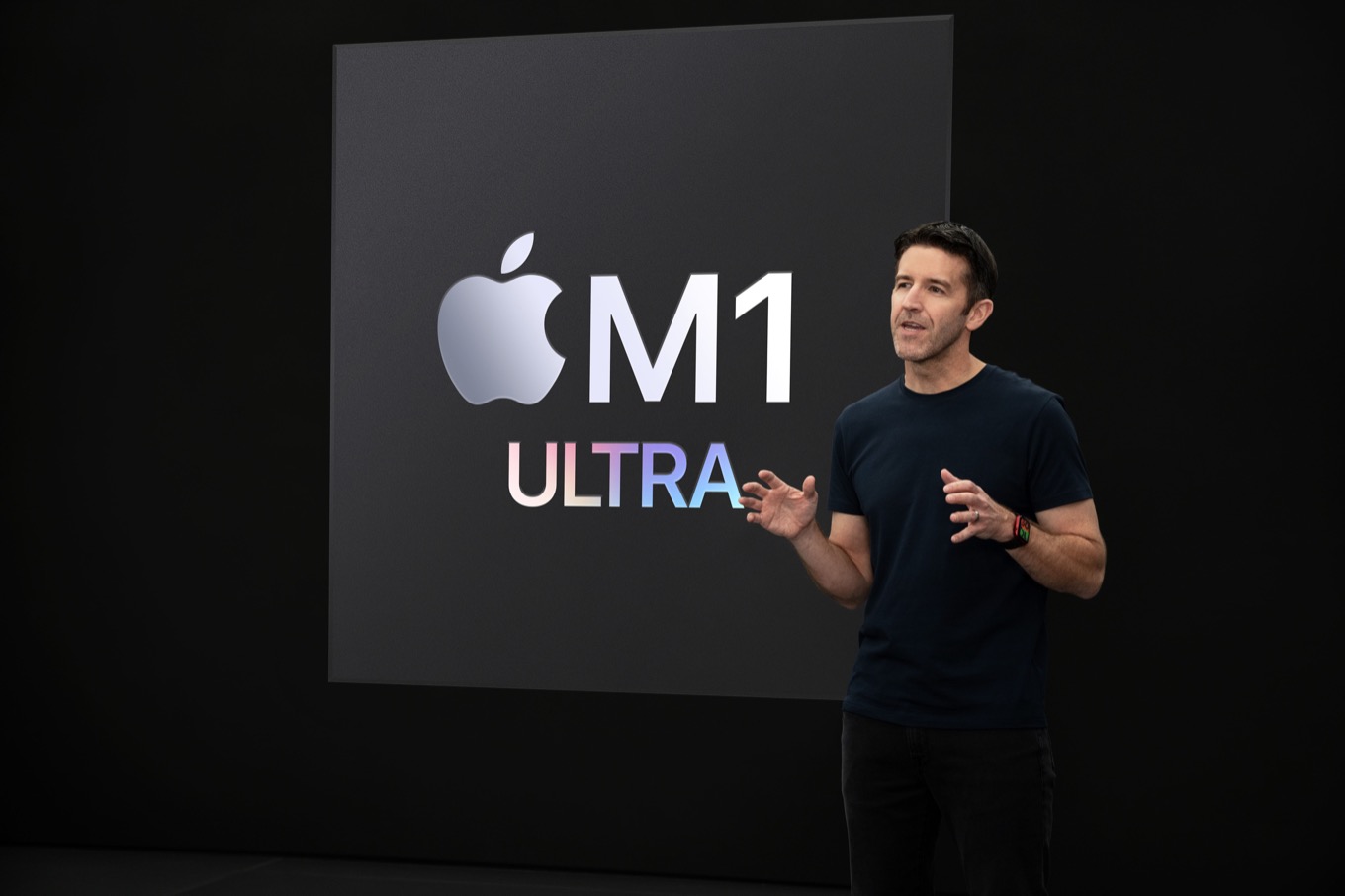
You heard Apple’s John Ternus right: The M1 Ultra is the final chip of the M1 era. No other M1 chips are waiting in the wings—this is it. And what a finale! The M1 Ultra is two M1 Max chips, the ones that wowed all of us when the 2021 MacBook Pros were released, stuck together through an ultra-high-speed interconnect.
There’s a good reason the M1 Ultra wasn’t named something like the M1 Max Duo: it’s not two chips, it’s two complete systems-on-a-chip combined into a single package. From the perspective of the system, and of the chips themselves, they aren’t two individual chips but a combined entity. Developers won’t need to modify their apps to properly take advantage of the M1 Ultra. Everything works together, from shared memory banks to processor core assignments.
Apple didn’t even need to build new scheduling intelligence into macOS to make sure that the right cores on the right chips were being used to be more efficient. The M1 Max chip itself is intelligent about saving energy by shutting off unused elements, so there doesn’t need to be a micromanager at a high level trying to spread the load.
Given that Apple’s Jon mentioned that there was a new Mac Pro on the way, but that it was a topic for “another day,” I think we’re going to have to assume that the Mac Pro will be getting a chip based on the M2 processor, not the M1. (Some reports suggest Apple is at work on a 40-core monster, essentially tying two M1 Ultras together for use in that forthcoming Mac Pro.)
Since this is the end of the era, I’d expect Apple to turn the page soon and introduce the first wave of M2-based Macs. The M2 will probably be a somewhat modest improvement—you can’t make a big leap in performance and energy efficiency like the M1 every time out. Then again, the A15 processor was more of an improvement over the A14 than most of us had expected, so I’d expect the M2 to be more than a minor update.
It’s not every day that Apple introduces an entirely new Mac line. But on March 8, that’s exactly what happened. Jason, Myke, and special guest Stephen Hackett discuss the new Mac Studio and Studio Display, along with the updated iPad air and iPhone SE.
As always, the facts come fast and furious at an Apple event, so some details about its latest products fall through the cracks. Others, the company chooses not to dish out, leaving instead for its press releases and product pages.
Here are a few things that you might not have caught in the initial barrage.
“Friday Night Baseball” will be available on Apple TV+ — and, for a limited time, without the need for a subscription.1
However, Friday Night Baseball won’t be the only baseball content Apple’s providing. There’s also a live show airing every weeknight, “MLB Big Inning”, featuring highlights and glimpses of games. Plus, there’s a 24/7 livestream with replays, classic games, and more, as well as on-demand content.
Can’t stand it
Apple’s new Studio Display looks impressive, but depending on how you want to mount it, it could cost a little bit more.
Either the standard tilt stand or a VESA mount option will be included in that base $1599 price, but if you want the fancier height-adjustable stand, it’ll boost the price $400 to $1999. (Still a fraction of the cost of the $999 Pro Stand for the Pro Display XDR, so I guess Apple’s been improving the cost-efficiency of its stand technology.)
Oh, and the nano-texture option on the glass to reduce glare will cost an additional $300 over the display’s base price.
Your Studio, your way
$1999 isn’t a bad intro-level price for the Mac Studio: for that, you get an M1 Max processor with a 10-core CPU and 24-core GPU.
Jumping to a 32-core GPU will cost you $200, and from there you’ll have to make the move to the M1 Ultra, with a 20-core CPU and 48-core GPU for $1400. The higher powered 64-core GPU M1 Ultra will really ratchet up the cost, by $2400.
RAM options aren’t for the faint of heart either. The base model has 32GB of unified memory, with an option to pay $400 for 64GB.
Going higher than that, to 128GB, requires the M1 Ultra chip and will set you back $1200 from the base model. (Obviously, it’s a little cheaper if you start with the M1 Ultra model.)
The base model also comes with a 512GB SSD, with options to upgrade to 1TB for $200, 2TB for $600, 4TB for $1200, or $2400 for 8TB.
The only other key difference between M1 Max and M1 Ultra models are that the former has only USB-C ports on the front, as opposed to the latter which features Thunderbolt 4 ports.
The $3999 model, by comparison, starts with an M1 Ultra, 64GB of memory, and 1TB SSD.
And in case you’re wondering what the most expensive model would be, maxing out the high-end model will take you to $7999—and that’s without keyboard, pointing device, or display.
27 ways to say goodbye
At the end of the event, Apple senior vice president of hardware, John Ternus, made an interesting pronouncement:
They join the rest of our incredible Mac lineup with Apple silicon, making our transition nearly complete, with just one more product to go: Mac Pro. But that is for another day.
It’s an interesting statement, given that many had expected a replacement for the 27-inch iMac to appear at some point. And Ternus’s statement doesn’t preclude it—there’s every possibility Apple could roll one out in the coming months, treating it as nothing more than an expansion of the existing iMac line. (Though it would be harder to imagine it being branded as an “iMac Pro” then, as many have predicted.)
However, as the dust of the event cleared, the existing 27-inch iMac was nowhere to be found: it’s no longer displayed on the Mac section, nor is it obviously available for purchase on Apple’s website. Putting it in the Compare tool shows no price, nor Buy button.
So is there a replacement on the way? We’ll probably have to wait until June—at least—to find out.
Updated at 4:37pm Eastern to clarify the status of Friday Night Baseball.
One has to wonder if the current contract dispute that led to a delayed season start played any part in this. ↩
[Dan Moren is the East Coast Bureau Chief of Six Colors, as well as an author, podcaster, and two-time Jeopardy! champion. You can find him on Mastodon at @dmoren@zeppelin.flights or reach him by email at dan@sixcolors.com. His next novel, the sci-fi adventure Eternity's Tomb, will be released in November 2026.]
Disney inevitably embraces advertising, NBC inevitably takes its ball and goes home, and The Batman inevitably forces a discussion about the future of theatrical releases.
This is it: Apple’s 2022 is kicking off in earnest on Tueaday at the company’s “Peek Performance” event. It’s likely to feature the first of its major product announcements for a year that, based on rumors, is jam-packed with new developments out of Cupertino.
Unlike the immense spectacle that is the company’s June Worldwide Developers Conference—in which the company rolls out its software road map for the year ahead—or the flashy iPhone-centric announcements of the fall, Apple’s spring events tend to be more of a hodgepodge, featuring whatever the company has ready to go. In the past, that’s ranged from iPads to Macs to the occasional iPhone, with plenty of other wildcards thrown in the mix.
As we look ahead to the spring event, let’s run down the most likely culprits that Apple may indeed let us peek at.
An interesting development in terms of Apple corporate governance, as reported by Levi Sumagaysay of MarketWatch:
Apple investors on Friday voted to support an audit that would examine the impact of the tech giant’s policies and practices on the civil rights of employees, customers and society, as well as an investigation into the company’s use of concealment clauses.
It’s not very often that measures opposed by Apple pass at these meetings, but two of them did. The first will prompt a third-party audit of Apple’s commitment to civil rights, and the second will very specifically probe how the company may have used non-disclosure agreements to induce former employees into silence about working conditions.
Apple, of course, said that the measures were unnecessary because Apple was already doing everything required of it in these areas. It seems like the company may have the opportunity to prove that such statements were correct, and not made in the interest of hiding questionable practices.
Soccer writer Grant Wahl went to Qatar to report a story in advance of this year’s World Cup soccer tournament. Apparently everyone in Qatar needs to install an app that tracks your location at all times in order to do anything, citing Covid safety:
The way the Qatari government explains it, Ehteraz is a Covid-19 app that’s designed for public health. But as anyone who’s seen the app can tell you, Ehteraz is also a tool that the Qatari state can use to monitor your location at any time. And that’s more than a little scary…
On the morning after my second night in quarantine, someone knocked on my door, gave me a Covid rapid test and told me I’d be free to go in 15 minutes if it came up negative. Which it did. But I still couldn’t enter any public buildings in Qatar until my Ehteraz app was working and I could show a green QR code. (A green QR means you’re negative, a yellow one means you’re in quarantine, a red one means you’re positive and a grey one means you’re a suspected positive.)
All the international tourists who are planning on going to the World Cup at the end of the year should be prepared. For the rest of us, this is a good example about how an authoritarian government can use smartphone technology to track everyone’s movements—and make it essentially impossible to opt out.
In short, MaskerAid allows you to quickly and easily add emoji to images. Plus, thanks to the magic of machine learning, MaskerAid will automatically place emoji over any faces it detects.
I got to try this app during beta testing and it’s a lot of fun to use. If you want to deface photos with emojis, or cover up faces of people who didn’t consent to have their faces shared on the Internet, it does the trick in nifty fashion.
MaskerAid (get it?) is free on the App Store with just the 🙂 smiley emoji enabled; a $3 in-app purchase unlocks every single emoji, so you can place a Japanese Ogre on the faces of your loved ones instead.
As a so-called elder millennial, I remember our 19″ Zenith television, with an actual clicker, that sat in the oak armoire in the family room. It would display whatever happened to be broadcast, and that was it. You could buy a TV Guide from the grocery store, and it would have a printed listing of what would be on TV and when, so people would plan to watch a channel at a certain time or set their VCR to record something on tape.
Then we had cable, and eventually a cable channel that just showed a programming guide that slowly scrolled through all the channels. Eventually, we got an interactive programming guide, where you could click to move around in a grid of channels. Finally came the ability to set a DVR recording from the grid.1 The important thing is that we offloaded the burden of managing live TV viewing to computers.
We’ve lost some of that simplicity because of the innovations in on-demand TV. On-demand TV is great, and it lets us live our lives unencumbered by any viewing schedule. However, there are still live events, news, and other situations where I prefer to leave the decision-making up to network programmers while folding laundry.
“Live” TV is rarely live, but it is linear in that there are discrete blocks of programming, TV or movies, arranged sequentially. Think of it more like a playlist, and that playlist is linked to a specific point in time and can be compared with other playlists.2
But sometimes, the channels aren’t quite linear. Some let you restart a show that’s already in progress—making the linear channel more like a showcase for on-demand video content. You might also record an upcoming program or receive a notification that an event is happening live.
In the world of streaming TV, even “traditional” TV is complicated.
Live on Fire
The gateway to Amazon’s live TV interface.
Amazon recently revamped the Fire TV’s Live TV viewing. While this latest Fire TV update made a host of awful additions to the Fire TV home screen, Amazon’s live TV interface revision is interesting, and something Apple could learn from.
To access the new Live TV view on Amazon Fire TV, you go to the top row of the (very bad) home screen. Once you select Live, you’ll see a Guide button, a few recently watched or favorite programs, and some suggestions for live programming. The guide button opens a very traditional interactive guide view. The guide is populated based on which apps on the Fire TV offer live TV integration. (All recently updated Fire TVs will already have IMDb TV and Fire TV News synergistically integrated.)
The Menu button on the Fire TV remote will bring up options to add the currently selected channel to your Favorites, Add Channels, Manage Channels, and More Info. Previews are displayed of what’s on a channel if you hover over it. If you’re already watching something and looking through the guide, that channel’s content will appear in a picture-in-picture box. Add Channels isn’t really about adding channels—it’s a list of apps available on the Fire TV store that offer guide integration.
Unfortunately, everything in the guide’s grid view is categorized by what app it’s in, which makes it feel more like several guide views were glued together. It isn’t sorted based on content type (for example, all the news offerings from all the services in one spot)—for that you’d need to look at the main “Live” view of the home screen, not the guide view. Most importantly, it doesn’t do anything with duplicate channels offered by different apps.
(If you favorite America’s Test Kitchen on Pluto, it’s different from favoriting that channel under IMDb TV. Why? Because these are ad-supported offerings—so it matters very much which service your eyeballs are going to.)
Amazon’s guide mostly suffers because it lacks integration with cloud DVR services. You need to use the guide available inside of each of those discrete apps for those. The same goes for notifications about upcoming programs. There is no convenient way to jump between the Fire TV guide, or live view, to the streaming app’s version of that guide. So you need to back out and navigate to the thing you’re already looking at.
Apple, far from the tree
All those pros and cons for an integrated guide sure sound tough to manage, don’t they? Well, what if you didn’t do anything at all to manage that? Welcome to Apple’s TV app!
The TV app does offer a row of live news channels, it’s not filtered by what you’re subscribed to, drastically reducing its utility. Instead, the crown jewel of live TV in the Apple TV app is found in the Sports tab.
There are many sports.
The Sports tab lists upcoming events organized by sport. But no attempt is made to filter results based on compatible subscriptions. Presumably, the logic is that if you see a game you want to watch, click through on it, see that it requires ESPN+, then you’ll subscribe to ESPN+ and not just say, “Why the hell are you showing me something I can’t watch?”
Plenty of room for improvement
While Amazon could certainly do a better job of cleaning up their unified view to be more fully-featured and useful, it’s an impressive attempt all the same.
Apple, meanwhile, has really fallen behind. The TV app itself has done a decent job of presenting itself as a catalog of individual on-demand programs (except for Netflix!) and live sports. Still, the last few years have resulted in an explosion of apps offering live, linear TV channels—and Apple needs to react.
Certainly, if the Fire TV interface is any guide3, Apple has an opportunity to create a better, more unified experience for presenting all the live TV options a user currently has access to.
Sometimes you just need to put something on while you fold laundry.
To take the ferry cost a nickel, and in those days, nickels had pictures of bumblebees on ’em. “Give me five bees to a quarter,” you’d say. Now where were we…↩
Some services (like Sling, YouTube TV, and others) encapsulate the entirety of the linear cable TV experience into an app. But there are also many free streaming-only linear TV services supported by ads, like Pluto TV and Tubi. And some on-demand services (Peacock, Paramount+) also offer linear channels. ↩
Using a self-driving taxi service, common myths about livestreaming, our gaming habits, and how we value art created by machines and artificial intelligence.
It’s official — Apple’s doing a product launch event on Tuesday, March 8. The company sent out invitations bearing the phrase “Peek performance,” a Dad-Joke-level play on words that frustrated humorless editors and sticklers everywhere.
Now begins the reading of the tea leaves1. While I usually try not to give myself a pareidolia headache by staring at Apple artwork and asking “what does it all mean, maaaaan?”, in this case I think it’s worth mulling things over a little bit.
It’s all about that second word—performance. Ever since Apple started including its own chip designs in Macs, Apple has—rightfully—promoted the power and promise of those chips heavily. Since new iPhone-class processors only really appear in the fall, this has to be a reference to Macs running Apple silicon.
What’s the Apple silicon news likely to be? There are a couple of options. First, and less exciting, would be the arrival of M1 Max and M1 Pro chips in new Mac models—perhaps a larger iMac, a new Mac mini, and even an updated 13-inch MacBook Pro. I’m so ready for a new iMac that I want this to be the case.
It’s not really a new story, though. A new story would be the release of the M2 processor, 16 months after the original M1 ushered in the Apple silicon era. But, assuming the M2 was based on the same core technology as the A15 processor in the iPhone 13, we’d probably expect to see only a modest speed boost.
Here’s the longshot: What if the performance Apple is teasing is something even bigger than we’re expecting? Reports have suggested that the company is working on a new Mac Pro based on multiple M1 Max chips working in concert. Everyone has assumed that a new Mac Pro would likely not appear until the end of the year, but maybe it’s ready now—or maybe Apple’s willing to give everyone a peek at the performance to come when the product ships later this year.
It’s also possible that Apple will debut the concept of two M1 Max chips working in concert to drive extra performance in high-end iMac and Mac mini models, which would make the performance story of those systems a bit more exciting than if they were merely running the same chips that we’ve already seen in the MacBook Pro.
At least we only have a few days to wait to find out. But, as silly and dad-jokey as “peek performance” is as a concept, I have to admit that it’s increased my anticipation for the event. So… mission accomplished, I suppose. We’ll see if next week’s event can deliver on that slogan’s promise.
I usually call this “Apple Kremlinology,” but that’s just not a fun turn of phrase right now. ↩
Reaction to Russia’s invasion of Ukraine has been unprecedented, from financial sanctions to seized assets to the de-platforming of Russian state-funded media from social networks. One of the most interesting wrinkles happened Tuesday when Apple said in a statement that it had “paused all product sales in Russia” and removed RT News and Sputnik News from the App Store outside Russia. Mykhailo Fedorov, deputy prime minister of Ukraine, credited Tim Cook with the move.
I applaud Apple joining with many governments and companies to sever ties with Russia. But make no mistake: Apple can afford to do so. While the company certainly makes money in Russia, it can afford to walk away… permanently, if it needs to.
Apple can’t do that with China, should that country decide to act in a similar fashion as Russia.
On Tuesday Apple halted all sales in Russia and removed the RT and Sputnik apps from the App Store. Here’s the Apple statement:
We are deeply concerned about the Russian invasion of Ukraine and stand with all of the people who are suffering as a result of the violence… We have paused all product sales in Russia. Last week, we stopped all exports into our sales channel in the country. Apple Pay and other services have been limited. RT News and Sputnik News are no longer available for download from the App Store outside Russia. And we have disabled both traffic and live incidents in Apple Maps in Ukraine as a safety and precautionary measure for Ukrainian citizens.
According to Politico’s Alex Ward, the Vice Prime Minister of Ukraine made this statement: “Apple has stopped selling its equipment in the official online store in Russia, thanks to Tim Cook.”
Our most speculative draft yet! Jason and Myke refuse to wait for Apple. Instead, they predict what will happen at Apple’s next product launch—whenever it might happen. Will the M2 make its debut? Will there be an iPhone SE, and will it look any different? Are there other Mac and iPad offerings in the works? And most importantly, what fresh colors will be on offer for spring? We do our job—and now it’s time for Apple to do its.
In June 2020, when Apple unveiled its first Mac built around its own chip, the M1 processor, the company said it was planning for a two-year transition for its entire computer line. Here we are, just months away from the two-year anniversary of that announcement, and we’re poised to find out exactly what’s next in Apple’s processor jump—in more ways than one.
Recent reports suggest that Apple could be planning an event to take place around March 8, which might feature the introduction of one or more new Mac models. So, as we await news of whether such an event will indeed be happening next week, it’s worth it to take a moment and run down the state of this two-year plan and what exactly might be in the offing.