Firm make3 was asked to build a device called the Lumon Woemeter, which bears a more than passing resemblance to a certain pseudoscientific device; they did so in just six weeks.
It’s powered by an ESP32 (the same chip in my E-ink On Air sign, which I’ve been messing around with more recently) and uses some knobs and switches salvaged from vintage audio tape recorders, combined with 3D printed components and a custom printed circuit board.
I love this melding of old and new tech; it fits perfectly in the aesthetic of the show. And I particularly appreciate how design-oriented the team behind the show is.
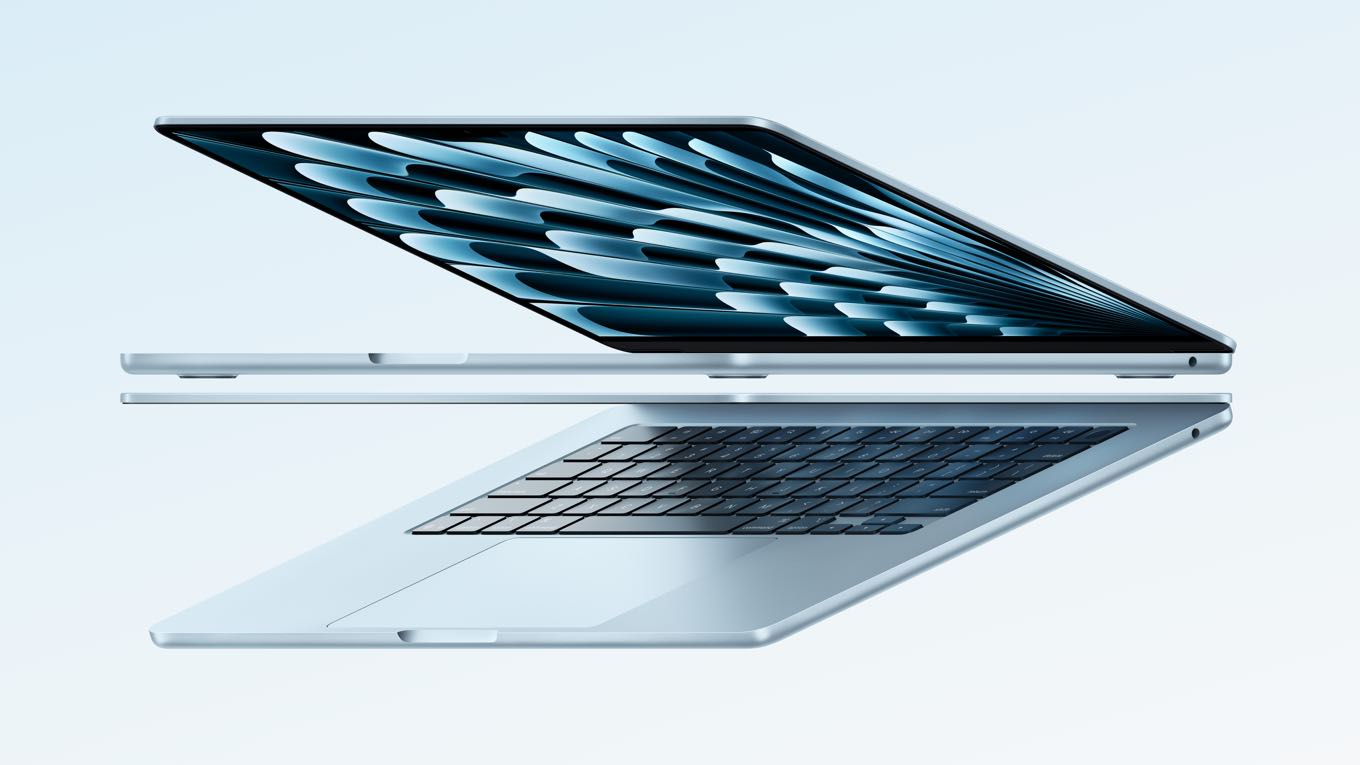
The M4 MacBook Air, announced on Wednesday and shipping in a week, is technically unsurprising (it’s powered by the M4 chip, unveiled by Apple last May and added to Macs last November, and features an upgraded camera) but offers some very surprising twists (it’s got a new color and a lower price). Not bad for a small update to Apple’s most popular Mac.
Let’s start with the surprises. Both M4 MacBook Air models are priced $100 less than their predecessors: $1199 for the 15-inch model and $999 for the 13-incher. If I’m not mistaken, this is the first time that the new-generation design of MacBook Air introduced with the M2 chip has been available at the classic $999 price at launch. (The M1 Air, based on the Intel-era visual design, debuted at $999, but the M2 Air debuted at $1199 and only reached $999 when it was offered as an older model alongside the M3 Air.) As of now, the M4 Air can hold down the sub-$1000 price point all on its own, and previous models are mostly1 discontinued.
Another surprise is the the new color option: Space Gray is out. The ultra-dark-blue Midnight remains, as do the classic Silver and hint-of-champagne Starlight. The new color is Sky Blue, which apparently is a metallic light blue that really shows itself as a color gradient when viewed at various angles. I haven’t seen it in person, so I will reserve my final judgment, but my guess is that this will be another one of those colors that will read as silver until you notice that, yes, it’s actually a little bit blue in certain light or at certain angles. (If you, like me, have been hoping the MacBook Air might gain a bright eye-popping color, you will need to keep waiting.)
Now to the more expected details: It’s been obvious that the M4 chip would make its way into the MacBook Air since it was unveiled 10 months ago. If you’re wondering what performance differences it offers over the M3, you might want to check out my reviews of the M4 iPad Pro and the M4 iMac. To sum up:
The M4 single-core score was 24% higher than an M3 MacBook Air and 45% faster than the M2 iPad Pro. In multi-core operations, the 10-core M4 bested an eight-core M3 by 22%, and the eight-core M2 iPad Pro by 50%.
Of course, most people buying a new M4 Air won’t be upgrading from last year’s M3 model. But the M4 has proven to be a powerful processor, even in the fanless iPad Pro, and I’d expect the same to be true for this MacBook Air. Most notably, the M4 (like the M3 before it) features Apple’s latest-generation GPU architecture, boosting performance for graphics and games.
The M4 also completely unlocks a feature that some MacBook Air fans have been clamoring for since the Apple silicon era began: The ability to drive two external displays and its own display, simultaneously. The M3 Air got the ability to run two displays lid closed, but now dual-monitor fans can keep that lid open. Hats off to Apple for that one.
A big quality-of-life upgrade in this model is the addition of a new 12-megapixel camera that supports Center Stage. These specs are identical to those found in the recently upgraded M4 iMac and M4 MacBook Pro. If this upgrade is anything like those, it’ll be a major improvement. Not only is Center Stage a convenient feature, but as I wrote back in November, the new camera offers “more contrast and more natural-looking skin tones.”
Apple also isn’t adjusting its battery life claims from the M3 Air models—the M4 Air will still offer up to 18 hours of battery life. Both the 13- and 15-inch models will be available for pre-order starting Wednesday and will go on sale Wednesday, March 12.
The M2 Air will apparently still be available in certain (unspecified) countries at a lower price point, but its run as a mainstream “new” Mac seems to be over. ↩
It’s been nearly two years since the Mac Studio was updated to M2, but on Wednesday Apple announced the next step in its evolution. And if you’re ready to write off the Mac Studio as having skipped the M3 generation entirely… maybe don’t do that? That’s because Apple’s announcing two models of Mac Studio, each based on different chip generations.
With the M4 Mac mini being powerfully tempting for desktop Mac users who crave power, Apple has upgraded the Mac Studio to blast past the mini in terms of performance. The base model, still starting at $1999, is powered by the M4 Max chip previously available only in the M4 MacBook Pro. And the new high-end Mac Studio, starting at the same $3999 price tag, is powered by a monstrous chip with 32 CPU cores (including 24 performance cores) and up to 80 GPU cores. It’s a chip never seen before anywhere—the M3 Ultra.
You heard me. For Apple’s fastest Mac ever—and it’s clear that it will be—Apple’s shipping a chip based on two high-end chips (fused together with Apple’s UltraFusion technology) from Apple’s previous processor generation. Weird, right? It seems like a few things are going on here: first, that the development of the Ultra chip takes longer and that Apple won’t commit to shipping an Ultra chip in every chip generation. Second, that the first-generation three-nanometer chip process of Apple’s chipmaking partner, TSMC, isn’t as dead and buried as generally thought. Just this week Apple also introduced an iPad Air with an M3 processor, and of course the new iPad mini shipped with an A17 Pro processor based on the same process.
Is the old process still alive and kicking? Are all of these M3 chips being sourced from a special parts bin? Has Apple made just enough M3 Ultras to fulfill Mac Studio needs before shutting the whole thing down? I have no idea. But it does mean that at the very last moment when the final M3 Mac was going off the price list forever… a new M3 Mac has been introduced. Tricky Apple!
Most people will probably want the lower-end Mac Studio based on the M4 Max. That chip can be configured up to 16 CPU cores and 40 GPU cores, and those GPU cores mark the first time that Apple’s latest-generation graphics architecture has appeared on the Mac Studio, since it debuted with the M3 chip generation.
Speaking of which, that M3 Ultra model instantly becomes the ultimate Mac for the person who has everything except the ultimate Mac. When fully loaded it’s got 32 CPU cores, 80 graphics cores, 512 GB of unified memory, and up to 16TB of onboard storage. Apple estimates that the M3 Ultra will be nearly twice as fast as the M4 Max in workflows that can take advantage of all that extra everything. (Who needs a Mac Pro? Don’t answer that.)
Actually, if one of the reasons to prefer something like a Mac Pro over a Mac Studio is high-speed connectivity, the addition of Thunderbolt 5 (to both models) might be relevant. The M4 Max model offers four Thunderbolt 5 ports on the back, and the M3 Ultra model offers an additional two Thunderbolt ports on the front.
Though the prices for the two base models remain the same at $1999 and $3999, there’s one wrinkle: more memory. The M4 Max Mac Studio starts at 36GB of RAM, up from 32GB on the same-priced M2 Max model. And the M3 Ultra Mac Studio starts at 96GB, up from 64GB on the same-priced M2 Ultra.
Both models will be available for pre-order Wednesday and ship next Wednesday, March 12.
It’s a brand new Air, but it’s not what you thiiiiink: Apple on Tuesday updated its iPad Air line with the M3 processor and redesigned the Magic Keyboard for iPad Air. And just so it wouldn’t feel left out, the base-level iPad got a new chip as well, going from the A14 Bionic chip to the A16.
The most consequential part of the Air’s update—perhaps the only real update—is the M3 processor, which brings with it GPU-based capabilities like hardware-accelerated ray tracing and video encoding and decoding for ProRes and ProRes RAW.
Otherwise, the Air is basically unchanged: it comes in 11-inch and 13-inch versions, features the same cameras, battery life, the exact same dimensions1, and the same accessory compatibility as its M2-based predecessor. It even comes in the same colors—Space Gray, Blue, Purple, and Starlight—at the same prices starting at $599.
The new Magic Keyboard for Air is interesting in that it seems to meld parts of the older Magic Keyboard with the Magic Keyboard for iPad Pro last May. While the new Magic Keyboard includes a function row and a larger trackpad like its Pro compatriot, it lacks haptics in the trackpad and backlit keys, and it seems to be built on the same design of the original silicone exterior instead of the new aluminum-based model. But you get some cost savings for that: it’s just $269 instead of $299. Also, it only comes in white—black keyboards are for pros, I guess.
Likewise, the update to the base-level iPad, which Apple is denoting as the iPad (A16) rather than the eleventh-generation iPad, is similarly low-key. The A16 offers 5 CPU cores, one fewer than the 6 in the A14 Bionic2, though it maintains 4 GPU cores and the 16-core Neural Engine. Apple has also doubled the entry-level storage tier from 64GB to 128GB at the same $349 price, and now offers both 256GB and 512GB capacities as well. Apple’s also dropped the Nano-SIM slot in the cellular version, moving it to eSIM only like most of the rest of its cellular devices.
It’s definitely a muted update, which is no surprise as it comes just nine months after the introduction of the M2 iPad Air last May. The use of the M3 processor is also somewhat surprising, given that it’s based on an outdated manufacturing process that Apple has otherwise been aggressive about transitioning away from on the rest of its product line. The base iPad’s update is perhaps somewhat more disappointing, as that model was introduced in 2022 and its A16 processor will make it one of the few current main-line Apple devices—perhaps only—not to support Apple Intelligence.
In another minor descriptive change, Apple now describes the base-level iPad’s screen as “11-inch”, compared to the tenth-generation’s “10.9-inch”, though it says in a footnote that if the corners, which have rounded displays, are measured as rectangles “the 11-inch iPad Air, 10.9-inch iPad Air, iPad (A16), and iPad (10th generation) are 10.86 inches”.
Pre-orders for the new iPads are available now, with availability due on March 12th.
Okay, the 11-inch is 2 grams lighter than the M2 version and the 13-inch is 1 gram lighter. You got me! ↩
Apple previously dubbed this chip the “A16 Bionic” but seems to have dropped that nomenclature here, perhaps due to the lower core count. ↩
[Dan Moren is the East Coast Bureau Chief of Six Colors, as well as an author, podcaster, and two-time Jeopardy! champion. You can find him on Mastodon at @dmoren@zeppelin.flights or reach him by email at dan@sixcolors.com. His next novel, the sci-fi adventure Eternity's Tomb, will be released in November 2026.]
With Jason away, Six Colors contributor Joe Rosensteel joins Dan to talk about his exploration of Apple Music alternatives. [More Colors and Backstage members also get an extra 20+ minutes discussing AI apps.]
At Apple, we understand that sacrifices must be made in the name of progress. Over the last few weeks, we’ve proved this time and time again. But we also know that maybe you just see us as a faceless corporation, so we want to take this opportunity to share with you some of those sacrifices.
Take for example, the new iPhone 16e. We agonized over how to make the best possible iPhone for our price-conscious customers while still maintaining our meager 47 percent profit margins. Did we want to remove MagSafe? Of course not! Would we love to include ProMotion? Absolutely. But we all need to make sacrifices. Just, mostly for you. Not so much us.
Even then, it hurt us—physically hurt us—to price the 16e at just $599, but those are the kinds of sacrifices that we make for our customers, who we love and appreciate more than anything in this world, except for money.
Of course, our sacrifices don’t stop there. You may have recently heard of our decision to stop offering Advanced Data Protection in the United Kingdom, for…reasons. This is, naturally, a sacrifice of the highest orders…for our customers in the UK who rely upon the security of end-to-end encryption. Was there any alternative? We can’t say. Could we have done more? We can’t say. Will we continue to bow to the whim of governments who want to invade the privacy of our users? Again, we would love to say no, but we just cannot. We’ve already shown a history of sacrifices like this, such as ceding the operation of iCloud in China to a local company, just to make sure users could have the ability for their documents to get perennially stuck while syncing and also have those said-same documents monitored by an authoritarian government.
Then there’s our biggest sacrifice to date, made personally by our vaunted CEO Tim Cook, who always looks out for the good of the company (and its assets) above all else: his dignity. You may wonder if Tim could have instead just sacrificed some of his hard-earned money and, well, he did try. Sometimes it just doesn’t cut it, and you need to promise $500 billion in investments that you were kind of making anyways, just to appease a petty tyrant. You’ve been there, you get it.
But at Apple we’re not done yet. There are sacrifices left to be made, none so important as our offerings to the dread god Glog-Raggopth (all praise his name), who hungers for blood as most mortals hunger for Cheetos. However, we are a little short on sustainably sourced and conflict-free blood these days, so we’ve had to make some substitutions. Sacrifices on sacrifices! Instead of the traditional hemoglobin, we will instead be offering up the souls of our customers. Now, in line with our differential privacy and data minimization policies, we’ve developed a new system we’re calling SoulKit, wherein each of our customers will only have to sacrifice a very small percentage of their soul, and because we protect your personal data, nobody will know exactly whose soul is where.1
How do you take advantage of this exciting new feature? Simple, just buy any Apple product, and a small portion of your soul goes with it. Remember: it’s just a small sacrifice to make so that we can stay in business. And we want you to know that we appreciate it. Especially Tim, who could use all the soul he can get.
Soul obfuscation features not available in the United Kingdom or China. ↩
[Dan Moren is the East Coast Bureau Chief of Six Colors, as well as an author, podcaster, and two-time Jeopardy! champion. You can find him on Mastodon at @dmoren@zeppelin.flights or reach him by email at dan@sixcolors.com. His next novel, the sci-fi adventure Eternity's Tomb, will be released in November 2026.]
It’s the end of an era. Microsoft is shutting down Skype in May and replacing it with the free version of Microsoft Teams for consumers. Existing Skype users will be able to log in to the Microsoft Teams app and have their message history, group chats, and contacts all automatically available without having to create another account, or they can choose to export their data instead. Microsoft is also phasing out support for calling domestic or international numbers.
The writing has long been on the wall for Skype, which has struggled to remain relevant in the days of Zoom, Teams, Slack, FaceTime, and a million other VoIP solutions. But there was a time when Skype was a revolution: free, good sounding voice calls across the Internet. Not to mention the ability to make cheap actual phone calls internationally, in a day and age when that was usually ridiculously expensive.
In particular, Skype was a boon to the early age of podcasting, especially once Ecamm’s excellent Call Recorder for Skype hit the scene; it made recording your podcast as simple as clicking a button.
A lot of what Skype does is table stakes now, and though Microsoft acquired it in 2011, the company never really seemed that enthusiastic about it—even less so once it rolled out Teams in 2016. Still, Skype has stuck around, quietly doing its job even as users slowly migrated to other services.
Still, I’ll always have a soft spot in my heart for it: I spent many, many hours recording podcasts on Skype. Rest in peace, little buddy. Bleep-bloop.1
In a whitepaper posted to Apple’s developer site entitled “Helping Protect Kids Online”, the company details several improvements it’s rolling out in upcoming software updates, including making it easier to set up child accounts, providing age ranges to developers, and filtering content on the App Store.
Additionally, Apple is adding the ability to correct the age-range of child accounts:
Second, starting later this year, parents will be able to easily correct the age that is associated with their kid’s account if they previously did not set it up correctly. Once they do, parents of kids under 13 will be prompted to connect their kid’s account to their family group (if they’re not already connected), the account will be converted to a Child Account, and parents will be able to utilize Apple’s parental control options—with Apple’s default age-appropriate settings applied as a backstop.
Many of these additions are welcome ones for parents navigating managing accounts for their kids. There’s still a lot of work to be done, however. As the father of a two-year-old who gets only limited and controlled access to an iPad, I’ve run into numerous frustrations trying to both maintain appropriate security practices and let me conveniently manage the device. There are also numerous issues with critical features like Screen Time, which suffers from both inaccuracies in its measurements as well as methods for circumvention.
It’s also worth noting that these announcements are happening against the backdrop of more stringent age-verification laws enacted in U.S. states like Texas and Oklahoma. Critics of those laws contend that they unfairly target LGBTQ+ communities. Apple, for its part, says that it holds to a standard of data minimization, not sharing any more information than is necessary. So, for example, offering developers access to the age range of a user—with the consent of a parent—rather than providing a birthdate.
Where we prefer to edit photos, thoughts on VC investment vs. a level 14 round boi, our use of voice assistants and what improvements might make Alexa AI worthwhile, and the frustration of new USB-C products still requiring USB-A cables for charging.
Readers of AppleVis have had their say again this year, offering opinions on how well Apple’s accessibility tools serve blind and visually impaired users. The survey is modeled on the Six Colors Report Card, but draws from site users, instead of writers and podcasters:
AppleVis conducted a comprehensive survey where blind, DeafBlind, and low vision participants rated their experience using Apple’s major platforms (iOS, iPadOS, macOS, watchOS, and tvOS) with the available vision accessibility features included in the software.
This is the third year of the survey, which launched in 2023. Respondents this year gave highest praise to iOS and iPadOS, with lower marks for macOS, watchOS and tvOS than in past surveys.
The most important thing about the new iPhone 16e is the Apple-designed cellular modem inside. The C1 is the first visible sign of Apple’s decade-long goal to no longer be reliant on Qualcomm for one of the most important parts of any smartphone, namely its connection to cellular networks. The C1 is also an endorsement of the entire approach Apple has taken with Apple Silicon, which will lead to future Apple products that are more efficient and better integrated than ever before.
With Myke on paternity leave, Jason welcomes Casey Liss to discuss the new iPhone 16e, iPhone 17 leaks, visionOS updates, the TRMNL, and Apple acceding to the UK government’s demands while touting its investment in the United States.
Apple answers the question “what if it threw a phone launch and nobody came”? AI faces a couple of setbacks while iPhone users in the UK may want to empty the trash in Photos.
The “e” is for “eh”
Apple’s big reveal this week turned out to be the iPhone 16e.
No, really. And that was it. No AirTags or MacBook Airs or desktop robots or anything else.
Look, I just report this stuff.
Yes, say goodbye to the iPhone SE and the iPhone 14, the iPhone 16e is the new low-end Apple phone with the mid-range price tag. Introduced in a video by close-friend-of-the-Trump-administration Tim Cook, the iPhone 16e is powerful enough to run Apple Intelligence (assuming you want to) while only breaking part of the bank. Apple was apparently shocked and appalled to find it was selling iPhones for next to nothing and has corrected the error.
The iPhone 16e isn’t a bad device for the price, though, and it’s the first iPhone to feature the company’s own cellular modem. So, if you smell something burning, you’ll know what it probably is.
The device is still a little bit perplexing and has raised a number of questions. Questions like, does the number in the name indicate that will Apple be shipping a new one every year? What does the “e” stand for, anyway? Does it come with a side sauce? Did a penguin come up with those color options? Can I trade in Apple Intelligence to get MagSafe instead?
That last one’s not a real question because the answer is no.
While many questions remain, Apple is being clear about one thing: where it used to put an “i” on the front of every name, it is now going to put an “e” at the end of every name. These are just facts.
AI is still going great
Terrible news for…people who theoretically exist out there somewhere, I guess. Humane, the AI darling of 2023 that took the world by storm with its Ai Pin [CITATION NEEDED] has been sold for parts.
If you happen to own a Humane pin (which seems really unlikely), don’t worry. Your pin will stay active for… uh, one more week. So, that was $700 well spent.
Turns out Bloomberg is just chock full of bad news about AI.
Apple Inc.’s long-promised overhaul for the Siri digital assistant is facing engineering problems and software bugs, threatening to postpone or limit its release…
Problems? With Siri? Well, now I’ve seen everything.
Might want to reset those expectations for what the new Siri will be able to do. Again, I mean.
So long and thanks for all the privacy
After several years of back-and-forth with the UK government over creating a backdoor for access to iPhone users’ data, Apple is taking its privacy ball and going home.
That sound you heard was millions of UK iPhone owners scrambling to delete their… well, their everything.
The UK government is hot on this topic, however, feeling it needs this ability since unencrypted access to user data was how they got Guy Fawkes. Pretty sure that’s right.
This is an extremely troubling development. Apple may be hoping that this stance will create public outcry without it having to take the step of refusing to sell its devices in the UK, which would make Tim Cook cry.
Nobody wants that. I’m having a hard time even imaging that happening.
[John Moltz is a Six Colors contributor. You can find him on Mastodon at Mastodon.social/@moltz and he sells items with references you might get on Cotton Bureau.]
For an iPhone largely made out of familiar parts, the iPhone 16e is kind of interesting. [More Colors and Backstage members also get an extra 20 minutes about UK encryption backdoors opening and Kindle download backdoors closing.]
During its first year of existence, the Vision Pro kept getting better, adding spatial personas, an extended Mac Virtual Display, and a raft of quality-of-life updates with visionOS 2.0. I’m not worried about this fundamentally speculative and impractical device not being something everyone should rush out and buy; I’d get worried, though, if it seemed like Apple had lost interest in it. A device can only represent the future if its builder is committed to pushing it toward that general direction.
There’s good news on that front, as today Apple is rolling out the first visionOS 2.4 beta. This update (a final version is due in April) adds the Vision Pro to the list of Apple devices that can run Apple Intelligence, and will lean into the power of spatial video, add better ties to iOS, and address some of the weaknesses of visionOS Guest Mode.
Image Playground goes spatial.
The Apple Intelligence aspect is pretty straightforward: If you’ve seen that collection of features on iOS and macOS, you’ll know what you’re getting on visionOS. Writing tools, Genmoji, Image Playground, smart replies in Messages, Photos memory movies based on text requests, priority messages in Mail, chatGPT support, priority notifications, and Math Notes are all there. Apple says that these features will initially be available only in U.S. English, though more languages and features will be added “throughout the year.”
While a lot of us have gotten excited about the potential of Apple’s immersive video format, the truth is that the Vision Pro is also a great viewer of more traditional 3-D video content. And Apple has built a new visionOS app to highlight great spatial content: Spatial Gallery.
Think of Spatial Gallery as something sort of like the TV app, but for spatial videos, photos, and panoramas. The content comes from Apple as well as third-party content sources, and Apple is curating it all itself. The company says the content will be updated on a regular basis, and among the demo content I saw featured was some of 3-D (not immersive) behind-the-scenes content from various Apple TV+ productions such as “Severance” and “Shrinking.”
Just as the Apple Watch has its own app on iOS, so too will the Vision Pro. The new Vision Pro iOS app will be available with iOS 18.4, and will automatically appear on the iPhones of people who have Vision Pros. Of course the app will show off new content and offer tips, but it’s also functional: If you add highlighted media content via the app, it’ll be set to download on the Vision Pro. Similarly, you can use the Vision Pro app to remotely download apps to your Vision Pro, so they’re ready for you when you put the headset on.
iPhones can now guide guest mode (left, center); the new Vision Pro app for iPhone lets you set apps and content to download.
Finally, this update (and the corresponding iOS and iPadOS updates) will offer a major upgrade to Guest Mode. When a guest puts on a Vision Pro, a prompt will appear on the owner’s iPhone or iPad, so they can approve it without putting on the headset. The owner can also select what apps to allow the guest to have access to, and can start apps for them. To top it all off, the app also offers the ability to turn on AirPlay so that the owner can see what the guest is seeing.
Vision Pro as a platform has a long, long way to go. visionOS 2.4 is another sign that Apple is still pushing it forward, spotlighting some of the platform’s best features and making it easier to show it off to friends and family.
With over 5,000 five star reviews; Magic Lasso Adblock is simply the best Safari ad blocker for your iPhone, iPad and Mac.
Designed from the ground up to protect your privacy, Magic Lasso blocks all intrusive ads, trackers and annoyances – stopping you from being followed by ads around the web.