The consensus about the new iPad Pro is in: the hardware is more powerful and impressive than ever, but it’s still largely hampered by software that just hasn’t managed to keep up.
Such has been the story of the iPad Pro almost since its inception almost nine years ago, and despite moves that would seem to augur good things for the platform—like forking iPadOS off from iOS—Apple hasn’t exactly done a bang-up job of assuaging users about its commitment to making the tablet a full-fledged citizen of its lineup.
But zooming out there’s a larger question at play here: what are the long term prospects of the iPad? Once heralded the future of computing, the iPad seems to have fallen short of that promise and, in the process, become Apple’s most at-risk product line. And compared to the rest of Apple’s offerings, the iPad increasingly looks like it may be the one left standing when the music stops.
I linked to this in my iPad Pro review, but in case you missed that, Federico Viticci has done everyone who writes about iPadOS a service and written a detailed account of what we mean when we say “the iPad hardware is let down by its software”:
In our community, we often hear about the issues of iPadOS and the obstacles people like me run into when working on the platform, but I’ve been guilty in the past of taking context for granted and assuming that you, dear reader, also know precisely what I’m talking about.
Today, I will rectify that. Instead of reviewing the new iPad Pro, I took the time to put together a list of all the common problems I’ve run into over the past…checks notes…12 years of working on the iPad, before its operating system was even called iPadOS.
I’ve been stunned to see some reactions to our criticism of iPadOS this past week suggest that, somehow, people like Federico and myself just don’t “get” the iPad. We’ve spent years using the iPad and pushing what it can do. We get it all too well.
You can summarize every iPad review for the past decade: iPad hardware is writing checks that its OS simply can’t cash. iPad silicon has so rapidly outgrown the limitations of the software that it has had ample time to break out and do three generational laps through the entire Mac lineup and back since the last time I wrote about it, and yet little has meaningfully improved about the iPad experience.
A solid list from a developer who cares very much about the iPad.
The new iPad Pro is here, and Jason is joined by Federico Viticci to discuss the new model, Jason’s review, and the limitations of iPadOS. Stephen Hackett also joins the show not to crush some creative dreams, but to answer your questions.
Apple’s hardware and chip teams are really at the top of their game. The new M4 iPad Pro is a sleek slab of concentrated computing power, tucked behind a spectacular OLED display. It arrives with a bundle of impressively updated accessories, which is appropriate given that the iPad is partially defined by its ergonomic adaptability.
As has seemingly been the case since the introduction of the first iPad Pro, the challenge is squaring the amazing hardware with the (relatively, compared to macOS) limited flexibility of iPadOS and its library of apps. iPadOS has improved in numerous areas in the past few years, but it’s hard to come close to the speed at which Apple’s hardware designs seem to move.
This all leaves 2024’s modern iPad Pro in a very familiar place: It is a remarkable piece of hardware that can handle pretty much any task it’s capable of executing without breaking a sweat, and thanks to its new display, it’ll look great doing it. But it’s let down by iPadOS limitations (and more than a decade of slow-paced iPad development) that preclude it from being the shining star of Apple’s productivity line-up that it should probably be.
A familiar design, refined
Apple calls the M4 iPad Pro an “all-new design,” and I’m sure its internals have changed dramatically, but from the outside it really does just look like a thinner version of the 2018-era design. It’s a good design that didn’t really need changing for change’s sake, as the iPad is already pretty far down the path of finding its ideal shape: a rounded glass rectangle with bezels big enough to grab with both hands without interfering with the touch-based interface.
Apple also boasts about the thinness of the device; I reviewed the 13-inch unit that measures in at 5.1mm, making it Apple’s thinnest product ever. But did the iPad Pro really need to be thinner? I don’t really think so. It could sure stand to be lighter, though, and the M4 model is only about 85 percent of the weight of its predecessor—a noticeable improvement. The larger iPad Pro has always been a bit awkward to hold, owing to that weight being spread out over a large surface area. It’s less awkward to hold in one hand now.
All the while, Apple has kept to its commitment to an ideal iPad battery life of around 10 hours. That commitment informs every other choice Apple makes about the iPad, in terms of the chip’s power efficiency and the size of the battery. I get the sense that the M4’s improved efficiency was enough that Apple was able to get away with reducing the physical size of the iPad Pro’s battery, thereby reducing weight while maintaining that benchmark battery life. I’m sure some people would prefer a heavier iPad with much longer battery life, but I think Apple made the right decision here.
Apple’s conservative approach to altering the iPad Pro’s design means that it’s bypassed some opportunities to expand the device’s connectivity. There’s still a single USB/Thunderbolt 4 port, which is probably plenty, but it does mean that you can’t connect an external device and charge the iPad unless you use a powered dock or are using a plugged-in Magic Keyboard. The magnetic Smart Connector port on the back seems pretty much the same, though it apparently supports faster charging speeds via the Magic Keyboard. The 12MP rear-facing camera is similarly unchanged, though Apple has removed its ultrawide companion (which I never, ever used—so no great loss).
In fact, the major physical change to the iPad Pro’s exterior is one that was prefigured by the release of the 10th-generation iPad in 2022: the FaceTime camera has been relocated to the horizontal side of the device. It’s been a long time coming, but it’s absolutely the right decision. I rarely use my iPad in vertical orientation, and it’s a lot harder to cover the camera with my thumb this way. (This goes for the Face ID sensor, too.)
There’s one other modest physical change, namely that Apple has officially left the physical SIM card era behind for cellular models. It’s eSIMs all the way down now. I’m okay with it.
OLED arrives on the iPad
As a longtime user of the 12.9-inch iPad Pro, I’ve been spoiled the last few years by its Liquid Retina XDR display. It was good, but it added weight and thickness, and even its 2500 individual dimming zones couldn’t match the precision that an OLED display can bring. Apple has outdone itself with the new Ultra Retina XDR display, powered by a tandem OLED panel that offers dramatic contrasts and bright colors.
A longtime complaint users had about the Liquid Retina XDR is that with “only” a few thousand dimming zones, areas of an image with large amounts of contrast would display “blooming,” the appearance of a glow around a white point caused by the entire backlight for that area lighting up to represent the light pixels. OLED, of course, lights itself—one pixel per pixel—meaning that blooming is a thing of the past. I even noticed contrast improvements in the standard iPad user interface, where blacks seemed blacker, for example with black text on a white background.
I also watched all sorts of HDR content on the iPad Pro, including both movies and TV shows, and they looked uniformly great. The contrast will even be greater for those users who weren’t spoiled by the Liquid Retina XDR on the larger iPad Pro models, because it’s a huge leap from a more traditionally backlit display. If you want the ultimate handheld personal theater and are willing to pay for it, the iPad Pro will deliver.
While I didn’t test an iPad Pro with the new glare-reducing nanotexture option offered by Apple, I did get to use one briefly and I can offer this warning: You should only choose this option (available on high-end models only) if you regularly do work in extremely bright conditions and are willing to sacrifice some of the finer detail and contrast of the OLED display. Basically, if you don’t know that you’re that person, don’t do it.
An unexpected M4 debut
Perhaps the biggest shock out of the announcement of this iPad Pro is that it also marks the release of the first chip in Apple’s next-generation Mac chip family, the M4. Apple has some complicated reasons to push its chips forward so quickly, but the result is our first glimpse of the processor that will be powering all sorts of Macs in the near future, and it’s pretty impressive.
A MacBook Air and iPad Pro share a whole lot of technology, but they’re different devices in different enclosures running different operating systems. So it’s hard to compare them like to like, though I’ll point out that Geekbench tests of the M2 iPad Pro and M2 MacBook Air came within a few percentage points of one another.
The M4 chip now maxes out at 10 CPU cores, up from eight in previous base M chips; Apple has added two power-sipping efficiency cores to the party. The two lower-end iPad Pro configurations are nine-core models with only three performance cores; the iPad Pro I tested was a 1TB model with the full boat of M4 features, as well as 16GB of RAM.
To be clear, Apple’s choices in configuring the M4 iPad Pro mean that not every iPad is created equal. The 256GB and 512GB models have just those three performance CPU cores as well as only 8GB of RAM, so if you think you might push the iPad Pro to its limits, whether it’s with CPU intensive tasks or just using lots of RAM, you may want to consider increasing the storage to reap the included benefits. I don’t have a problem with Apple segmenting the product line like this; people with those extra CPU and RAM needs are pretty likely to also have greater storage needs. But I do wish Apple would call out the differences even more prominently, given that there are an increasing number of them.
Regarding the M4 as a whole, the early returns are encouraging. The M4 single-core score was 24% higher than an M3 MacBook Air and 45% faster than the M2 iPad Pro. In multi-core operations, the 10-core M4 bested an eight-core M3 by 22%, and the eight-core M2 iPad Pro by 50%.
The M4 appears to have a similar GPU architecture to the M3, adding support for features such as hardware-accelerated mesh shading and ray tracing to the iPad for the first time. The M4’s Geekbench Metal score was 13% faster than the M3 MacBook Air and 18% faster than the M2 iPad Pro.
Essentially, this is the most powerful iPad ever by a long shot, and the M4 architecture should also serve the Mac well whenever it gets there. Apple’s pace of M-series chip development, which advances at least one aspect of the chip’s components every year, remains impressive.
Pencil, Keyboard, and Folio
Yep, the iPad is thinner than the Apple Pencil Pro.
Isn’t the iPad all about the accessories? Being able to choose to work with an Apple Pencil or pop the device into a Magic Keyboard for laptop-like work—and then drop it all and let it become a light touch tablet again—is what makes the iPad unlike any other product in the Apple universe.
The physical redesign of the M4 iPad Pro may be subtle, but it’s substantial enough that it’s broken compatibility with previous models. If you buy a new iPad Pro and have a previous-generation model, you’ll need to buy a new Magic Keyboard and Apple Pencil Pro (unless you bought last year’s USB-C Apple Pencil, which also works with these models).
I’m not the ideal reviewer for the Apple Pencil Pro, since I’m not much of an artist and my use of the Apple Pencil is limited to editing podcasts using Ferrite Recording Studio. I will say that I appreciate Apple’s approach to the pencil’s haptic feedback, which dramatically improves the double-tap gesture and also enhances the new squeeze gesture that brings up a contextual menu. I’m impressed with Apple’s standard array of PencilKit features for the Pencil Pro, which include a radial undo command that lets you step back and forth between edits without taking your hand off the pencil. (You can even modify the squeeze gesture so it triggers a Shortcut!)
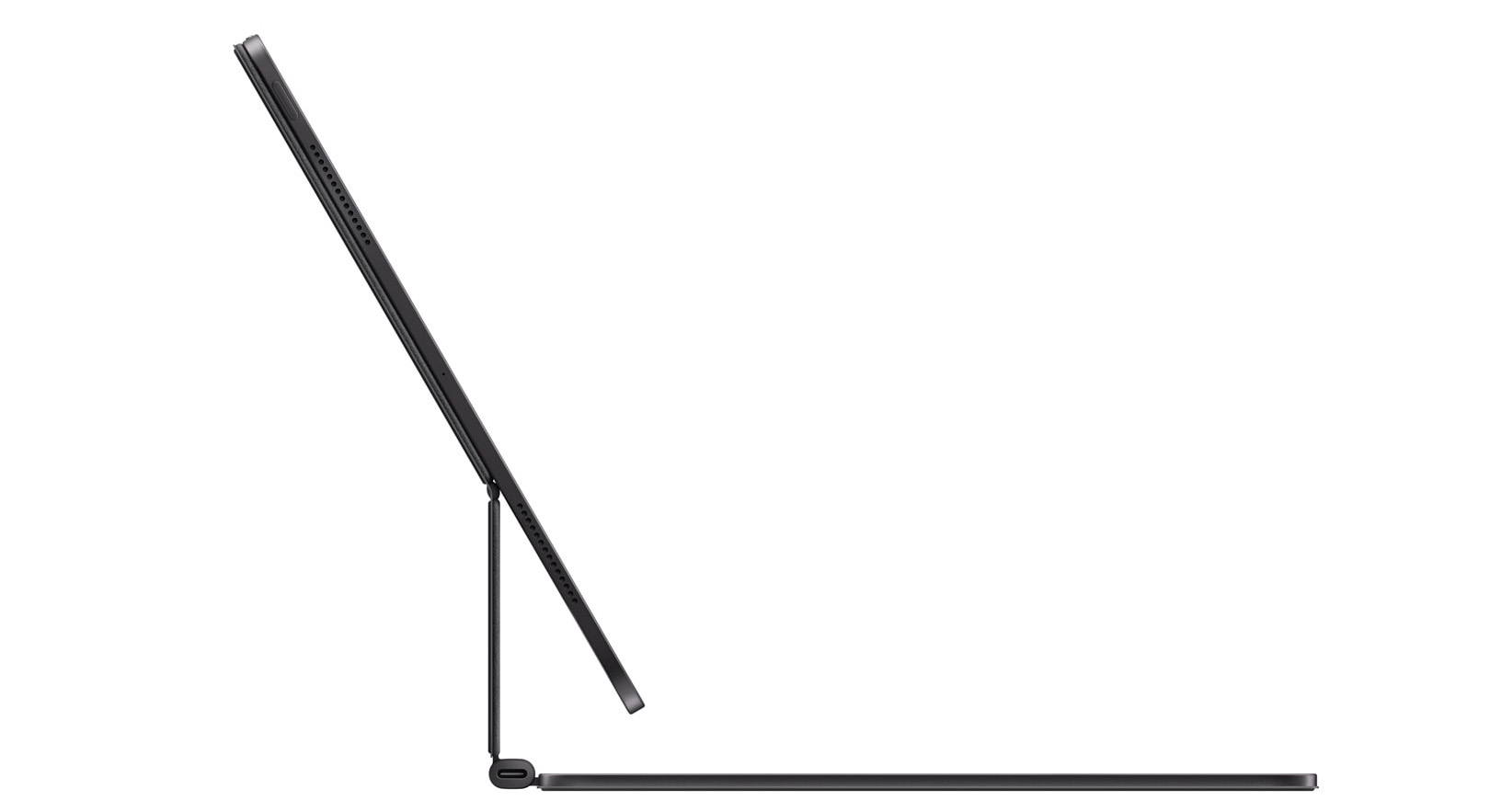
The new Magic Keyboard is a solid evolution.
Pencils may not be my strong point, but keyboards are definitely more my thing. The new Magic Keyboard is an improvement over the original model, introduced in 2020, in numerous ways. Perhaps the biggest improvement is the addition of a full function row, which allowed me to tweak display brightness, adjust volume, control media playback, and a whole lot more, all with one keypress.
The trackpad itself has also gotten larger, and follows Apple’s other trackpads in becoming a pressure-sensitive area that uses a haptic to inform you that you’ve clicked. The trackpad is good and the clicks feel natural, and Apple has sprinkled a few other haptic easter eggs into the iPadOS UI—reordering the songs in Music’s Up Next queue will provide a brief bit of haptic feedback as you slide a track around, as will longpressing on an item.
There’s also a big design change: the keyboard plane of the Magic Keyboard is now clad in color-matched aluminum (either silver or Space Black), making it feel a bit more like one of Apple’s laptops. The outsides of the case are still the rubbery material found in the last model, with the Space Black in a very dark gray and the silver model getting a white exterior. I think the white color is a mistake1, but clearly Apple’s color czars and I have a strong difference of opinion about how color is deployed (or not) on Apple devices.
The new Magic Keyboard seems great. I do think it’s too expensive, at $349 ($299 for the 11-inch model), and the 11-inch model’s keys still feel too cramped to me, though I sure do like the size of that 11-inch model folded up like a laptop. Takes me back to my 11-inch MacBook Air days. I’m also a little concerned about the durability of the thing; there’s a somewhat awkward area where the rubber backing is attached to the metal base, and I am a bit worried that it might not wear very well.
There’s also no way to adjust the keyboard brightness—and yes, the Magic Keyboard has always had backlighting!—from the keyboard. I usually leave my keyboard dark, mostly because I can’t be bothered to dig into Settings in order to adjust it. Turns out there’s a Control Center option, which I had no idea existed, so that’s something. But a keyboard command would be better!
In another big win for fans of the Magic Keyboard, this new model is lighter than its predecessor. My 13-inch Magic Keyboard weighs 667 grams, 38g down from the old model. Combine that with the weight drop in the iPad itself and the iPad-and-keyboard combination is only about 20 grams heavier than my MacBook Air. And I can’t rip the keyboard off my MacBook Air to save weight.
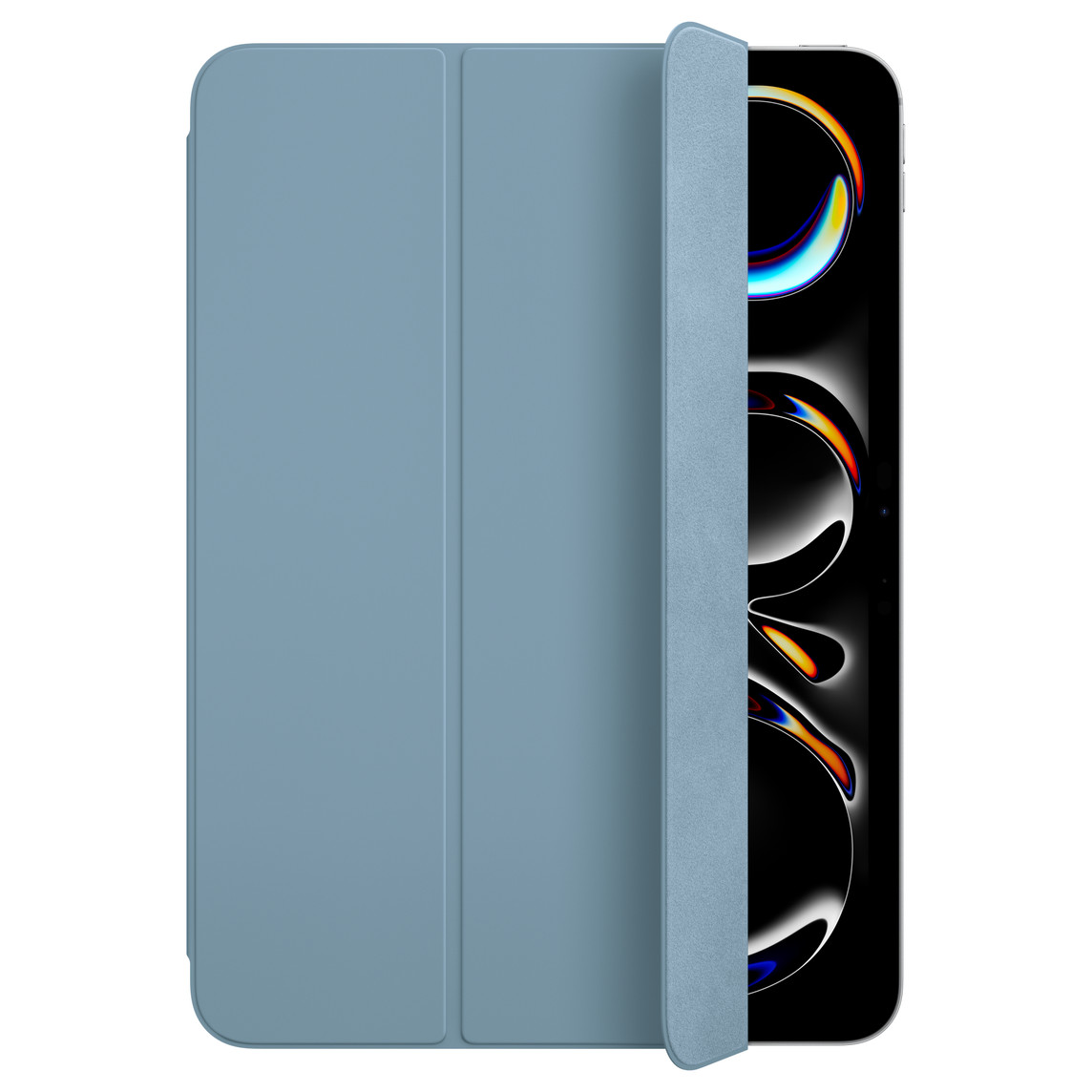
Finally, a quick note about the unsung hero of the iPad accessory world, the iPad Smart Folio. There are new models for the new iPad Pros, and they fold slightly differently—one of the three zones of the trifold design is a lot smaller. The result is a major win if you use the Smart Folio to prop the iPad upright, as there are now multiple magnetic “stops” you can use to adjust the angle from straight up and down to more of an artful lean. Unfortunately, if you use the Smart Folio to lay the iPad mostly flat with a slight downward incline—which I do, frequently—you may be disappointed to discover that the iPad now sits much lower and flatter in this configuration. This change will probably make more people happy than sad, but I’m in the sad camp on this one.
The state of iPadOS
One of my criticisms of the trajectory of the iPad in recent years has been that it’s just not advancing fast enough, while macOS has been revived with Apple silicon. As a result, I’ve begun traveling with a MacBook Air again. I realize that in various articles and on various podcasts, many people have lost track of the long, long thread of the experiences of those of us who have tried very hard to use the iPad Pro to get our jobs done for years now—and it’s true, you shouldn’t need to follow a ream of footnotes to get a quick summary of the current state of affairs.
In using the iPad Pro exclusively in advance of this article, I got to appreciate several of the ways that iPadOS has progressed in the last few years. When you consider the added support for external storage devices, the introduction of (and updates to) Stage Manager, and the release of Final Cut and Logic for the iPad, the iPad Pro is in a much better place than it was five years ago. In my four days of using just the iPad Pro, I found that I could do my work pretty well. Most of what I wanted to do, the device provided. In a few areas, I had to spend extra time due to limitations of the operating system or various iPad apps. And of course, there are some areas where the iPad simply won’t go—or at least, where Apple refuses to take it.
My workflow for building charts like the one that appears in my M4 processor section involves using Numbers to input test data and generate a chart. I export the result as a PDF, which I bring into Affinity Designer to tweak. I was able to get that entire workflow to work, eventually, but the process showed the pair of issues that continue to limit the iPad: individual apps and the OS itself.
Despite several claimed innovations, iPadOS remains essentially stupid when it comes to fonts. Instead of allowing users to, you know, add fonts, instead they’re encouraged to download “font apps” (which, at least on my iPad, linked to a nonexistent corner of the App Store), or use apps that allow you to sideload fonts inside them. My charts use a font, Proxima Nova, that doesn’t appear on the iPad, so I needed to install it. In macOS, this takes a double-click in Finder and then another click in Font Book, the Mac’s font manager app. On iPadOS, I kept getting the runaround. Adobe Creative Cloud said it could install the font, but failed to install most of it. Installing via the old-school method of using a Profile download also failed. I did eventually manage to load the font via Affinity Designer’s own font loading feature. It worked—but it took me 25 minutes to figure it out. This is painfully representative of the iPad experience.
But I can’t lay this all on iPadOS. Using Affinity Designer, an incredibly powerful app, was also frustrating—mostly because the app differs from its Mac version in a bunch of basic ways that forced me to act as a detective, trying to ferret out the features that would allow me to rebuild my workflow. Similarly, Numbers behaves mostly like its macOS version—except in the ways where it doesn’t. Due to the lack of a menu bar, commands are sometimes in very weird and unexpected places. I also am a bit baffled by the idea that Numbers defaults to a preview mode that lets me click around, but not actually edit the file. But these are different platforms, and while I always hope to leverage my familiarity with the Mac versions, sometimes that is just not possible.
In my particular niche, things have actually gotten way better in one area—thanks not to Apple but to Zoom, which has added cloud-based recordings of individual audio tracks from a call, providing the vital backup recordings I need to edit podcasts. And they’re even downloadable right to an iPad, where I can take advantage of Safari’s Downloads feature to save them to my device. I recorded my podcast, edited it on the iPad with the Apple Pencil Pro, and uploaded it to my server via a 5G connection from the back seat of a car headed down the interstate. Pretty great, right?
Unfortunately, the iPadOS audio subsystem remains embarrassingly primitive. In my particular instance, I’d like to be able to record my microphone audio using one app while talking on a Zoom call separately, but iPadOS isn’t built to do that. To record a podcast this weekend, I traveled with a microphone with dual audio outputs and an external audio recorder, so I could use USB to talk on Zoom while using XLR to record my audio directly to an SD card. (When everything was done, I was able to use Files to copy the file right from the SD card, which was once impossible.)
This has more mainstream knock-on effects. On my Mac, I can play songs in Music and click on videos on social media and both streams just keep on playing. On iPadOS, the initiation of any alternate media stream causes the currently playing stream to pause. iOS and iPadOS have had 17 years to address this, and it’s still comically bad.
There’s also no concept of true background tasks. Like the inane audio infrastructure, this shows the legacy of the iPad being built from assumptions made about the iPhone. The iPhone, being a very small mobile device with a tiny battery and very little RAM, was designed to run one app at a time. Over the years, multitasking has made things a little more flexible, but on today’s 1TB iPad Pro with 16GB of RAM you can’t export video from Final Cut Pro in the background.
Or consider the concept of background utilities, which perform innumerable helpful tasks on macOS. They’re banned on iPadOS, meaning there’s no way to use an alternative launcher like LaunchBar, or a file watcher like Hazel, or a clipboard manager, or a configurable launcher like the Stream Deck. You can’t even leverage the existing Shortcuts automation system by setting keyboard shortcuts! These sorts of functions are enormous productivity boosters, and while they might not make sense for the iPhone (and even that’s arguable), they absolutely make sense for the iPad.
I will not travel without my iPad. I wouldn’t want to live without my iPad. It’s my device for reading and social media and games. Its optional built-in cellular connectivity is a game changer (that should really come to the Mac). I have such an affinity for my iPad that I have wanted to integrate it into as much of my life as possible. And for an increasing number of tasks, I can. But for many others, I am eternally bumping up against the severe limitations of the platform.
I am often told that the iPad is just a media tablet, so why do I get so worked up about this issue? First, I don’t consider it just a media tablet. Second, why does Apple sell a keyboard and trackpad for it if it’s just a media tablet? Third, why can you spend upwards of $2000 on something that’s just a media tablet? Fourth, why is something that’s just a media tablet called “pro”?
Apple needs to decide what it wants to do with iPadOS for professional users. If it can identify some areas where there are big wins for pros and execute those changes, that would be wonderful. But it needs to pick up the pace.
The iPad hardware has shown that a light-and-thin touch tablet that can also be popped into a keyboard case to become a laptop is a powerful combination. That’s why the iPad fits really well into some people’s lives, including mine. So is the iPad the future of convertible devices in Apple’s ecosystem? Is it some future evolution the Mac? Is it some combination thereof?
I’ve spent a lot of space recently suggesting that Apple might want to back off on intense iPadOS development, ship a macOS virtual machine for the iPad Pro, and call it a day. Let me be clear: I would prefer to see iPadOS grow and develop into its own unique but functional platform that can fulfill the needs of disparate pro user bases. I have suggested macOS virtualization more out of a sense of despair, borne out of the fact that the iPad’s hardware is certainly capable of performing the task and that its software is eternally too late and a dollar too short.
Back where we started
The original iPad Pro was great. The 2018 iPad Pro was great. The new iPad Pro is great. It’s got a fast processor, a gorgeous OLED display, and a collection of accessories that are (mostly) improved from the previous generation.
The iPad Pro fits in some places better than any other device. It’s supremely portable and flexible. The Apple Pencil makes it a game changer for artists and people who mark up PDFs all day. The Magic Keyboard can transform it into a MacBook Air-class laptop with the snap of a magnet—and will relinquish it back to its natural state with one simple gesture.
The design and power make me love the iPad Pro more than perhaps any other Apple product I own. This one’s even better. This is all good stuff. Unfortunately, I have to end this review the same way I’ve ended almost every iPad Pro review I’ve written: I wish iPadOS loved the iPad Pro as much as I do. We continue to live in a world where Apple’s most flexible, powerful, groundbreaking piece of hardware is let down by an inflexible, weak, and slow-to-be-upgraded operating system. “Unfortunately, the hardware has outpaced the maturity of the operating system and app ecosystem” is a thing I wrote nearly nine years ago, and while everything has evolved since then, it’s still true.
If the iPad Pro works for you, you won’t be disappointed by this one. I just wish more people could fit in that category.
Fans of white keyboards, like white cars, are apparently legion. I hope you enjoy your weird white keyboard! I don’t like it. ↩
Apple breaks its usual pattern with the new iPad Pros this week, its possible next CEO is a huge fan of public transportation, and what happened to the time-honored method of releasing apologies via a Notes screenshot?
The Fantastic M4s
They called them mad (MAD!) at the Institute (AHAHAHAHA!) but Apple did it anyway: it leapfrogged its M3-based Mac lineup and put an M4 in the iPad Pro first. Now, BEHOLD THE POWER!
To do what, exactly? Well… it’s really fast. There’s that. It does seem likely the company will have another iPad story to tell next month at WWDC about how people can take advantage of all this computing power, so stay tuned for more on these smoking hot processors that actually don’t run that hot at all.
While it did go nuts at the high end, Apple actually rationalized the iPad lineup a bit. You’ll pay more for an iPad Pro now, but it has the latest and greatest processors Apple makes and, particularly with the introduction of the 13-inch iPad Air and discontinuation of the 9th generation iPad, spreads the lineup out a bit. Now when your cousin asks you which iPad they should buy, you won’t have to run two spreadsheets and a flow chart to figure it out.
You’ll still need a spreadsheet to figure out which Pencil to buy, though.
Apple Exec: The Next Generation
If Mark Gurman is to be believed (and, hey, he was right about those M4 iPad Pros), that guy you saw talking to a camera on BART about new iPads is the odds-on favorite to be the next CEO of Apple.
So, let’s meet senior vice president of hardware engineering John Ternus! Either a Taurus or a Gemini (he likes to keep an air of mystery!), John graduated from the University of Pennsylvania and joined Apple in 2001 as a member of the design team! The youngest member of Apple’s executive corps, John likes long walks on the beach, friendship bracelets, and making his patented tater-tots-n-cheese for that special someone!
(Some of that may have been made up, but I think it’s pretty close just from his general vibe.)
Whoever takes over for Cook, we can be sure that they’ll be better than if Apple’s board listened to Cook’s critics just seven years ago who said the company should buy Tesla and make Elon Musk CEO.
Of course, that’s not saying much. Better choices for CEO than Musk include:
The Hamburglar
Hans Moleman
Skeletor
A sack full of angry badgers
Promoting from within by cultivating and rewarding success is definitely the best way for Apple to keep being Apple. Although, honestly, I kind of want to see the Hamburglar regime.
Crushing it
While most everything Apple showed at its Tuesday morning event was fast, some of it was out of control. The company’s “Crush” ad attempted to show all the creative things you can do with an iPad…by literally crushing creative things.
In terms of metaphors, probably should have reconsidered that one.
Perhaps not really wanting yet another sign that capitalism is the hydraulic press under which we are all obliterated, the ad was met with some large degree of backlash in the days after the event. Everyone from Hugh Grant to Stephen Colbert felt obliged to weigh in. The situation got bad enough that just two days later, Apple apologized for the ad, saying “We missed the mark with this video, and we’re sorry.” The company canceled plans to run the spot on TV and will spend the weekend sitting in its room thinking about what it did and reflecting on the bad choices that led it to making that ad.
Well. Now we can all put this unpleasantness behind us and get on to the real scandal.
[John Moltz is a Six Colors contributor. You can find him on Mastodon at Mastodon.social/@moltz and he sells items with references you might get on Cotton Bureau.]
As a native Safari extension, Magic Lasso blocks all intrusive ads, trackers and annoyances – letting you experience a faster, cleaner and more secure experience across all your devices.
The M3 chip, introduced last October, is already yesterday’s news. We’re living in an M4 world, courtesy of the surprising announcement that the new iPad Pro is powered by Apple’s next generation of chips.
Even if you don’t care about iPads, this announcement will affect the trajectory of the Mac and iPhone in quite a few ways.
We got together with Backstage pass members live on Zoom earlier today to discuss all sorts of stuff, but mostly Tuesday’s Apple announcements. We’ve embedded the video below, or you can watch it on YouTube.
How we recommend iPads to people, whether Apple should stop holding events, what one task our perfect chatbot would do, and how we feel about the Apple Pencil.
Ever since Steve Jobs’s famous two-by-two grid of Apple devices, Apple aficionados have tried to cram the company’s product lines into neat little boxes.1
In recent years, the iPad line has seemed exceptionally complex and difficult to delineate. Should you buy an iPad Air or an iPad Pro? What about the multiple low-end iPads? How does the mini fit into the equation?
With this week’s refreshes to the iPad Air and the iPad Pro, it seems as though some clarity might be returning to the tablet lineup…but it may have also introduced some new uncomfortable questions.
At what price iPad?
From a price perspective, Apple’s recent changes come in two extremes: the top and bottom of the lineup. The demise of the ninth-generation iPad and the price cut on the tenth-generation has clearly staked out the low end; on the high end, the iPad Pro has become even more expensive.
Here’s a chart of the available storage configurations. (I’m not including options like nano-texture screens and cellular connectivity.)
Purely looking at price, I’d argue the iPad lineup actually makes much more sense now. The base-level “for most people” iPad is available in small and large capacities with a $150 markup for four times the storage. (Should it probably have 128GB on the low-end? Sure, but when it comes to margins, Apple’s gonna Apple.) Likewise, if a small screen is what you value above all else, the iPad mini remains a product in the lineup.2
Where Apple has de-muddied the lineup, though, is in the mid-range. Previously, once you went higher than the paltry base of 64GB storage on the iPad Air, you quickly got into entry-level iPad Pro territory, then forcing you to make a more complex decision between more capacity and more capability at around the same price point. Rather than the simplicity of a decision based around more storage for more money, customers instead had to weight the ability to store more photos vs. Face ID which…how do you even?
In the new lineup, that’s not really a problem. The base-level iPad Airs now boast an acceptable 128GB of storage and are still priced well below an iPad Pro. You’ve go to go up to the top-tier iPad Airs before you really start competing with base level iPad Pros—which is as it should be.
From a feature standpoint, Apple’s made that delineation clear too. With powerful (and, thus, pricey) features like OLED displays, M4 chips, Face ID, and Thunderbolt, it’s clear that the iPad Pro really is being targeted at those who want the most power that an iPad can deliver.
Back in 2022, when trying to decide between the iPad Air and Pro I ultimately bought an 11-inch iPad Pro with an M1 chip and 128GB of storage for $799; a 256GB iPad Air would have cost only $50 less, and I got a lot for that extra $50. But today, the $999 starting point for the iPad Pro would definitely make me think twice, and I believe I’d probably end up with a cheaper (if less capable) iPad Air.
And you know what? That’s fine. I generally opt for the MacBook Air over the MacBook Pro too, and the iPad Air and Pro lines are now positioned more closely to the differences between the Mac laptop lines.
Though, speaking of which, let’s change gears here.
Putting on (Pro) Airs
The most expensive iPad Pros have always trodden on the toes of low-end Macs, but with these recent revision, that’s even more the case. As Jason wrote the other day, the iPad is no longer the future of computing; instead, it’s more of an alternative to the Mac, for those who want a touch interface with the flexibility to add a keyboard and trackpad.
Still, purely from a price perspective, things do get more confusing now. Consider the comparison between the iPad Pro and the MacBook Air. (All quoted prices are for the base level 13-inch (8-core CPU/8-core GPU) and 15-inch MacBook Air (8-core CPU/10-core GPU) models with 8GB of RAM.)
Of course, some of the iPad Pro models have different amounts of cores and RAM, making this all a bit fraught. Not to mention that if you want a true comparison, you are probably adding at least a $299 Magic Keyboard into the mix.
Look, I get that it’s apples and oranges. People who prefer the iPad are going to get an iPad, and people who prefer the Mac are going to get the Mac. Some people might get both!
But zooming out, there are certain broader assumptions that become clear: the iPad Pro commands a price that is comparable to a Mac laptop, meaning that Apple kind of slots them into the same market.
Which is fine, as far as the hardware goes; the problem remains the software. Is a 13-inch iPad Pro with specs that are equivalent to—and in some cases, better—than a comparably-priced MacBook Air as capable as that MacBook Air? There are trade-offs, which would be perfectly reasonable…if the tradeoffs were really just about whether you want a detachable tablet or the ability to use an Apple Pencil.
But so many of the tradeoffs are about what has been hampered by Apple’s decision to have iPadOS spend years trying to reinvent the wheel. In the iPad’s earliest days, Apple was determined to obfuscate all those computer annoyances like file management and multitasking, only to eventually have to backtrack because it turned out people needed those abilities, annoying as they were.
So an iPad is comparable to a Mac laptop…except where it isn’t.
It’s raining shoes
All of this leaves me with a feeling I know well: of waiting for a shoe to drop. We’re about a month away from WWDC, when Apple will reveal the latest updates to its software platforms, including iPadOS.
Will the company unveil something major that makes us all sit up and think “Aha! This is the missing piece of the iPad puzzle!”? I’d like to say yes, but I worry I’d be Charlie Brown lining up to kick a football, only to end up once again with a head injury explaining why I don’t remember this next year.
Because even if the iPad does get something to deliver on that promise, it’s not as if the Mac is standing still. And I’m forced to ask myself: were Apple’s laptops to some day get touchscreens and Apple Pencil support and perhaps even a detachable screen…would there still be a need for an iPad Pro?
I contend that the a defining characteristic of humanity is a futile striving to bring order to chaos. ↩
Should the mini maybe just be a smaller version of the tenth-generation iPad? Maybe. But there I go trying to put things into boxes again! ↩
[Dan Moren is the East Coast Bureau Chief of Six Colors, as well as an author, podcaster, and two-time Jeopardy! champion. You can find him on Mastodon at @dmoren@zeppelin.flights or reach him by email at dan@sixcolors.com. His next novel, the sci-fi adventure Eternity's Tomb, will be released in November 2026.]
Apple declared Tuesday as the biggest date in iPad history since the launch of the product in 2010. I’m not sure I’d go that far. It was a major event, to be sure, but so was the original iPad Pro and Apple Pencil launch in 2015 and the 2018 launch of the redesigned iPad Pro and the Apple Pencil 2.
But yes, today brought a brand-new iPad Pro and a new iPad Air that continues to be recycled out of the features of previous models, but at a more accessible price. The lack of any updates to the low-end iPad (other than a price drop) and the iPad mini (which desperately needs one) diminish my enthusiasm for Tuesday as the all-time iPad update.
It was a good day, though. Especially for those of us who use and love their iPads. But despite all of it, I’m also left with some of the same feelings of unease that I had back in 2018.
The iPad Air is the new iPad Pro
iPad Air, in two sizes at last.
Don’t get too hung up on the iPad Air’s name. It makes sense in that it forms half of a pair with a more powerful, higher-priced device in the same product line, like MacBook Air and MacBook Pro. The difference is that the iPad Air is thicker and heavier than the iPad Pro. What’s lighter than air? On the iPad, Pro. Pro is lighter than air.
But that’s not the point of the iPad Air. It’s meant to bring iPad Pro features down to a cheaper price so more iPad users can benefit from features that used to be cutting-edge. Apple cuts the price and saves by reusing tech from other iPads.
This time around, that’s been taken to an extreme: the 11- and new 13-inch iPad Air are identical in size to the old (2018-2022) iPad Pro models. Apple’s literally re-using those old models, with only some minor feature variations. There’s no Mini-LED HDR display on the 13-inch model as there was on the M1 and M2 versions, nor is there a Face ID sensor; if you want a keyboard, the 2020-era Magic Keyboard will suffice. You can use either the USB-C Apple Pencil or the new Apple Pencil Pro, so that’s a win, and the FaceTime camera has been moved to the horizontal axis.
There are a few other minor cuts here and there, but fundamentally, the iPad Air is even closer now to the old iPad Pro and offers a larger model for the first time. Just as with the MacBook Air, which finally stretched to offer a 15-inch model, now there’s a more affordable 13-inch iPad. It’s a good thing, even if it’s not the most exciting or cutting-edge hardware. (Given the past of iOS software innovations, that might be just fine.)
Even better, Apple has finally decided to embrace simplicity and is calling the larger iPad Air a 13-inch model. Yes, the screen is technically 12.9 inches when measured diagonally, but all of Apple’s laptops are rounded to the nearest inch for simplicity’s sake, and now the iPad has been given the same treatment. 11 and 13, that’s the spirit.
One disappointing note: Apple continues its trend of removing color from its products as they escalate in price. The iPad Air’s colors were subtle before, but they’re vanishingly distinguishable now. On Tuesday, I sat not two feet away from two iPad Airs in blue and purple, and, reader, I could not tell that they were not silver. And while you may be thinking, well, poor Jason’s colorblind, and that’s why he’s saying such hurtful things, I’ll remind you that blue and purple are colors I can see.
For the life of me, I don’t know why Apple hates fun colors. The regular iPad has them.
The M what now?
It was quite a shock when Bloomberg’s Mark Gurman reported last week that the new iPad Pro might ship not with an M3 processor, but with the debut of the M4 processor. The report seemed outlandish, but the more I thought about it, the more it made some sort of crazy sense. And it turns out, Gurman was dead on.
Why the M4 now? It mostly has to do with Apple shifting chip production at TSMC (the company that fabs Apple’s chips) from the first-generation 3nm process to a new, more efficient second-generation 3nm process. There’s a whole backstory about TSMC’s change in 3nm processes that’s not worth getting into here, but suffice it to say that the first-generation process is largely a dead end, and the company is moving to a new set of 3nm processes.
So while Apple was proud of buying out TSMC’s first batch of 3nm processors to build the M3 and A17 Pro chips, it’s time to close the book on those chips—and by the end of next year, that generation will probably be entirely discontinued.
While it’s easy to think of processors as monolithic, every new M-series processor is really a collection of different parts, and they advance at different rates. With the M4, Apple’s moving to a new process a little earlier than one might expect—I doubt the company wants to release a new M-series generation more often than once a year—and the chip itself seems somewhat evolved over the M3.
The M4’s CPU cores are slightly improved over M3, featuring next-generation Machine Learning accelerators that help speed more basic AI tasks that don’t require farming things out to the Neural Engine or the GPUs. Apple has also changed the balance of the CPU cores in the M4, taking the total number to 10 (from eight) by adding two additional efficiency cores. This should boost overall CPU efficiency, though the four performance cores will largely gate peak performance. (And on the lower-end iPad Pro models, Apple’s using binned M4 chips with only three functional performance cores.)
The features Apple touts as being major GPU improvements are actually ones introduced in the M3, which never came to the iPad Pro—so it seems like there are no major changes on the GPU front in the M4 after the major upgrade during the last generation. However, the M4’s display engine has gotten a major upgrade, which was required for the complex Tandem OLED display of the M4 iPad Pro to work properly. (It’s a shining example of how Apple benefits from controlling its own chip design so it can build functionality that enables specific product features.) It remains to be seen if there are any other display-engine enhancements that might affect Macs running on the M4.
Finally, the M4 has powerful AI processing units… just like Apple chips have had for years. It was hard not to listen to Apple on Tuesday and get the sense that the company feels it’s being unfairly marked as “behind” on AI, given that it’s been building its Neural Engine cores into chips since 2017.
The Pro hardware
You can have it in any color you want, so long as it’s silver or Space Black.
Adding the M4 is impressive, as is the rest of the iPad Pro hardware package. I want to spend more time with the Ultra Retina XDR displays to really experience how bright and colorful they are in various conditions and with different sample media, but my brief exposure to them was definitely eye-opening. Apple has done a lot of engineering work to build a unique dual-layer OLED system that can produce eye-watering brightness.
Just as impressive is the resulting physical size of both iPad Pro models: They got smaller. In the case of the 13-inch model, a lot smaller—it’s not only the thinnest iPad (or Apple product?!) ever, but perhaps even better, it dropped nearly a quarter of a pound in weight. The new model is only 85 percent of the weight of its predecessor! And the 11-inch model weighs just slightly less than a pound. It’s a huge engineering victory.
I also have to applaud the relocation of the FaceTime camera and Face ID sensor to the horizontal side of the device, as I almost never use the iPad Pro in any orientation but horizontal. The Apple logo on the back still needs to be rotated to match, but I’ll take the win. And thumbs up to Apple for finding a way to make the relocation happen while also retaining the ability to magnetically dock and charge the Apple Pencil at the same location.
Unfortunately, the new iPad Pro suffers from the same tragic lack of color as other Apple products. You can get them in any color you want, as long as they’re silver or the new Space Black, which appears to be a bit darker than the old Space Gray.
Saying that the processor in the new iPad Pro can handle anything thrown at it is praise, sure, but it’s also a little bit of an indictment. As users, we need more things to throw at it.
I got those vibes again on Tuesday. Apple has evolved the iPad a lot since 2018, but the product still exposes a remarkable imbalance between the incredibly confident and skillful march forward by the company’s hardware design and processor architecture groups and the erratic advancement and limited functionality of iPadOS.
I will give Apple credit: It worked hard on Tuesday to show off all the use cases that might lead someone to buy an iPad Pro for between $999 (11-inch, base config, no accessories) and $3077 (13-inch, max config, all accessories). There were lots of great Apple Pencil-based demos featuring creative professional apps, of course. I was impressed with the substantive updates planned for Final Cut Pro and Logic Pro.
There was also a dude on a BART train editing a spreadsheet in Numbers. Which, ooookay….
I like seeing Apple sweat a little in making a case for a product. It’s really doing its best, and if I were someone who primarily performed creative tasks with an Apple Pencil, I’d be all in. As someone who uses a keyboard (and a USB microphone, I suppose) to make a living, I’m looking at $2177 for a mid-range 13-inch model with cellular, an Apple Pencil Pro, and a Magic Keyboard. That’s substantially more than I’d pay for a new MacBook Air, and while I know that I can’t use the MacBook Air as a thin and light touch tablet, I also can’t use my iPad Pro as a travel podcasting unit.
I’m not saying that iPadOS and the iPad platform are bad. They’re not. I write regularly on my iPad Pro and read on it every morning and evening. I wouldn’t travel without it.
What I’m saying is, when it comes to iPad Pro hardware, it feels almost like Apple can do no wrong. On the software side, iPadOS is still rife with limitations that probably don’t matter much if you’re just using it to watch TV in bed or triage a few emails—but matter a lot if you’re trying to go beyond a limited set of features and some specific apps.
I will live in hope that the next version of iPadOS will address some more of these issues. (I have expressed this sentiment every single time a new iPad Pro has been released. It hasn’t helped.)
The accessory situation
Look at that function row.
Accessories make the iPad. No, really: The iPad’s ability to use things like the Apple Pencil and the Magic Keyboard are what make its Apple’s most ergonomically versatile computing device. It’s the reason I love the iPad.
So let’s cheer the new accessory additions. While I’m not a heavy Apple Pencil user—I only really use it for editing podcasts and the occasional marking up of a PDF—I have huge admiration for the Apple Pencil 2 as the apotheosis of Apple Products. It is a high-tech object that feels and looks like an inert solid block. It’s the most non-technical tech product ever, and yet when you bring it close to an iPad, magic happens.
The new Apple Pencil Pro is a sensible revision of the Pencil 2. (Apple’s moving to a model where iPads will support two Apple Pencils, one on the low end and one on the high end.) If you want to save some money, you can use last year’s USB-C Apple Pencil on these new iPads, but you’ll lose magnetic charging—which is delightful—and some snazzy new features, like a squeeze gesture that brings up a contextual menu, haptic feedback that reacts to the squeeze gesture and other events, and the ability to rotate the pencil to change how brushes function or apply other changes to content.
The new Magic Keyboard is also an improvement. It retains the clever cantilever design but takes advantage of the lighter iPad Pro weight to slide it further back, adding room for a larger trackpad (with haptic click!) and a full row of function keys. Oh, to finally adjust my iPad’s volume and brightness without taking my hands off the keyboard.
The anticipation resumes
I look forward to the new iPads shipping next week. While I continue to view Apple’s iPadOS software strategy with consternation, I am still a heavy iPad user and want the product to keep getting better. On the hardware side, it has certainly taken a big leap forward.
As for the rest, well, you know. Hope springs eternal. There’s always the next WWDC.
Both Jason (New York) and Myke (London) have had their hands on the new iPads and are here to report back with all the details. We discuss M4 surprises, iPad Air choices, iPad Pro use cases, and save a little time to Lawyer Up.
The newly announced iPad Pro hides a sneaky upgrade option that Apple didn’t mention during its event today. When you cough up the $600 it costs to jump from the 256GB base model iPad Pro to the 1TB version, Apple doesn’t just double the RAM along with that — it also puts a faster chip inside, going from a nine-core M4 chip to a 10-core version.
One core is probably not going to make a lot of difference in most performance cases, but it does reinforce the fact that these chips are Apple’s newest and thus, presumably, more expensive to make. So it isn’t surprising that they’re using the 9-core version in the lower tiers of iPad Pros, along with providing half the RAM. (The M2s in the iPad Air, if you’re curious, all have the same specs: 8-core CPU, 10-core GPU, 8GB of RAM.)
I do kind of miss the days when I didn’t have to worry about processor cores and RAM in my iPad: sometimes ignorance really is bliss.
Apple on Tuesday made some big moves to its iPad lineup, introducing new models of the iPad Air and iPad Pro, as well as a new Magic Keyboard and the Apple Pencil Pro. But Apple’s video was fairly short, clocking in just over half an hour, so as usual, there are some details that it didn’t have space to share. Good news, though: I’ve collected a few of the biggest ones for you!
The ninth-generation iPad is (mostly) dead
Pour one out for the home button: with the tenth-generation iPad’s price drop to $349, it now solidly holds down the low end of the company’s tablet lineup. The ninth-generation model has accordingly shuffled off this mortal coil, though you can, as of this writing, grab an eighth-generation model from Apple’s refurbished store. It’s also still available for education customers, which have whole fleets of older iPads. (And would we be surprised if it found its way to Walmart or Costco at some point soon?)
This standardizes Apple’s iPad design across its lineup, with edge-to-edge screens, USB-C ports, and flat edges, no matter which model you buy—except the mini is now the only model with the front-facing camera in portrait orientation instead of landscape, which is slowly killing me.
Logic Pro and Final Cut Pro updates come to the Mac as well
If you’re a Mac user casting an envious glance at those newly updated Pro apps for the iPad, don’t worry: the Mac versions of the software will be getting many of the same benefits.
Logic Pro for Mac 11 will be available, like Logic Pro for iPad 2, on Monday, May 13, and include the Session Players, Stem Splitter, and ChromaGlow features. It’ll be a free update for existing Logic Pro users or cost $199.99 for new customers.
The Final Cut Pro story is a little more complex. Final Cut Pro for Mac 10.8 will appear as a free update for existing users or $299.99 for new customers. It brings new AI-powered features like Enhance Light and Color and Smooth Slo-Mo, custom names for color corrections and video effects, and the ability to search the timeline index and text-based timeline. However, it doesn’t seem as though it gets several of the other features of Final Cut Pro for iPad 2, like the integration with Final Cut Camera or Live Multicam.
Nanotexture will cost you
Unsurprisingly, for those who’ve opted for the glare-reducing nano-texture option on Apple’s standalone displays, the iPad Pro version will cost you. For one, it’s only available on 1TB and 2TB models, meaning a starting price of at least $1599 for the 11-inch model and $1899 for the 13-inch model, but on top of that it’s a $100 premium.
This new nanotexture formulation was built with the iPad in mind, meaning that it’s meant to survive contact with our greasy paws (as well as the Apple Pencil). As its positioning on only high-end iPads implies, it’s really meant for professionals working in environments with heavy glare. The nanotexture cuts glare, but as you’d expect, it also lessens the dramatic blacks of the OLED display.
Smart Folio gets redesigned
If you don’t want to splash out for the pricey new Magic Keyboard, there are also redesigned versions of the Smart Folio for your iPad Air and iPad Pro, which Apple says now “supports multiple viewing angles for greater flexibility.” (Though I’m not sure exactly what that means: it looks pretty much like the previous versions.)
The Air model will come in four colors—charcoal gray, light violet, denim, and sage—while the Pro version is available black, white, and denim1. 11-inch versions cost $79; the 13-inch model will run you $99.
[Dan Moren is the East Coast Bureau Chief of Six Colors, as well as an author, podcaster, and two-time Jeopardy! champion. You can find him on Mastodon at @dmoren@zeppelin.flights or reach him by email at dan@sixcolors.com. His next novel, the sci-fi adventure Eternity's Tomb, will be released in November 2026.]
iPad Pro and keyboard, circa its October 2018 announcement.
It’s hard to believe that it was more than five and a half years ago that I flew home from a New York Apple event, my mind spinning with the announcement of a new iPad Pro at a unique Apple event in Brooklyn.
Now all signs point to a new era in the iPad Pro beginning on Tuesday. It’s made me reflective about what’s happened to the iPad since the fall of 2018.
In hindsight, that event was a bit of a foreshock for the arrival of Apple Silicon. During the event, Apple introduced a new iPad Pro processor—clearly a forerunner of the M series that would power Macs in a couple of years—and boasted about how much more powerful it was than almost every PC laptop being sold. It was the first big brag about Apple’s chip-design prowess that went beyond the iPhone, which had been already running circles around Android phones powered by Qualcomm chips.
But that boast also drew the iPad into direct comparisons with PC laptops, and while its sheer hardware power might have defeated most of those laptops, power isn’t everything. It’s what you do with the power. And in many ways, that’s been the story of the iPad Pro since then: This is a device with computer power, but running a phone-adapted operating system that’s not nearly as capable or flexible as macOS. And thanks to the Apple silicon transition, today’s core iPad Pro hardware is almost indistinguishable from the chips that power a MacBook Air.
If this narrative sounds familiar, it’s because despite it coming up in 2018, it’s never really gone away since then. Apple has evolved iPadOS quite a bit since then, adding Stage Manager and a revamped Files app and even introducing versions of its pro apps, Final Cut and Logic.
But over this same span, it’s become clear to me that Apple no longer views the iPad as the future of personal computing. This is to the Mac’s credit: Now that it’s on Apple silicon itself, the Mac’s battery life can rival the iPad, and it can pick up all the new features and apps that come to the iPhone and iPad thanks to a much more aligned base operating system and platform-smoothing features like Mac Catalyst and SwiftUI.
So where does that leave the iPad? More specifically, where does it leave the iPad Pro? What’s the role of a professional iPad, when the Mac is now much more capable of doing professional jobs with similar power and at a similar price?
It comes down to physical attributes. The iPad is something a Mac can basically never be, at its core: a touch-driven tablet that’s thin and light, with literally nothing else attached. From that base, the iPad can be whatever a user wants it to be—just a tablet, or a tablet with a pencil, or a tablet with a laptop-style keyboard and trackpad. It can even be docked to an external display and drive multiple windows.
The iPad’s adaptability takes me back, once again, to 2018. That was the event that introduced the Apple Pencil 2, and in some ways generations of iPad hardware are defined more by their accessories than any other characteristic. The Apple Pencil 2 was a solid update on the original, with a magnetic charging system that’s simple and elegant—a far cry from the approach of the original Pencil, with its Lightning port hiding under a little plastic cap.
(However, one feature of the Pencil 2 was a bit of a flop—I never could get the hang of its subtle, accelerometer-based double tap. It seemed to never trigger when I wanted it to, but would accidentally trigger all the time. I’m hopeful that Tuesday will bring another, improved take on letting Pencil users get some more control while still holding the implement in their hand.)
Still, it’s funny to think that perhaps the most defining accessory of this iPad Pro generation didn’t ship until more than a year later: the Magic Keyboard. That keyboard—now with a trackpad, and proper pointer support on iPadOS for the first time!—made the iPad into a tablet that could truly convert into a laptop. Apple’s first true convertible computer didn’t run macOS, but iPadOS.
But again… that was the problem. I’ve been an iPad Pro user since the beginning, and have spent plenty of time trying to coax the platform into fulfilling all the needs as a creative professional. I’ve been successful far more often than not, but that made the failures all the more frustrating. My standard travel backpack is a microcosm of this storyline: After years of trying to make it work with just the iPad Pro, the advent of Apple silicon has made me go back to traveling with a MacBook Air. It’s small enough, powerful enough, and can do literally everything I need—something the iPad Pro just can’t.
So what’s the way forward for the iPad Pro? I’ve spent the last year trying to figure out what I’d do, if I were one of the people inside Apple with the future of the iPad in my hands. There are no easy answers. For the iPad Pro to be a viable product, it needs to justify its higher price—at this point, the cheaper iPad Air can do everything that 2018 iPad Pro could do. So why buy an iPad Pro at all?
Accessories have to be part of the story—this is the iPad we’re talking about, after all. Reports abound that in addition to that upgraded Apple Pencil, there will be a new Magic Keyboard, one that’s more laptop-like. That’s a good start, because it leans into the idea that the iPad is Apple’s convertible device, a tablet that can be a laptop when you need it to be. If that keyboard is sheathed in aluminum and connects to the iPad Pro less awkwardly, it just reinforces that the iPad Pro can be a laptop when you want it to be.
(As an aside, I’m so tired of the people who come out of the woodwork to ask why people who use the iPad as a laptop don’t just buy a Mac. Let me answer the question one more time: I can’t rip the screen off a Mac and use it as a touch tablet. But I can make an iPad into a laptop when I need it to be. Not everyone needs or wants a convertible computer, but it has advantages that the Mac is incapable of matching.)
It’s funny how the Mac keeps coming back into this, isn’t it? There’s a good reason. The Mac is Apple’s do-it-all computing platform, and thanks to the boost from Apple silicon, it’s really doing better than ever. That mid-2010s malaise when it felt like Apple had no clear idea about the Mac’s future, which coincided with the possibility that the iPad would ultimately replace it, is gone.
Instead, the Mac is a key that can unlock the limitations of Apple’s platforms. One of the best features of the Vision Pro is its ability to connect to a Mac and display the Mac’s interface in a large virtual space. The Vision Pro becomes a stronger product because macOS exists, and integrates with visionOS.
This brings me to the issue I’ve been championing for a while now, which I think is the ultimate solution to the problem of the iPad Pro: the Mac. The iPad Pro is already capable of transforming from a tablet into a laptop, when needed. It’s got the same power as a MacBook Air. Apple’s built virtualization and a hypervisor framework into its products.
iPad Pro buyers already value the product for its flexibility. Imagine how much more flexible it would be if it could run macOS, virtualized, when connected to an external keyboard and trackpad. Apple’s first convertible device would be able to becomes a Mac when it needed to—and exit that mode when it doesn’t. Travelers could invest in the iPad Pro and all its accessories—at a price comparable to a MacBook Air, by the way—and know that they’re getting the best of Apple’s tablet experience and its traditional computer experience.
If Apple were to accept that at the top of the iPad product line, the iPad literally transforms into a Mac, that choice would also take a lot of the pressure off of iPadOS. Does Files in iPadOS really need to keep slowly trudging toward life as an ersatz Finder? And more to the point, does anyone who has used Files over the past five and half years really believe it’ll ever get there? And should it even try, or is that stuffing way too much functionality into a much more basic, iPad-like file manager?
The iPad no longer feels like the future of computing, and that’s fine. The Mac is here to stay, something that didn’t seem like a sure thing five and a half years ago. It feels like it’s time for Apple to accept this state of affairs. macOS isn’t just one of Apple’s platforms—it’s a feature, a secret weapon that it can use to make all its other platforms more powerful when they need to be.
I don’t have any idea if Apple really has any intention of letting macOS run on other devices, whether it’s an iPad or a Vision Pro or even an iPhone plugged into an external display. But it seems to me that if there’s any Apple product that is flexible enough to make it work, it’s the iPad Pro.
I still love my iPad Pro. I look forward to Tuesday’s announcements, whatever surprises they might bring.