After months of rumors and speculation, Apple’s annual Worldwide Developers Conference is imminent. In just a few short days, all that rumor and speculation will finally be answered, and we can make way for…new rumor and speculation. (At least then it will be based on things we’ve actually seen.)
But as we enjoy our last hurrah before the hurricane of news and updates hits, it’s time to compile a look at what exactly we might be expecting when Apple executives appear (in a no doubt slickly compiled video) at Apple Park next week, and what isn’t likely to make the cut.
Prioritizing Apple Music Classical for Android over Apple’s other platforms does make sense, though. The separate app is based on Apple’s acquisition of Primephonic, which was a standalone classical music subscription service, and the Android app went away with Apple’s purchase. That’s similar to how Apple Music for Android has served as a replacement for Beats Music for Android.
Well, yes and no. I’m sure the Apple Classical app leverages a lot of Primephonic’s work, but just looking at the app also makes it clear that it’s drawing heavily from Apple Music; it seems unlikely that it’s more technically challenging to bring Apple Classical to the Mac and iPad than it is for Android.
That said, Apple could very well have metrics from both Apple Music and Primephonic showing which devices people use to listen to classical music, and it decided to prioritize where there were more users. I also wonder if developers of Android apps at Apple might have somewhat more availability than engineers working on apps for its own platforms—especially right now.
Despite all that, the lack of support for macOS, iPadOS, tvOS, and CarPlay definitely feels a bit awkward. Here’s hoping a subsequent release will not only improve the Classical app for iOS (which hasn’t been substantively updated since launch) but also bring users of the rest of Apple’s platforms into the fold.
It’s time for our eighth annual competition regarding what will happen at Apple’s WWDC keynote! Jason and Myke will be there in person—but what will be announced? Is the Apple mixed-reality headset really going to happen? Will there be room for new Mac hardware? And what do we anticipate for macOS, iOS, iPadOS, and watchOS?
Hey, it’s our antepenultimate week talking about the Apple headset speculatively! New apps are a-shipping and generative AI asks “How many fingers am I holding up?” The answer may surprise you.
Will the realOS please stand up?
Cue the “IT’S HAPPENING!” gifs because it turns out that all these headset rumors have legs, unlike Meta’s offering.
[rimshot]
If you needed more proof of the actual thingness of Apple’s headset, this week did not disappoint. According to one of the outlets that received an invitation, Apple has invited a number of XR media outlets to WWDC. This is the first time the company has done so.
So, either Apple will be announcing a headset at WWDC or this is a really amazing troll. Either way, should be exciting.
Apple has also gone through a flurry of trademarking activities, including scooping up xrOS as well as realityproOS and realOS. Rest assured it will be called something.
And, no, somethingOS cannot be ruled out at this time.
The new appness
Some new apps were shipped or announced this week that really ran the gamut of the agony/ecstasy scale. First, let’s try ecstasy.
I mean…
You know what I mean.
Tapbots finally (does six months warrant a finally?) shipped Ivory for the Mac, meaning that if you are a refugee from Tweetbot you’ll feel pretty at home on Mastodon on all your devices. Unless one of your devices is a Samsung smart fridge.
Mimestream, a much-anticipated Mac app for Gmail created by former Apple engineer Neil Jhaveri, also came out of beta this week. If you’re a Gmail user, you might appreciate a native macOS client that takes full advantage of Gmail’s API instead of using IMAP.
On the agony side of things, let’s take a look at… sigh… Max. Only the remarkable clown show run by David Zaslav would foist upon users a worse app than the previous one in order to support a rebranding. The new version doesn’t use Apple’s native video player, doesn’t have Siri Remote jog support, doesn’t support “What did they say?”… the list goes on. HBO also stepped in it by lumping writers and directors under “creators” in the credits, a flaw that may be a contract violation. Nailed it.
While there is ecstasy in Bungie’s announcement that it is rebooting the Marathon franchise of the 1990s, there is also agony in the fact that it will only ship on the PlayStation 5, Xbox Series X/S, and PC. Meaning you will not be frog blasting the vent core on your Mac, unless you’re running the ‘90s version on an old Performa. In which case, can I come over and play? I will bring the soda and chips.
Will Apple give AI the finger at WWDC?
Apple could surely fill up an entire WWDC with just a headset announcement (“just”), but what else might it have to talk about?
For its part, Google said “AI” over 140 times at Google I/O a few weeks back. That’ll certainly fill some time. But will Apple say it at all? As Jason opined, Apple’s still got plenty of time to get its AI ducks in a row. I mean, ducks don’t even have hands, which AI image generation is notoriously bad at, so how hard could that be?
If you’re unfamiliar with this quirk, James Thompson recently asked Photoshop’s new AI feature for sample images of “a hand” and while the results did return the expected number of fingers when you average them out per hand, it seems some work remains to be done. Of course, there are people who have six fingers and people who have four, so maybe Photoshop is simply trying to challenge our normative perceptions. In which case, that’s on me.
It’s worth noting that Apple is not standing still on AI, content to have Siri slowly singing “Daisy… Daisy…” as other companies pass it by. It recently ramped up hiring of generative AI experts, posting positions for at least a dozen jobs. Still, don’t expect a lot of time to be spent on the topic at WWDC this year. Apple will be focusing instead on the previous thing everyone said it was behind in but really wasn’t.
[John Moltz is a Six Colors contributor. You can find him on Mastodon at Mastodon.social/@moltz and he sells items with references you might get on Cotton Bureau.]
My thanks to Kolide for sponsoring Six Colors this week. Kolide offers a more nuanced approach to setting and enforcing sensitive data policies. At most companies, employees can download sensitive company data onto any device, keep it there forever, and never even know that they’re doing something wrong.
IT teams routinely struggle to enforce timely OS updates and patch management, meaning that end users are storing sensitive on devices that are vulnerable to attack. Many MDM solutions are too blunt an instrument and many DLP tools are too extreme and invasive.
Kolide’s premise is simple: if an employee’s device is out of compliance, it can’t access their company’s apps. Kolide lets admins run queries to detect sensitive data, flag devices that have violated policies, and enforce OS and browser updates so vulnerable devices aren’t accessing data. And instead of creating more work for IT, Kolide provides instructions so users can get unblocked on their own. Check out Kolide today.
Hands on with pro iPad apps, Mimestream 1.0
Dan can’t reason with Logic. Jason reserves the right to Final Cut. And Mimestream 1.0 arrives with a surprising subscription price.
Sometimes you want to watch more than one thing on your TV.
This impulse was initially satisfied by the introduction of TVs with picture-in-picture functionality, but as access to TV began to come from various decoder boxes, picture-in-picture became less practical.
In recent years, set-top-box software has become more sophisticated, home Internet bandwidth has gotten faster, and multi-view TV has returned as an option. Apple introduced picture-in-picture to tvOS, and some apps like ESPN and Fubo have built their own features to allow you to tile multiple live video streams at one time.
Three MLS games at once on Apple TV.
With tvOS 16.5, Apple has added multi-view functionality to the TV app for its live sports broadcasts. This past weekend I was able to try it out with both Friday Night Baseball and Saturday MLS games.
I use Fubo’s multi-view feature all the time; Apple’s is similar but with some uniquely Apple touches. (For example, every box has rounded corners.) To enter multi-view while watching a live event, bring up the player controls and choose the new multi-view option (it looks like a four-square grid; the classic picture-in-picture feature is also still available).
When you enter multi-view, a row of available live events will slide up from the bottom of the screen. The event you’re currently watching will be selected, and you can click on other events to add them to the stack. You can watch two, three, or four events at once and even select which layout you’d prefer. (For example, you can have four events displayed in four tiles taking up quadrants of your TV—at 4K resolution, it’s like you’ve got four 1080 HD TVs!—or you can opt to display one feed at a large size with three others as thumbnails stacked up to the right.)
You can switch audio between feeds by moving around using the Apple TV remote. Clicking on the selected feed will slide it forward into full-screen; tapping the back button will return the interface to multi-view. It’s all pretty straightforward and easy to figure out.
Unfortunately, this excellent implementation is currently limited to the TV app itself. That’s great for Apple’s sports ambitions, but Apple is also the owner of the entire tvOS platform—and this feature should really be a part of tvOS itself. I watch live sports on the Fubo, MLB, ESPN, Peacock, and Paramount+ apps, sometimes at the same time.
The TV app’s multi-view feature is good. So good that I want it everywhere, and I’ll be crossing my fingers that Apple might offer such support in the next version of tvOS.
Whether we’d be comfortable in a driverless taxi, our thoughts on the U.S. Surgeon General’s advisory regarding kids and social media, using Final Cut Pro and Logic Pro on the iPad, and the last time technology blew us away.
Jason and Dan were joined by contributor Joe Rosensteel and various Backstage members to discuss WWDC, and not just that rumored headset. (Though there’s a lot of that, too.) Also we talked about HBO Max and streaming tech a little bit.
Everyone wants to talk about AI. Most of them don’t know what it is, but they still want to talk about it. Who’s got it, and who doesn’t. What industries it’s ripe to disrupt. And the one company that’s not in the middle of that conversation is Apple.
Viral images generated by Stable Diffusion and pathological chatbots from OpenAI, Microsoft, and Google are the story of the day. Apple, meanwhile, has nothing. Or perhaps, considering the current state of Siri, less than nothing.
Apple’s nowhere when it comes to AI. That’s the narrative. The thing is, it’s not true. At least, not yet.
Special guest: Jason Snell. Topics: Headset, headseat, headset. And no baseball talk other than how games might look in VR. Also: Final Cut Pro and Logic Pro for iPad, and GM’s dumb decision to drop CarPlay.
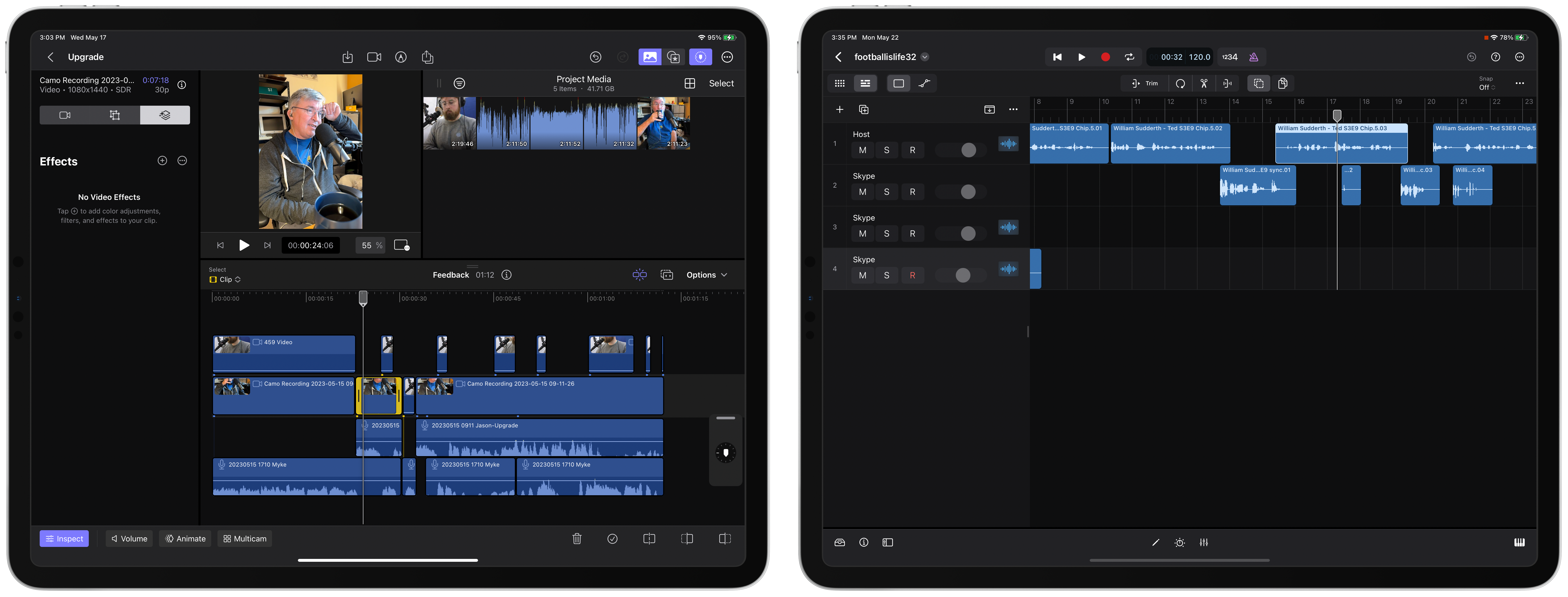
Final Cut Pro and Logic Pro are finally available for the iPad. I’ve had a week to use beta versions of the apps, each of which arrives in the App Store on Tuesday for $5/month or $50/year. And while it’s far too soon to issue final judgments, I’ve definitely got some initial impressions about both of these apps.
Logic Pro: Logical for musicians?
It just wasn’t meant to be.
It’s not you, Logic Pro—it’s me.
I’m not a musician. While Logic Pro on the Mac is one of the apps I’ve used the most over the last decade, I am using it decidedly wrong. I use Logic to edit podcasts, and while it’s perfectly good as a podcast editor, I know I’m not Logic’s target market, nor are its features tuned for me. And that’s only right!
When Apple chose to build Logic for the iPad, it logically focused on music creation and production. The result is an app that I feel like I just can’t judge fairly. I attempted to edit a podcast on Logic on iPad, but the commands I use the most just aren’t there. Splitting clips requires toggling to the separate Split mode, selecting a clip, and swiping down—or alternately, tapping and holding on a clip to bring up a contextual menu, then selecting Split Clip from the Split submenu. Strip Silence, a tool to automatically break long clips into component parts, doesn’t appear at all.
Unlike Final Cut, Logic offers roundtrip support for Logic projects between iPad and Mac. That’s great, but be warned: your Mac project must have saved as a package (if it’s not, you’ll need to use the Save As command to make a project version) and must use the musical grid, not the standard time format. (That’s a very strong hint to anyone who is not a musician—this is not the tool for you.)
Perhaps some of those features will come in time. Perhaps they won’t. That’s okay—Logic is not a podcast editing tool but a tool for musicians. If you are a podcast editor who wants to use the iPad, consider the $30 app Ferrite Recording Studio, which also works on the iPhone and does just about everything a podcast editor would want.
Final Cut Pro: A work in progress
I use Logic a lot on my Mac, but I also use Final Cut Pro all the time. Lately, I’ve been editing short video clips from the Upgrade podcast into videos to share on social media. So I was excited to take Final Cut for iPad for a spin and used it to build video clips from last week’s and this week’s episodes of Upgrade.
Final Cut Pro for iPad doesn’t contain the entire Final Cut feature set and isn’t round-trippable between platforms, though iPad projects are importable to the Mac. I quickly ran into a feature that I use—image stabilization—that just isn’t available on the iPad at this point. You may find some of your favorites missing, too.
While the iPad app’s interface isn’t quite the same as the Mac app, it’s close enough to feel familiar. Performance was never an issue on the M2 iPad Pro I used to test the app—even file exports were snappy. Once I got the hang of it, I was able to edit and export projects pretty quickly, and nobody would ever know that I used my fingers rather than a keyboard and mouse to do it.
However, there’s a lot of room for improvement, even when it comes to Final Cut’s basic touch interface. All the basic editing tools are there, and Apple has come up with some very clever ways to provide touch interfaces for many of them. There are quick-access buttons to turn on multiple selections or to quickly split or trim a clip to the play head. You can choose from multiple selection modes, such as range or clip or edge. Though I was working without any documentation (owing to the apps not being out yet!), I was able to figure out almost everything I wanted to do.
But just because something’s usable doesn’t mean it’s efficient, and that’s where this 1.0 version of Final Cut for iPad falls down. To use Apple’s preferred method of selecting a bunch of clips and then splitting them all at the play head—something I do all the time—required tapping on the selection mode, tapping on each clip in turn, then tapping Done, then tapping the Split at Playhead icon. For a four-clip stack, that meant seven taps every single time I wanted to split those clips.
Dragging items around in the timeline could be frustrating, even when waveforms weren’t turning upside-down and crashing.
The good news is, there’s a bit of a workaround—you have to start dragging with your finger when it’s in an empty area of the timeline and then keep dragging out the resulting selection box until it selects all the clips—at which point you can tap Split at Playhead and get what you want.
Unfortunately, I couldn’t find solutions for other common editing behaviors of mine. Every clip splitting requires a tap in the middle of the screen to select and a tap on the bottom right of the screen to split the clip. Every time I need to toggle between play and pause, I have to tap the play button at the middle left of the screen, which necessitates me holding the iPad in a specific way so that my thumb can hover over the play-pause button most of the time.
These might seem like small things, but every extra gesture, every extra five inches covered, slows down the editing experience. My experience using Ferrite Recording Studio to edit podcasts on the iPad might be instructive: Ferrite lets me split clips by tapping on them and swiping down on the clip with my finger. Two simple gestures, a tap and a swipe, in a single location—much more efficient. Ferrite lets you toggle play and pause by tapping two fingers down on the screen. I don’t want to think about how much time I’ve saved—let alone the creative cost of breaking my concentration!—by tapping with two fingers rather than having to move my hand elsewhere on the iPad screen to hunt for a small play/pause icon.
The app also doesn’t work right when moving tracks within the timeline. I found it exceedingly difficult to slide a clip forward or back without my touch being ignored or triggering an unwanted contextual menu. The only workaround that seemed somewhat reliable was to tap a clip and drag it upward as if I was going to relocate it to a different layer in the stack and then drag it left or right (as a transparent ghost clip) before dropping it back down. Editing by touch was easy—but sliding clips around was excruciating.
I did appreciate the introduction of the jog wheel, a floating interface element that lets you move through the timeline or trip or move clips with precision. I struggled with it conceptually for a few minutes, but after I saw how it worked, I was able to integrate it into my workflow. It certainly helped ease the pain when I was unable to slide clips around by dragging them with my fingers!
A few minutes of editing on an iPad, including use of the jog wheel.
I was similarly disappointed by the app’s seeming indifference to the Apple Pencil. I have come to rely on the Apple Pencil when I’m editing audio on the iPad with Ferrite. It allows a level of precision—both of selection and of gesture—that makes me much faster than I am with my meaty fingers alone. It feels like Final Cut could really fly if the Pencil could quickly split clips and move things around, but right now, it’s almost irrelevant.
I did pick up quite a bit of speed when I snapped the iPad Pro into a Magic Keyboard. Keyboard shortcuts sure can speed things up, and Apple has provided a bunch. Not only was play/pause toggled by the space bar, but I was able to perform familiar Final Cut tasks like splitting clips by typing Command-B while hovering over the proper edit point.
The prerelease version of the app I used could occasionally be quite buggy. At one point, my project crashed something like six times in a row after I attempted to drag an audio clip about five seconds back in the timeline. Sometimes the waveform on the audio clip would display inverted (a bad sign!) just before the inevitable death. Other times, the app would hum along with no trouble for long stretches of time.
Setting a resolution requires tapping a numpad on the screen, even if you have a keyboard.
I also found a bunch of sections of the app that felt very much half-baked. Entering in a custom resolution for a timeline required tapping on a custom number-entry element on the screen, even if I had a keyboard attached. The act of duplicating or editing timelines in a project takes place in the app’s project viewer when I’d expect it to be done in the open project itself. The floating picture-in-picture video preview doesn’t resize to support vertical video.
I couldn’t export a selection, but once I made a new timeline I was able to export my videos quickly and easily.
I was also disappointed by the app’s inability to export the contents of a selection. The only way I was able to export small clips was to duplicate my timeline, delete everything but the short clip, and then export that.
Getting media onto the iPad was also a bit challenging. The video assets for my weekly Upgrade social videos total about 32GB, and while I could probably preprocess the videos to make them a bit smaller, that’s still a lot of data to transfer over Wi-Fi or AirDrop. I ended up connecting my iPad Pro to my Mac and dragging them over using Finder’s file-transfer integration. It was still slow, but less so than all the other methods I tried, short of plugging in an Ethernet adapter.
After quite a few hours in Final Cut Pro iPad, my impressions are mixed. There were moments where I really did get into a groove and felt great about the app—generally when I was using the Magic Keyboard since it gave me access to shortcuts that haven’t been properly translated into the touch interface.
But I also felt a lot of familiar frustration at an app that’s packed with features but hasn’t quite realized that multi-touch gestures and the Apple Pencil can make the process go smoother even without an attached keyboard. The pieces are all in place for Final Cut Pro to become a great iPad app, but it’s still got a lot of growing up to do.
I’m not sure if people are ready for VR (or “XR” as Apple appears to be calling it), but one of the strongly rumored apps is a virtual IMAX screen. Yes, it will be great for movies, but also for sports. I’ve talked about the NBA’s courtside videos on Meta’s Oculus and with a 4K screen instead of the not-HD that even the new Oculus’s (Oculi?) have, it will be even better. I expect the sound will be too, or we’ll just use the AirPods we all have now.
But Apple doesn’t have NBA content… What Apple does have is the MLS, including the rights to do “new and innovative” things, and they have a weekly MLB game….
It’s that one game that I’m focused on. It’s going to need to be more, which means more like MLB.tv than a Friday night game of the week. MLB had one of the first apps on the iPhone and I fully expect that not only will there be a game of the week on the new headset, but also an app that does what the phone app does, except in big, IMAX-sized doses….
The confluence of Apple’s societal dominance, the collapse of RSN’s, and the opening of the VR era – no, really this time – is a potential inflection point inside sports. Not just MLB, but at every level, including the fans.
Needless to say, I’m very interested to see how Apple’s interest in live sports connects to the launch of its new mixed-reality platform.
Last week Joe Posnanski wrote an excellent story about PitchCom (subscription required), the technology that’s now used by Major League Baseball to relay pitch calls between catcher and pitcher. After a century of catchers sticking down one finger for fastball and two finger for curve, two magicians adapted technology used for mind-reading acts to work in baseball.
It’s a fun story, but there’s one technology-related line that made me laugh out loud:
How about using a Bluetooth device so the pitcher and catcher could just talk with each other? Well, in the words of Craig Filicetti, one of the world’s great builders of magic devices, “Bluetooth sucks. It’s completely unreliable and nobody can figure out how to connect and disconnect. It will never be Bluetooth.”
With WWDC and our annual draft right around the corner, it’s time to survey the final rumors about Apple’s AR/VR headset, while also taking stock of some real accessibility developments due this fall. Also: Jason has gazed into the many faces of the Apple TV Quadbox, and Mimestream 1.0 has arrived.
A couple of years ago, my favorite Mac email app—the Gmail web wrapper app Mailplane—was discontinued. After an appropriate period of mourning (which included using Apple Mail regularly for the first time in years), I was desperate for an email app that worked the way I wanted it to.
And the solution presented itself! Neil Jhaveri, who previously worked on the engineering team for Apple Mail itself, founded a company to build a new email app: Mimestream. After a few years in open beta development, on Monday Mimestream 1.0 was officially released.
If you don’t use Gmail as your mail service or need to use the same app across Mac and iOS, Mimestream isn’t for you—yet. I asked Jhaveri what he meant when he said the company will be “turning its attention a bit broader” in the future, and he told me that while the company needed to focus in order to launch a compelling new app, “our mission is to just be the best general-purpose prosumer email client on the market.” That will take time, and the next step is probably an iOS version.
As for support for IMAP email services, it’s also on Mimestream’s to-do list, but right now the app shines because it is a Gmail client through and through, so adding support for the very different IMAP metaphor will need to be done with a lot of care. I do think the app should definitely expand its remit, because it’s very good. But as someone whose top priority was a better Gmail app on macOS, Mimestream was a perfect fit for me on day one—or, technically, two years before day one.
If you’re a Gmail user, Mimestream will be a revelation. Since it was built from the ground up to understand Google’s approach to email, it doesn’t suffer from the weird workarounds required to map an IMAP protocol metaphor onto Gmail’s particular quirks. Instead, it behaves… like Gmail. But in a pure, Swift-driven Mac app.
Most importantly, it uses Gmail’s API to efficiently search my entire Gmail repository. Searching Gmail in Apple Mail frustrates me with its inconsistent and slow behavior, but Mimestream just works. Labels, Inbox categories, server-side filters… it’s got them all.
The app will look completely familiar to anyone who has used Apple Mail. It’s got a multi-column design with mailboxes on the left, a message list in the center, and message content on the right. (And yes, you can close off the message preview if you prefer to open messages in their own windows.)
With version 1.0, Jhaveri and the rest of his team have imported a few features that haven’t appeared before during the app’s lengthy beta, including better multi-account support via a “profiles” system that lets you place multiple accounts into different buckets. Profiles can be toggled on and off using Apple’s Focus Filters feature. Google’s Vacation Responder system is now available directly in the app’s interface.
Don’t let the version 1.0 label scare you. I’ve been relying on Mimestream as my Mac email app for two years, and it hasn’t ever let me down. This is probably the most mature version 1.0 release I’ve ever seen.
The biggest change in going to version 1.0 is that, after two years of using an in-progress email app for free, it’s time for Mimestream to become a real app—with real money changing hands. The app is available as a $5 monthly subscription or a $50 annual subscription. (There’s a 40% discount offer for year one available for the next few weeks.)
As with any productivity app, you’ll need to decide if the price matches your needs. (Mimestream has a page explaining their pricing decision.) Apple Mail is free. Gmail in a browser window is free. But after two years with Mimestream, I couldn’t put down my credit card fast enough.
The headset goes on a real expectations rollercoaster ride this week as Apple clears the deck for WWDC.
The Apple headset is awesome
If you were worried about Apple’s chances in the AR/VR space you can relax because it looks like they’ve got this headset business all sorted.
Word on the street—well, it’s more like an alley, a dark alley where rumors are passed—is it’ll knock your socks off. If you wear them on your face.
I’m not here to judge your fashion choices.
Oculus VR founder and noted rich person Palmer Luckey had this to enigmatically tweet about Apple’s upcoming offering this week:
The Apple headset is so good.
How does he know? Unclear. In what way does he mean? Who knows? Do we care what he thinks? Reasonable people can disagree.
Still: huge, if true.
This, of course, comes after a tester said last month that people would be “blown away” by the Apple headset. So, it looks like it’s going to be a tremendous hit. So good, in fact, that you can just close this tab and not bother reading the next bit.
The Apple headset sucks
I’m sorry did I say the headset was great? Apologies. That was a typo and should have been edited out. What I meant to say is that it’s kind of a mess and Tim Cook has actively tried to distance himself from the project.
The device Cook will present, say people familiar with a development process that spread over seven years, has deviated far from his initial vision. Initially imagined as a pair of unobtrusive eyeglasses that could be worn all day, Apple’s device has morphed into a headset that resembles a pair of ski goggles and requires a separate battery pack.
Apple’s bringing back steampunk. Not that it ever went away.
As always, for those of you watching at home, please remember that…
The stakes are high.
Apple, teetering as it is on the edge of bankruptcy…
Wait.
Look, it seems silly, but a lot of people don’t know that if you write an article about an upcoming product from Apple and you don’t say that the stakes are high, you lose your membership to the Apple pundit gym. It’s a harsh rule, but it was laid down in the early 2000s and it’s hard to change bylaws.
For Cook, it’s the release of a long-awaited product that could be one of his last big swings as Apple CEO…
Tim is apparently about to go out for cigarettes and he’s not coming back.
…and will affect his legacy, either by giving him another major achievement or underscoring the narrative that the company’s biggest victories were initiated under his predecessor, Apple co-founder Steve Jobs.
So, Cook has had “major achievements” but not “the company’s biggest victories”. OK. As an exercise for the reader, you can find charts of Apple’s revenue, profit, and valuation over the last 12 years. Have they gone up or down at all? Just wondering aloud.
It is Tim Cook’s great curse that it was Steve Jobs who introduced the iPhone, the biggest product in the history of products. And the history of history. And histrionics. Did Tim Cook also introduce the biggest product ever? No, he did not. ‘Nuff said.
Michael Gartenberg, a former Apple marketing executive who’s now an independent consultant, warns that the device could be “one of the great tech flops of all time,”…
For his part, Ming-Chi Kuo said Apple is “well prepared” for the device’s release. But that’s largely because it doesn’t think it’s going to sell that many.
Apple expects to sell just one headset per day per retail store…
Apple has 535 retail stores, so…that’s not a lot.
Well, at least we know it’ll either be a huge hit or an absolute disaster. Just like every other Apple product launch ever.
Before we begin…
Apple made a slew of announcement this week, the most important of which was a series of important new accessibility features that will be coming to iOS 17, including Assistive Access—an easy way to get to the things you most often do with your phone—and Personal Voice, a means of recording your voice for future digital use.
The company also said that it’s bringing new concert discovery features to Apple Maps and Apple Music, including Set Lists that show you what songs were played at a particular show. Now you can go home and listen to the songs you just saw performed, in the order you saw them played, instead of all random like an animal.
Some would say that set lists are what separate us from the animals.
Apple also said it had prevented more than $2 billion in App Store fraud. Boy, a billion in fraud, two billion in fraud…pretty soon you’re talking about real money.
Because of both these announcements and those last week, some are expecting the company to unveil its expected larger MacBook Air next week, setting the table for a really big show in June.
Personally, I think if Apple wants to show it has a really big WWDC planned, it should announce the headset next week instead of waiting. That’s how you throw down the gauntlet.
Wait, does the headset come with gauntlets? If not, how will I complete the ensemble?
[John Moltz is a Six Colors contributor. You can find him on Mastodon at Mastodon.social/@moltz and he sells items with references you might get on Cotton Bureau.]