Six Colors
Six Colors

Apple, technology, and other stuff

Support this Site

Become a Six Colors member to read exclusive posts, get our weekly podcast, join our community, and more!


Headset narratives and accessibility drops

Picking apart the business and product narratives around Apple’s probably impending headset and applauding Apple’s continued accessibility feature releases.


Julia’s back at last, so we blast through discussing HBO Max becoming Max, Hulu going inside the Disney+ app, the WGA’s “streaming strike”, the NFL’s Peacock playoff game, and ESPN plotting its inevitable over-the-top service.


by Jason Snell

How I Podcast: Recording (2023 edition)

I am reminded by Reader Donni that I haven’t updated my “How I Podcast: Recording” article since the days of Skype. I don’t use Skype now. I use Zoom. So I made a quick update to bring it up to date.

In short: Zoom is the thing we use now, mostly because Zoom is pretty much universally cross-platform and lets you record every participant’s voice on a separate track. That makes editing a podcast vastly easier—but you should still record your own microphone file locally, because that file will sound better than whatever Zoom sends over the Internet.


Behind Apple’s new voice cloning feature

Fast Company’s Harry McCracken talked to some of the team behind Apple’s new Personal Voice accessibility feature about its development as well as some more fine details:

When it came to enabling third-party apps to speak via Personal Voice, Apple put privacy measures in place similar to those it imposes for photos, location, and other bits of personal data in its care. Such apps can only hook into Personal Voice with the user’s permission, must be running in the foreground, and receive only enough access to read text in the voice, not to get at the data used to generate it.

I’ve been thinking a lot about the privacy implications, but the implementation of this feature certainly seems that it will be harder to abuse than something like ElevenLabs’s voice cloning tech. For example, just having to spend fifteen minutes training the model with a random set of words is going to make it a lot harder to create a model of someone else’s voice without their knowledge, even if it does give me shades of training the ViaVoice dictation software circa 2000 by reading Treasure Island to it.


By Joe Rosensteel

Software subscriptions feel weird, but they work

Creative Cloud isn’t going to win any awards, but the service works.

With the recent announcement of Final Cut Pro and Logic Pro for the iPad we have renewed the same, silly argument about subscription pricing that happens far too often. Without having the apps in hand (literally) there’s very little to say in the way of assessing the value offered by the subscriptions at this time, but there’s plenty to say in favor of recurring payments from behind the safety of this paywalled post (thanks for subscribing).

When Adobe switched to Creative Cloud pricing, there was a lot of sturm and drang, and while it hasn’t been all rainbows and puppies it’s largely worked out for all involved. Yes, Adobe executives have probably bought themselves a nice vacation home, but Creative Cloud has been a success for me, personally. I use Lightroom for my photo hobby, I use Premiere for cutting my demo reel every so often, and I use Audition for editing podcasts.

Let’s unpack why I’m satisfied paying Adobe every month:

  1. The barrier to pay Adobe’s monthly rate was far lower than paying the the upfront cost for Logic Pro and Final Cut Pro in a time where I was uncertain how many months, let alone years of use, I would get out of the apps.
  2. Adobe releases predictable updates. I felt particularly burned by Apple as a loyal Aperture customer, and as someone who used Shake for my jobby-job. Without much warning, someone at Apple decided it wasn’t worth it to make these apps. Would they do that again, to their flagship pro software? Maybe. Aperture and Shake won prestigious awards. Prestige isn’t the whole story.
  3. Familiarity was also important, and I had experience with Premiere from college, so for cutting demo reels it was easier than having to learn Final Cut Pro. Likewise, Audition’s sort-of similarity to Premiere meant it was a more natural fit with my existing experience.

My credit card was put on file, software was downloaded, and Adobe drops in some new stuff every now and then. There’s no major concern about upgrading to a version of macOS and losing my software. (Although Adobe is not always timely with addressing some compatibility issues, they do get there eventually—and I know better than to download a new release of macOS on day one.)

Compatibility? No problem. Adobe lets you install old versions (right now all the way back to version 22.2).

The Creative Cloud a desktop app that pesters me about Adobe stuff is bad, but the underlying service itself? It works as expected. I can turn off auto-updates, or download old versions if I need something for compatibility.

I could have spent less money by knowing ahead of time how wildly successful podcasting would be for me, or by cutting that occasional reel update with a single purchase of Final Cut Pro, but no one really knew how many years of free updates Logic Pro and Final Cut Pro would receive. (I’m not even sure Apple has ever had a clear picture. It mostly just seemed like they didn’t want to add paid upgrades to the App Store so they sheepishly just kept updating the one they sold.) It is an aberration in the world of selling software that Apple has kept investing in these two pro apps with no income from the existing user base.

My point about familiarity might not seem that important when it comes to talking about subscriptions but it absolutely is. Kids generally can’t afford to pay for their own pro software. Back in the day, they might have used cracked codes for downloaded software, but generally their access to pro software would be through the world of higher education. A five-dollar expense makes sure little Braden or Madison is predisposed to consider Apple’s pro software.

The only weird thing is that the iPad announcements didn’t come with any Mac announcements about pricing. Surely, at some point they will need subscription pricing too. It’s been over a decade of free updates for these apps. Deeply unserious people might continue to argue in favor of free updates for apps for eternity, subsidized by RAM and SSD prices from pro Mac sales, but this is an unhealthy business model. It also suppresses competition in the pro app market.

Ideally we should live in a world where if you’re unhappy with your pro software you can cancel your monthly subscription and subscribe to another pro software solution. If you need a specific piece of software for a project as a freelancer, you’re just paying for the timeframe you’re working on that project.

It’s far more predictable to have a monthly recurring fee to estimate your expenses than it is to try and figure out when large sums of money should be plunked down and if you’ve timed your purchase with this year’s NAB conference, and out-of-cycle updates. Particularly if you’re an institution purchasing volume licenses.

Now, one fear that even some sensible people have is this: We might one day find ourselves in a situation where the subscription prices just keep ticking up, or that the software you rely on will be placed inside an expensive bundle of software you don’t need. But those are all fears that could be true in a world of software license purchases, too! Which is exactly why it’s important to have a variety of software vendors with sustainable revenue streams, instead of just Adobe which has the pro bundle of all pro bundles, or Apple which hasn’t seemed all that motivated by drops or gains in app sales.

Perhaps the presence of Apple’s pro apps on the iPad will nudge Adobe to compete for dollars there as well. Other than Lightroom, and now Photoshop, Adobe has only made overly simplified apps for iPad. There’s an Adobe Premiere Rush app, but it’s not Premiere, and there’s not even a toy version of Audition. If Apple just offered their Pro apps for free on the iPad, I doubt Adobe would ever even consider trying harder.

One final point: The App Store is not a free market. Adobe is big enough that it gets to sidestep the App Store with a Creative Cloud login that you acquire on adobe.com, but not a lot of developers get that benefit. If someone has to compete with Apple in the App Store, they do so at an extreme disadvantage for either sales or subs. That dramatic imbalance is really why we should rise up and overthrow our pro app oppressors.

But until then, I’ll just let Adobe charge my credit card so I can focus on getting work done.

[Joe Rosensteel is a VFX artist and writer based in Los Angeles.]


Apple’s new accessibility features, buttons vs. touchscreens, a free ad-supported television set, and whether we’re contributors or lurkers on social media.


By Dan Moren for Macworld

On the heels of new pro apps, where does the iPad go from here?

More than a decade ago, on the heels of the iPad’s announcement, I took to the pages of this very magazine—then still available as a physical object shipped to your home—to describe it as not just a third device, but a third revolution.

And at the time it was: Apple’s attempt to once again remake the idea of personal computing, a thesis it would return to several times in the subsequent years, perhaps most cogently expressed in the “what’s a computer?” ad from 2017.

But in recent years, that future has seemed in jeopardy, as the iPad has entered a kind of holding pattern, like the understudy waiting in the wings that’s never asked to step into the main role. The Mac, which seemed poised on the brink of retirement, not only kept trucking along, but even garnered a late-career resurgence with the transition to Apple Silicon. The iPad’s big break suddenly evaporated.

This past week, Apple once again took a step towards the idea of the iPad as the modern-day computer replacement with its long-awaited announcement of Final Cut Pro and Logic Pro for the platform—but is it too little, too late?

Continue reading on Macworld ↦


By Shelly Brisbin

Apple previews new accessibility features, including AI-generated voice clone

Note: This story has not been updated since 2023.

Live Speech

For the third year running, Apple has offered a preview of accessibility features coming to its platforms later this year. The announcements were timed to mark global accessibility awareness day on May 18. The preview featured several completely new offerings aimed at people with cognitive and speech disabilities, plus updates to existing macOS and iOS features.

These preview announcements don’t come with beta software or release dates, but it’s understood that the new features will appear in forthcoming releases of macOS and iOS. In past years, accessibility updates for watchOS and tvOS have been previewed, but this time the focus was on the Mac, iPhone and iPad. It should be pointed out that these early announcements are often not the only accessibility updates in a given release cycle.

Assistive access

Assistive Access for Messages

For those with cognitive disabilities, navigating the complex iOS interface a challenge. Assistive Access is a simplified, customized UI for the Home screen and some essential apps, including Phone, Messages, Photos, Camera, Music, and TV. Under Assistive Access, the Home Screen is limited to extra-large app icons for supported apps. The app interfaces are simplified, too, with larger text and bolder icons. A user or a caregiver can further set an Assistive Access app to display just the desired information, such as a select group of contacts.

Calls is an Assistive Access app that combines Phone and FaceTime. Messages can work with text, inline video, or an emoji-only keyboard that gives users who are not readers, or who can better communicate with symbols, an alternative to standard typing.

Assistive Access in Photos

Photos and Music each display their contents in a grid that’s “flatter” in structure than the hierarchical interfaces the standard versions of those apps offer.

Assistive Access is the closest Apple has come to an interface designed specifically for people with disabilities or elders—an option that Android has offered via its support for alternative launchers. It will be interesting to see if it’s full-featured enough to not only support users with cognitive disabilities, but also offer a “grandparent-friendly” experience for those trying to choose between and iPhone and an Android phone.

Speech accessibility

Personal Voice

Apple organizes its accessibility features and settings by functional categories: Vision, Hearing, Physical and Motor. Now there’s Speech, too. New features under the Speech heading support those who are partially or fully nonverbal. Personal Voice is an intriguing feature that might seem familiar to anyone who has experienced AI-based text-to-speech that’s been trained on an actual human voice.

Those diagnosed with ALS are at great risk for losing their ability to speak, but often have advance warning. Using Personal Voice, an individual will be able to use an Apple Silicon-equipped Mac, iPhone or iPad to create a voice that resembles their own. If the ability to speak is lost, text the user generates on the device can then be converted to voice, for use in a variety of ways. It will work with augmented communication apps that are often used to make it easier for people with limited speech to be understood. And no, you can’t create a new Siri voice this way. All Personal Voice training is done on-device.

Live Speech can use an existing Siri voice to give people with speech disabilities a quick way to use voice to express common phrases or sentences. Type and save a statement, like a food order or a greeting, then tap the text to have it spoken aloud. It works inside Phone and FaceTime, or in-person, and users can save common phrases.

More detection

The latest detection feature added to the Magnifier app–joining People Detection and Door Detection–is called Point and Speak. It’s designed to identify and read incidental text, like button labels you’d find on a vending machine or a kitchen appliance display. Like the other detectors, Point and Speak is aimed at blind and low-vision users, and requires a LIDAR-equipped device.

Based on the preview announcement, useing Point and Speak will feel similar to using Live text when combined with VoiceOver. What’s new here is that you can drag a finger around a display with multiple text labels and have each read aloud as you encounter it. That makes it a lot easier to correctly choose Coke, rather than accidentally pushing the Sprite button.

Hearing aids on Mac

Last year’s accessibility preview featured a handful of enhancements for hearing aid owners who use an iPhone. This year, Apple says support for Made for iPhone Hearing Aids is coming to the Mac. That’s been a long time coming. You’ll need an M1 or better Mac to make the connection, though.

Clever and targeted

This year’s preview also includes a grab bag of nice updates to existing accessibility features, including updated text size adjustments in macOS and tweaks to Siri voices for VoiceOver users who want to listen at extremely high speaking rates. Voice Control will add phonetic suggestions when editing text.

Several of the preview features clearly benefit from machine learning, and Personal Voice might be touted as an AI-based tool if it came from another company. It feels like an application of the technology that’s both entirely positive for the community it’s meant to serve, and reflective of a pretty nuanced understanding of what that community might want.

[Shelly Brisbin is a radio producer and author of the book iOS Access for All. She's the host of Lions, Towers & Shields, a podcast about classic movies, on The Incomparable network.]


Apple has finally announced Final Cut Pro and Logic Pro for iPad. What does this mean for the platform, what took so long, and is this the end of the story—or just the beginning? Also, the Wall Street Journal gets into the Apple Headset rumor business.


By Shelly Brisbin

Tracking the many social-media migrations

Twitter (left), Mastodon (center), and Bluesky (right).

Last week, I joined Bluesky, the new hotness in social platforms. It’s the latest refuge for those who have beef with the way Elon Musk runs Twitter. Last November, I queued up to rejoin Mastodon, the existing-but-revitalized platform that was the first beneficiary of agita over Musk’s Twitter takeover.

Despite boarding the outbound train relatively early, I still maintain Twitter accounts for myself and the things I make. All that is to say, I’m experiencing these three platforms all at once and finding them very different from one another in more than the obvious ways.

Being on Mastodon feels different than being on Bluesky, which is not like today’s Twitter. This despite the fact that a lot of people besides me appear to maintain accounts and even continue posting on all three. In my feed, the multiplatformers tend to be journalists of the tech and general-interest varieties, along with an array of other content creators. Some folks copy-paste their stuff everywhere, but many seem to understand how easily that behavior rankles. Like me, they’re hesitant to make a commitment to a single platform. And, like me, they’re probably thinking a lot about the kind of voice they want to project on each.

The people I follow because I like them personally are a little more likely to have chosen one place to be active, even if they have accounts spread around. That’s also true of interest-based communities who have collectively decided where they want to pitch their online camps. If I want to talk with fellow classic movie geeks, that’s Twitter. Lots of software developers and accessibility-focused peeps have migrated to Mastodon. The scarcity of Bluesky invites means it’s hard to judge who will make it home. But so far, the place feels like one where people crave seeing and being seen. Somewhere you might go to get followed by a famous person.

These are all logical ways of understanding your place online. Who do you want to reach, and who do you want to hear from? But it’s also true that each of these places has its own personality – a vibe that’s created by users who feel at home enough to contribute their words and pictures and maybe push the envelope in a way that advances their version of a desirable online world. And for my money, some vibes are better than others.

The Blue Bird of Complacency

Twitter rarely did me dirty in my own feed. After more than 15 years there, it was just the place that everyone was; the place where I bantered with other podcasters back in the day, got plugged into accessibility communities for the first time, promoted my books, and figured out how to follow Texas news obsessively on Election night or during the six months every two years the Legislature is in session. Musk’s takeover created a bright line – the beginning of more promoted content, the unwelcome For You tab, making my feed even more algorithmic than it was. In other ways, nothing much changed. Almost every reporter I know still tweets. The classic film bloggers and fans who keep up a running commentary on the movies we love still gather to watch TCM together. And my friends who are both Twitter users and non-tech people keep commenting on traffic or their favorite TV shows. Up until earlier this year, when Musk signaled a lax attitude toward hate speech on the platform, even the few famous-people-accounts I followed were still out there plugging projects or posting pictures of adorable things. It was possible to ignore a lot of how Musk has remade the platform.

You can still ignore it if your feed is well-groomed and you don’t care about legacy blue checkmarks or the API’s destruction of benevolent bot accounts. But it feels fragile, as if one troll or a neglected security feature could break up your happy reality, just as the disappearance of all those cool accounts did for those who’ve already left.

Utopia Has Rules

On Mastodon, the noncorporate, tech-forward dream is still alive. The folks who abandoned Twitter the earliest have plowed enormous energy into their homesteads on the federated plain. They write up intro guides for newbies, consider carefully which server feels like home to them, and wax on and on about the quality of specific third-party Mastodon apps. They boost strangers’ posts and follow liberally. They are earnest and sometimes starry-eyed about the promise of a social network not controlled by one company’s algorithms. Spend a lot of time there, and you’ll start believing everyone has migrated over from Twitter. Or everyone you would actually want to talk to, anyway.

I feel comfortable on Mastodon because I want to live in a world where my data is not currency. But I have seen people correct those who are not embodying the upright Mastodon dream. I had to switch servers when a dispute between major servers and those who ran my old one led to mine being defederated in a few places. I wasn’t asked my opinion or told it was happening. The defederation caused me to lose contact with lots of people I followed. Defederation is a core remedy for conflict over how Mastodon servers are run, but it’s not a very utopian process when it happens with no warning to the community.

School’s Out

If Mastodon is like a Habitat for Humanity build – all goodwill and productive earnestness – Bluesky is like Lollapalooza. It’s loud. It’s irreverent. It’s mischievous. And it’s crawling with people who want to be noticed. You’ll find celebrity journalists, politicians, and entertainment types with adorably low follower counts – because it’s invite-only so far, and those coveted codes are hard to come by. You’ll also find nudity, AI-based thread hijacking, and harassment. Everyone seems to be flirting with everyone and using their outside voices. And it feels like the people who are happiest there are those who bucked up the hardest against Musk’s Twitter regime. Whether you lost your legacy blue checkmark or had your posting bot murdered by the API lockdown, Bluesky feels like freedom, and a lot of its early fans, and the people they’ve invited, are acting like they’re on social media spring break. That’s totally a choice, and one that some folks a bit younger than I am will embrace wholeheartedly.

These opinions are mine, of course, and subjective based on my own feeds. And they’re a snapshot in time. Users come and go from social platforms all the time, and communities can evolve into hellscapes or into vibrant stews of news and information with room for diverse voices. Hopefully, the tools we use to connect can evolve, too, along with community standards. Bluesky doesn’t really have those yet, and users should ask hard questions about their security, their ability to address misinformation and harassment, and the ultimate business model of the place.

Mastodon fans will have to decide if they’ve got access to as many people and as much information as they once did on Twitter, and whether that affects the way they want to use the platform.

Twitter users should probably continue to expect the unexpected.

[Shelly Brisbin is a radio producer and author of the book iOS Access for All. She's the host of Lions, Towers & Shields, a podcast about classic movies, on The Incomparable network.]


By John Moltz

This Week in Apple: Finally Cut Pro

This week Apple gets around to making its own dog food and eating it too, iPhones take over the U.S. market, and it may soon be time for that “Cheers” re-watch you’ve been thinking about for years.

Can I get a “Finally.”?

Yes, this week Apple announced that Logic Pro and Final Cut Pro would be coming to the iPad. Now we can put the rest all the arguing over whether or not you can get work done on an iPad hahaha just kidding—we’re going to be arguing about that for the rest of our natural lives (and unnatural lives, if uploaded intelligence becomes a thing).

In a new move for Apple apps, both will only be available via a subscription, but the prices are quite reasonable at $4.99 a month or $49 a year. You don’t even have to be a professional to afford that. That’s doable even on just a fessional salary.

Because everything has to be taken in the context of products Apple hasn’t announced yet, Mark Gurman speculated that the two apps could conceivably run on the much-rumored Apple headset. I look forward to years of arguing over whether or not you can get real work done on your face.

The company also used the announcement to snare a leaker and the leaker’s sibling using a canary trap consisting of a combination of false release dates for each of the new apps. When the rumor-publishing sibling claimed the apps would be coming on the incorrect dates, Apple was able to identify their sister as the leaker.

Thanksgiving this year is going to be very awkward for at least one family, if it even happens at all.

We’re num-ber one! We’re num-ber one!

The iPhone has had long had a minority share in the smartphone market but now, at least in its home market, that’s no longer true:

While US iPhone shipments also fell, they did so more slowly than the smartphone market as a whole – enabling Apple to boost its market share from 49% in Q1 2022, to 53% in the same quarter this year.

In retrospect, it seems sort of natural that as the smartphone market has matured, the more staid, reliable platform — the one often accused of being boring for not shipping features before they’re completely ready — would start to do better. People just want phones that work.

You know, most of the time.

Smartphone evolution hasn’t completely stalled. This week Google announced the Pixel Fold which, get this, folds. Its screen also has pixels, so who says there’s no truth in advertising?

If we’re keeping track of technologies Apple’s behind in — I have a three-ring binder full of them! — this is considered by many to be another. Ming-Chi Kuo and Ross Young both believe that Apple won’t ship its first foldable product until 2025 at the earliest.

That is if you don’t count iPod socks.

That’s right. An iPod socks joke. I’m bringing it back.

There are at least a couple of reasons for that, though. Apart from Apple’s usual conservativeness in shipping technologies that might not be all there yet, it’s hard to get foldable screens in the kind of volume Apple would need. At the price points foldable phones hit — the Pixel Fold starts at $1,799 — one wonders how many of these screens even Apple would need, but it’s certainly a lot more than Google.

My innie is on strike

Gather ye television shows while ye may, Old Time is still a-flying and, uh, well, there’s a writer’s strike is the point I’m trying to get to, so you might run out of shows this fall. Not only are shows like ”Daredevil: Born Again” and ”The Last of Us” running on those other streaming services affected, but so are shows you get from your favorite fruit-themed company in a very plus manner.

Such as… “Production of Apple TV+ show ‘Severance’ suspended amid writers strike.”

Oh, that’s just great. Now where am I going to get my weekly dose of existential dread and loathing of late stage capitalism? Reality? I mean, yeah, I could do that, but that’s even more depressing than watching “Severance”. Too real, man.

Nobody likes their favorite shows being delayed, but writers are an incredibly important part of the production process and deserve to get paid fairly. As streaming services have proliferated, that hasn’t happened:

Since 2018, inflation-adjusted pay for screenwriters has fallen 14%, according to the guild. For writer-producers, pay has sunk 23%.

That’s not sustainable and it’s not fair.

Look, it’s not like the writer’s union is asking for tips. Cough.

But if any of the writers of “Star Trek: Strange New Worlds” are looking for tips, I have a lot of ideas. Call me.

[John Moltz is a Six Colors contributor. You can find him on Mastodon at Mastodon.social/@moltz and he sells items with references you might get on Cotton Bureau.]


One podcast wedding, two pro iPad apps

John Moltz joins Jason to discuss the announcement of Final Cut and Logic for iPad, including their subscription model and interface choices.


Completing precision tasks on iPad with Final Cut Pro and Logic Pro, our thoughts on AI in retail (in light of the Wendy’s news), Google joining the foldable phone market, and predictions for Apple’s WWDC and the mention of artificial intelligence.


If you thought we were above obvious microphone puns then I’m not sure what podcast you’ve been listening to but it wasn’t this one.


By Dan Moren for Macworld

The must-have accessory for Apple’s AR headset will be an Apple One subscription

As Apple’s Worldwide Developers Conference approaches, so too does the rumored announcement of the company’s much ballyhooed mixed reality headset. Expectations for the device are high—as is the reported price tag—and much of the tech community is waiting with bated breath to see if Apple can deliver a game-changing device where other competitors have foundered.

If Apple does manage to pull a rabbit out of its hat, the company will surely attribute that success to its signature ability to combine hardware and software into one seamless package, delivering a product in the way that only Apple can.

But there’s another element of Apple’s business that will play a big part in whether or not Apple’s headset is a hit, and you don’t have to go very far down the company’s balance sheet to find it: services.

Continue reading on Macworld ↦


By Jason Snell

Final Cut and Logic arrive on iPad: Questions and (some) answers

Note: This story has not been updated since 2023.

Back in November 2015, Apple released the first iPad Pro, and I was hooked. But in the intervening seven and a half years, it’s felt that the iPad’s hardware has constantly been let down by its software—and Apple’s failure to support its own pro iPad hardware with its pro-level apps was a perfect example of the problem.

“At least Adobe is investing in the future of the iPad Pro—something we’ve yet to see from Apple’s own pro software team, which still hasn’t offered versions of Logic Pro and Final Cut Pro for the iPad,” I wrote back in 2018, still lamenting the situation, as I did once again in 2021. When Apple released the M2 iPad Pro last fall, it was able to boast about video performance—but only by trumpeting the third-party app DaVinci Resolve, since Apple’s own video editing software still wasn’t available on the platform.

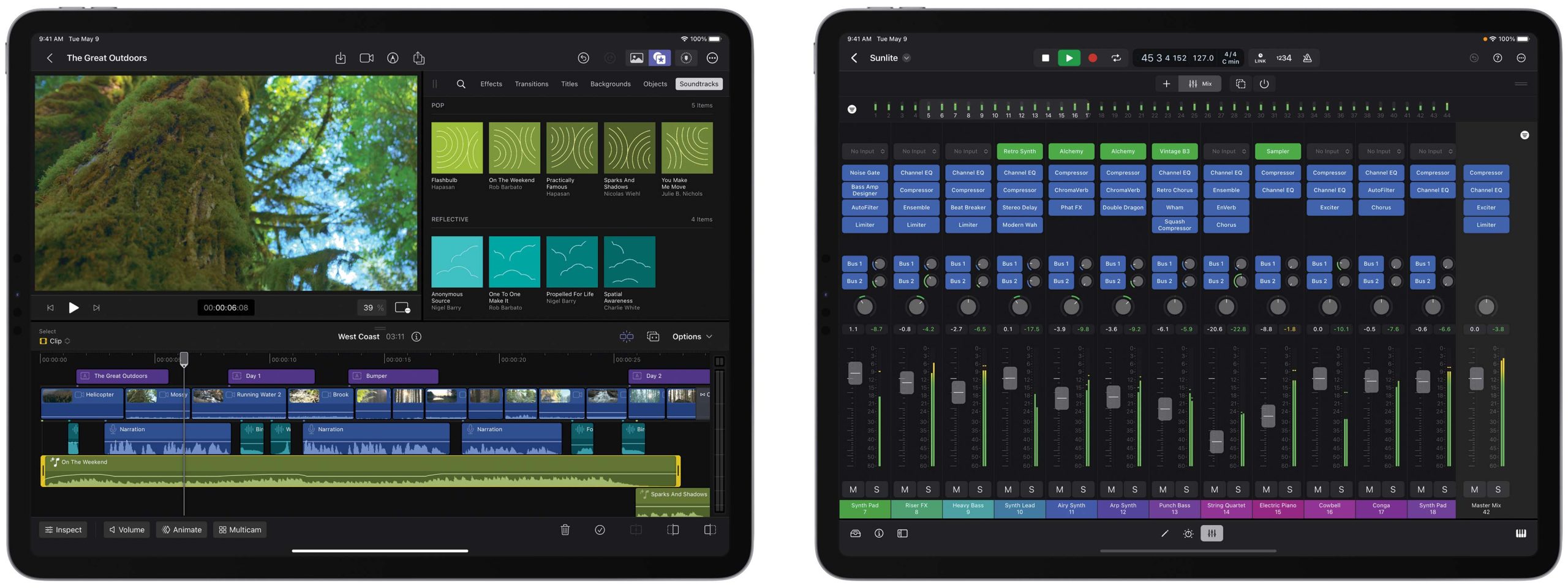
That all changes this month. Apple announced on Tuesday that Final Cut Pro and Logic Pro are coming to the iPad starting May 23. And beyond the obvious “what took them so long,” I had a lot of questions about both of these apps. Fortunately, I’ve got answers to some—but definitely not all—of them. (For the rest, May 23 is two short weeks away.)

What took them so long?

I said beyond the obvious one! I honestly don’t know, though it’s clear from what I’ve seen that Apple has put an enormous amount of effort into both of these apps. I really wonder what finally made Apple decide to build and ship iPad versions of these apps. (Surely it’s not a project seven years in the making!)

How different are these apps from their Mac counterparts?

Really different in a lot of ways—while also being strangely familiar. Apple clearly intends them both to be touch-first apps, just as the iPad itself is a touch-first device. You can swipe up and down in the center of the Final Cut Pro window to make the timeline larger (and the preview window smaller) or the reverse. A swipe from the left side in Logic makes the channel strip labels and controls wider, and there’s a loop navigator that can slide in from that side, too.

Apple seems to have done just what you might expect: these are apps that are familiarly Final Cut Pro and Logic Pro but modified to support touch gestures. I was especially impressed with the new jog wheel interface in Final Cut Pro, which lets you place a circular interface element on either the left or right edge of the screen and use it to move quickly (or slowly!) through the timeline.

But just as what makes the iPad special is that it’s not just a touch tablet but can take other forms, these apps also seem to embrace those other forms. There’s full support for Apple Pencil, and when you put the iPad Pro in a Magic Keyboard case or attach a keyboard, the app will use familiar keyboard shortcuts and responds to the trackpad-driven pointer as you might expect.

Due to the limited size of the iPad’s display, some items have been relocated—the Logic Pro mixer is its own window, for example—but everything seemed usable, even on a smaller iPad Pro. (I use Final Cut Pro and Logic Pro on a 13-inch MacBook Air without any trouble, so this shouldn’t be an issue—and it isn’t.) That said, the moment I saw Final Cut Pro running on an iPad, I immediately saw the potential of Apple making an iPad Pro with a larger display.

After seven years of editing podcasts on the iPad using Ferrite Recording Studio, I’ve come to appreciate the productivity enhancement that comes from using multi-touch features as the touch equivalent of keyboard shortcuts. The moment I configured Ferrite to toggle playback on and off by using a two-finger tap gesture, my productivity soared. At an initial glance at video demonstrating these apps, I didn’t see any hint of such gestures. But if users have to reach up to the top left corner of one of these apps every time they want to pause or play a video, it will get old really fast. I hope Apple has embraced multi-touch gestures—and if they haven’t, I hope they get with the program soon.

Are these apps compatible with their Mac equivalents?

Logic Pro appears to be more or less directly compatible. According to Apple’s press release, you can roundtrip projects back and forth between Logic on Mac and Logic on iPad without trouble.

Except… there’s just one thing. Many Logic users also use third-party audio plug-ins. You may not know it, but iPadOS supports Apple’s Audio Unit plug-in format and has for a while now. I’ve been using plug-ins inside Ferrite Recording Studio for years now. (And while the early days were pretty shaky, plug-ins are much more reliable today.)

The only catch is that the maker of the plug-ins you rely on must make iPad versions available, or your “roundtrip” Logic project really won’t be. Some pro filter makers, like FabFilter, support the iPad. Others, like iZotope, seem to not have even heard of the iPad. Your mileage may vary.

The compatibility story with Final Cut Pro is less good. You can import Final Cut Pro projects into Final Cut on the Mac in order to take advantage of object tracking and other pro features. That last sentence contained numerous red flags—I hope you caught them.

Final Cut Pro for iPad seems to be a subset of the Mac version. You can start on iPad and move to Mac, but the migration won’t work the other way, and a bunch of features from the Mac just aren’t there on the iPad.

This is disappointing. Yes, the lack of feature parity is unfortunate—but perhaps a bit understandable? But as someone who rarely uses those pro-level features, it’s also frustrating to realize that even my simple projects won’t be portable in case I need to leave home and run off somewhere with an iPad.

Still, there are a lot of cool features that did make it to Final Cut Pro for iPad, including multi-cam support (up to four cameras) and a bunch of “fast cut” features, including a nifty scene-removal mask. There’s also a machine-learning-driven “auto crop” feature that analyzes your video and chooses the best crop to preserve the content across different aspect ratios, like when you’re pulling 16:9 video into a vertical project.

Do these apps mean iPadOS’s sound subsystem has been improved?

iPadOS’s sound subsystem is remarkably rudimentary, as anyone who has tried to play audio from more than one app or record video while also playing back audio has discovered. There are some rumors out there that iPadOS 17 might give the iPad a serious audio upgrade, and I hope they’re true.

I doubt any major sound improvements will surface in iPadOS this month, but it is worth noting that Apple’s press release specifically says that these apps require iPadOS 16.4. That suggests to me that at least something in one or both of these apps requires a little bit of a modification to the operating system in order for them to run smoothly. (Third-party app developers wait for years for Apple to address roadblocks in its operating systems. Apple’s apps release alongside an OS update. That’s the ultimate advantage of being a first-party app.)

What will they cost?

These apps mark what I assume is a long-term policy shift with Apple’s pro media apps, joining tech giants such as Adobe in offering them only via subscription. Apple says each of them will cost $5 a month or $49 a year, and as always, there’s a free one-month trial. There’s no bundle discount, nor are they available in a bundle with their Mac counterparts.

Insert your own debate about subscription software here. Some hate it; some love it. I think, in many ways, it makes sense for apps that are on a pretty constant update schedule (as the Mac versions of these apps are), and I like the idea that you can buy a few months of Final Cut Pro for a project and then stop paying when you’re not using it. Then again, it also commits you to $49 a year — or $98 for both — for as long as you use the apps.

Whether that’s worth it is up to you. But I have to believe that this is the future of the Mac version of these apps, too.

Do these releases validate the iPad Pro as a product?

I love the iPad, but it’s true that in recent months I’ve begun to wonder if Apple truly believes that the iPad is the future of computing. I do think that Apple believes in the iPad Pro as a versatile, productive computing device—and that these apps help fulfill the promise inherent in the sheer power of the top-of-the-line iPad. (Logic Pro will also run on iPads powered by the A12 Bionic or later, but Final Cut Pro requires an M1 or M2 model.)

So, a promise has potentially been fulfilled. I want to praise Apple for (presumably) shipping these apps while also pointing out that it’s taken seven-plus years from the original iPad Pro announcement to get them out the door. There are still some serious questions about what Apple sees as the future of the iPad Pro. But as of this announcement, one big question mark has—finally!—been resolved.


Search Six Colors