After the company was repeatedly called out by Greenpeace for poor performance on environmental issues, it began a process to detail all the ways it was being green, including that now-familiar slide that appears at the introduction of every Apple product detailing how it’s made from recycled materials, doesn’t contain toxic byproducts, and more. You know the one.
But in recent years Apple has also become an expert at a different kind of recycling. The company has found strategic advantages in designing an increasing amount of its hardware in-house-and then, to make the most of it, it uses that hardware again and again in different products.
The most obvious example, at least this month, is the Apple Studio Display. It has the same Center Stage camera system that is in every current iPad model, the same A13 processor as numerous iPhones and iPads, and even runs a version of iOS behind the scenes. It’s not just the display’s aluminum that’s 100 percent recycled-most of its technology is, too!
Deeply sympathetic as I am to the goals of the right-to-repair movement, and deeply frustrated as I am by Apple’s storage prices relative to other high-end SSDs, Miani’s conclusions are based on incorrect assumptions about how modern Mac SSDs work. It’s also likely that these modular SSD slots actually do facilitate easier upgrades and repairs than, say, desoldering NAND chips from a logic board and soldering on higher-capacity NAND chips. There are just caveats you need to be aware of first.
This article explains, in detail, how Apple has chosen to structure its SSDs (the controller is in the M1 system on a chip) and why Apple has chosen to pair chips to individual systems for security reasons.
The fact remains: I suspect that sometime, someday, a trained tech might be able to expand the storage in a Mac Studio. But it’s not as simple as buying two Mac Studios and swapping in a different module.
Back in late 2000—unfortunately, I don’t have any email archives from this period—we were planning a cover story about Mac customization. Written by Christopher Breen, it recommended utilities like James Thomson’s DragThing and St. Clair Software’s Default Folder. In the era of OS 8, this story also discussed utilities for adding items to the menu bar and changing the appearance of the Mac interface (via Greg Landweber and Arlo Rose’s Kaleidoscope utility).
I’m sure our circulation consultants had told us that how-to covers were big sellers, so we went with “Customize Your Mac” as our cover line. For the art, we hired four models—a rare and fun situation—and did a photoshoot in which one posed with a Mac that had been “customized” visually to get across the idea that you could make your Mac represent your personality. A cowboy was roping an iMac on which we stuck cow spots. A hippie-esque woman in a yoga pose with flowers in her hair sat in front of a psychedelic-patterned iBook. A Neo-like dude in red-tinted wraparound sunglasses held an orange Power Mac G4 Cube. And a woman in a pinstriped suit clutched a pinstriped Wall Street PowerBook.
At some point, one of our production people had revealed that it was relatively easy to print multiple covers of the magazine. We frequently did subscriber-only covers that were a little more sedate and newsstand covers that were more aggressive to get the attention of people browsing on the newsstand.
In the case of the February 2001 issue, though, we were so enamored with the models that we decided to do three covers: the Cube Dude would go to subscribers, and the newsstand would get a 50/50 split between the cowboy and the flower child. (Apparently, multiple covers lifted sales because some people would buy both, either because they were collector’s items or because they thought it was a different issue. Oh, magazine business, so silly!)
Anyway… in those days, the president of Macworld was our conduit to Apple, in the sense that when Steve Jobs was mad at us, he was the one Steve would call.
I don’t know if it was Steve, but someone at Apple absolutely freaked out about our Customize Your Mac covers. They threatened legal action. They claimed that by “defacing” Apple’s Macs by dressing them up in costumes, we were violating their trade dress and their copyrights and literally any other ludicrous argument you could possibly make. Sabers were rattling.
As editors, we were baffled. Apple had never complained about anything we’d done on the cover since I’d been at Macworld. (And it wouldn’t do it again until we depicted a smashed and smoking Power Mac G5 in a 2005 cover titled “Prevent Mac Disasters.” They complained about that one, too. It was still silly and precious to complain about a photo illustration in a magazine, but at least I could understand that they didn’t like the implication that a G5 could explode!)
But… why did the cowboy and the flower child make them so mad? We just didn’t understand.
Months passed. Keep in mind, the February 2001 issue of Macworld was actually released in early January and mailed to subscribers in late December. (Oh, magazine business, again so silly!) And then, in February 2001, Apple announced some new iMacs.
Photos by Stephen Hackett.
They were called Blue Dalmatian and Flower Power. And while the polka-dotted Blue Dalmatian iMac doesn’t really resemble our dumb cow iMac1, that Flower Power iMac was awfully similar in concept to our hippie girl’s psychedelic iBook.
That’s when it began to dawn on us. This was why Apple was so freaked out about our dumb “Customize Your Mac” concept covers. They thought we were (accidentally!) spilling the beans on their forthcoming announcement. Not only was there nothing to be done, but it also didn’t amount to anything in the end. An already off-sale Macworld cover would not make any difference in how the world would greet these two iMacs.
It was almost the end for the G3 iMac. There was one more update in the summer of 2001, and Blue Dalmation and Flower Power were nowhere to be seen. The final iMac shades were Snow, Graphite, and Indigo.
It was much more the trade dress of cow-themed (really!) PC clone maker Gateway 2000. ↩
Jason’s got the new Mac Studio and Studio Display and it’s time for his complete review. We also discuss where the M2 chip might appear, and what the Mac will look like in 2023.
In our YouTube video on Thursday, Dan relayed a question from a listener asking if the Studio Display supported automatic rotation. I grabbed the screen and twisted — and nothing happened. Oh well! Maybe it’s a VESA mount thing.
But, being right-hand dominant, I had chosen to lift with my right hand and rotate with my left—moving the display counterclockwise, placing it on what was the left edge. This morning, after receiving a report from Six Colors member Kyle, I went against every instinct and rotated the display clockwise, placing what was the right edge on my desk.
Yep. Automatic rotation engaged immediately! That is a… very tall display.
And yes, the Studio Display’s built-in webcam also did the right thing and rotated accordingly, though of course it’s now positioned much lower, halfway up the right side of the display.
I’m looking forward to receiving my VESA-mount version of the Studio Display next month and trying this out, though I’m not sure there’s any scenario in which I’d use vertical orientation on a 27-inch display. (I love it for writing on my iPad Pro, but in that orientation a 12.9-inch iPad is 11 inches tall, while the Studio display is 24.5 inches tall.)
[Update on the Update: Yes, Center Stage works in vertical orientation. And the speakers don’t seem to change their behavior at all—sound was coming out of the left side of the display, with the “left” audio at the top and the “right’ audio on the bottom.]
I wasn’t expecting one of the bigger reactions to my Mac Studio review to be my aside about the power strip I’ve been using for more than a decade, but that’s what happened! Here’s what I wrote:
Funny thing about Apple silicon: Apple’s not kidding about power consumption. For 15 years, I’ve used an auto-switching power strip in conjunction with my desktop computers. When the computer turns off, the power strip automatically turns off many other devices—powered speakers, USB hubs, you name it.
The Mac Studio, even with its powerful M1 Max processor, freaked the power strip out. It kept clicking between on and off states because the Mac Studio uses so little power compared to a traditional computer that it dips below the power strip’s threshold. (I just ordered a new power strip with an adjustable threshold.)
The power strip in question was the APC Power-Saving SurgeArrest, which Amazon tells me I bought in April 2008, right after I read about it in a David Pogue New York Times column. APC doesn’t make it anymore, but they do make larger and smaller follow-on versions. Those new power strips have a feature mine did not: a switch to change the auto-switching threshold to a much lower level, “for Chromebooks.” But maybe it would work with the power-sipping Mac Studio?
I decided to go in another direction and bought a $20 Smart Strip. It’s got four switchable outlets (and two always-on outlets, which I need!) and a little plastic screw you can turn with a small screwdriver to adjust the power threshold. (Bonus: It doesn’t have the awkwardly placed switch that the last one had, which led to sudden power cuts on my desk at inappropriate moments.)
I plugged the Mac Studio into the strip’s control outlet and a floor lamp into a switchable outlet, then gradually turned the control screw clockwise until the lamp turned on. That seems to have done the trick. I’ve mounted the Smart Strip under my desk where the APC model used to be, and it’s shutting down other devices when I shut it down. It goes to show you how little power draw an M1 Mac, even an M1 Max model, can have in normal operation.
These switches are pretty great. Yes, they save power by turning off unnecessary accessories like monitors and USB hubs, but they can also save your sanity. For years I used an iPod Hi-Fi as my external computer speaker, and before that, I used a pair of Altec Lansing computer speakers. Both had the unfortunate quirk of making a low buzzing noise when they were powered on while the computer they were attached to was shut down. The smart power strip ensured that when the computer went off, so did they.
When it comes to iPhone upgrades, Apple is incremental. So are iPhone reviews. Those of us who review iPhones are, for understandable reasons, focused on what’s new between this year’s model and the last.
Fortunately, Apple’s release of a new iPhone SE in March 2022 is an opportunity to zoom out and take the long view. Most people don’t buy a new iPhone every year. The primary upgraders to the third-generation iPhone SE will be coming from older models. So here’s an attempt to provide a little more of a big-picture overview for owners of older iPhones who are wondering what’s new in the iPhone SE.
Studio Display reviews, Mac Studio, and Dan’s iPad
Jason’s spent a week with new Apple products. Lots of opinions about what’s wrong and right with the Studio Display. Jason third-thinks his Mac Studio purchase and comes out ahead.
Matter, the new smart home interoperability standard being developed by Google, Apple, Amazon, Samsung, and others, has been delayed. Again. Expected this summer, the launch has been rescheduled for fall of 2022, Michelle Mindala-Freeman of the Connectivity Standards Alliance (CSA) which oversees Matter, told The Verge.
CSA claims that the delay is because a lot more platforms than expected are planning on building in Matter support, which certainly makes it sound like a good problem to have, although given that the second part of the explanation is that the software development kit (SDK) needs more time makes me wonder which one of those is truly responsible. That said, they are promising a complete SDK in the second quarter of the year, with a spec to manufacturers by the end of June.
So we’ll need to wait a bit longer for our interoperable smart home tech, which is a bummer on one hand, but on the other, seems totally predictable. These things never launch on time.
On Thursday Jason and Dan went on YouTube and talked about the new Mac Studio and Studio Display and answered your questions. Here’s the video in case you missed it:
Apple’s most popular devices come with their own displays. The iPhone, iPad, MacBook, and iMac can all be used right out of the box. In some ways, it’s the ultimate triumph of the original iMac’s “there’s no step three” ethos.
But some Macs—the Mac mini, the Mac Pro, and the new Mac Studio—don’t play by these rules. They’re old-school computers, and you need to bring a display to the party. If you’re a Mac laptop user, you might want to sit down at a desk sometimes and spread out in front of a larger screen. An external display is just what the doctor ordered!
Apple used to recognize these facts and made Apple-branded displays that were a good fit with their current products, both in terms of style and of onboard technology. But in the mid-2010s, just as Apple was losing its way in terms of Mac product design, it also abdicated its role as the maker of monitors for Mac users.
The idea was that a vibrant market for external displays already existed and that Apple didn’t need to be involved. Other companies would fight over Apple’s customers and compete to make great displays for them.
That didn’t happen. Instead, there were a few Mac-focused displays that people liked but didn’t love and a whole bunch of PC displays at resolutions that weren’t a good fit with how Apple has defined the Mac Retina display experience.
Just as Apple’s getting the Mac back into shape, it’s also returned with an external display designed for just about any Mac user who might want a little more screen space on a desk. The $1599 Apple Studio Display isn’t cheap, and it isn’t perfect, but who’s complaining? This is the monitor that Mac users have deserved for years, and it’s finally here.
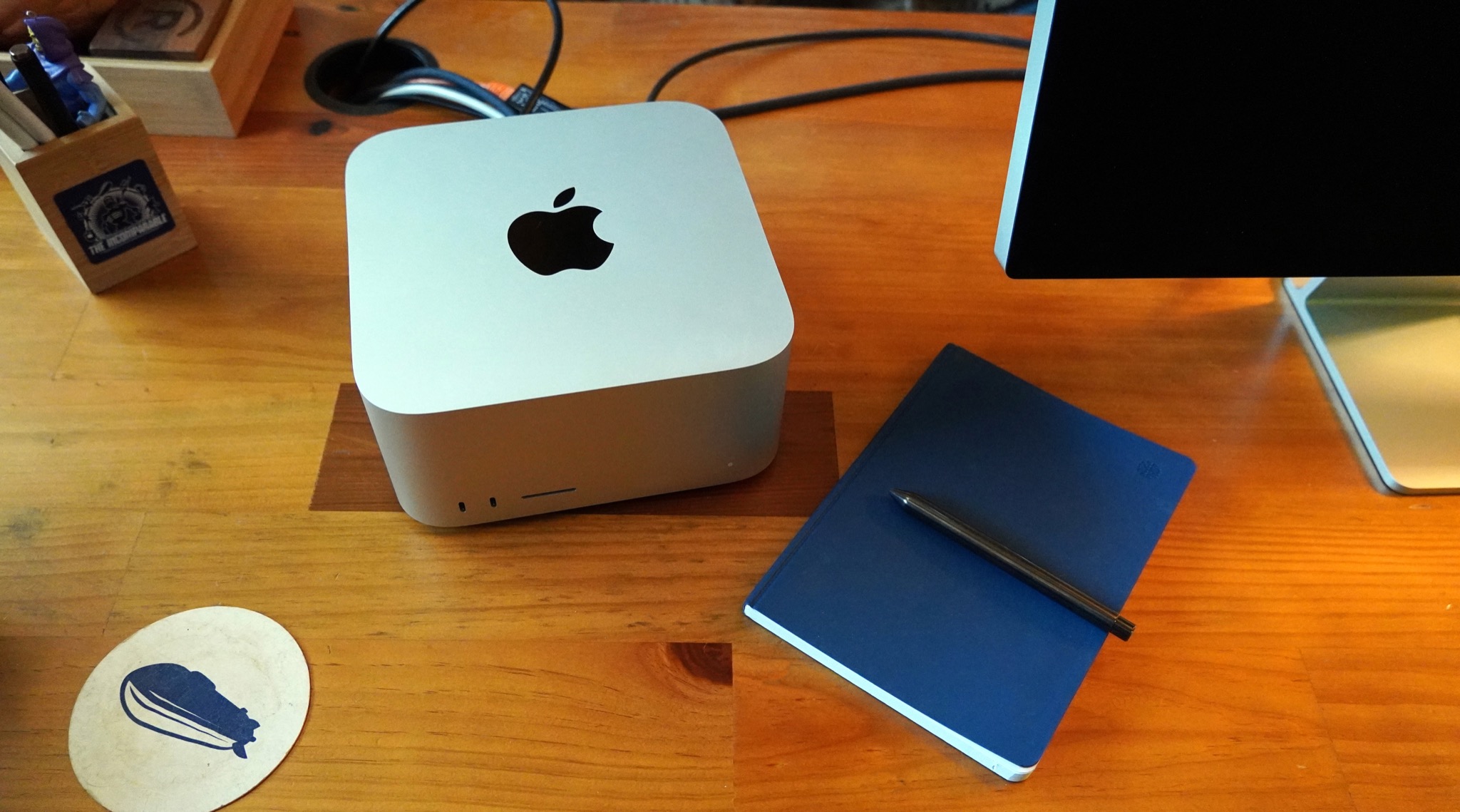
The Mac Studio is the first entirely new entry in the Mac product line in a very long time. It’s a kind of Mac—the mid-range-desktop—that used to be common, but vanished shortly after Steve Jobs returned to Apple. It’s more powerful than an iMac or Mac mini but more affordable than a Mac Pro.
The Mac Studio isn’t for everyone, that’s for sure. Some will find it utterly boring—but others will consider it the fulfillment of a decades-long dream. For the moment, it’s the fastest Mac ever made—and yet if you’re a MacBook Pro user, you might find that your laptop offers equivalent performance.
The beauty of the Mac Studio is, I suppose, in the eye of the beholder. I bought one for myself on the day the product was announced, and after a week of using one provided by Apple, I’m sticking with that purchase, but plenty of people will be better served by a different Mac model. In fact, that might be the most beautiful thing about the Mac Studio: It fills a very specific ecological niche to perfection.
Our experience with game streaming services, our thoughts on Elden Ring, whether we order tech online or choose to pick it up, and the products we purchased from Apple’s March event.
There comes a time in one’s life when, no matter how long one puts it off, one must buy a new iPad. For me, that day came immediately following last week’s Apple event, at which the company unveiled the fifth-generation iPad Air.
But, before you ask: no, I didn’t buy an iPad Air.
I was tempted, I must admit. Given that the previous generation of iPad Air already had many of the great features of the iPad Pro (as Jason has pointed out), but at a lower price, it seems like an obvious choice.
What ended up tipping me over the edge, however, was the one thing that Apple didn’t change. Like its predecessor, the base $599 model of the new iPad Air comes with just 64GB of storage.
As I was weighing my options, I took a look at my current iPad Pro, the 10.5-inch model from 2017. Despite having a spacious 256GB of storage, I was using only around 60GB. Which, yes, is less than 64, but not enough so that I wouldn’t have to constantly police how much stuff I had on it. (I’d already enabled a bunch of space-saving measures, like letting iPadOS offload apps that I don’t launch regularly.)
So, I was clearly going to need more than 64GB. Unfortunately, upgrading to a 256GB iPad Air raises the price to a decidedly less cheap $749. More to the point, that’s just $50 short of the 11-inch iPad Pro with 128GB of storage.
At that point, I had to ask myself some hard questions. For $50 more than that 256GB iPad Air, I could not only get a probably sufficient 128GB of storage, but also pick up all those extra features that the Air lacks: Face ID, a ProMotion display, better rear-facing cameras, Thunderbolt, and so on. Were those features worth $50, especially compared to storage space that I wasn’t likely to use?
The answer, for me, was an unequivocal yes. Don’t get me wrong, the new iPad Air’s a great device. But as someone who enjoys the finer tech in life, I couldn’t resist the lure of all those step-up features. If I end up keeping this iPad as long as I did my last one, I don’t want to feel like my technology is falling behind.
So far, in the day that I’ve had it1, I haven’t been disappointed. As with any piece of technology, there’s a delight to upgrading to a many years’ newer device, giving you several models’ worth of new features. Though I am still retraining myself not to look for the Home button, and not to accidentally cover the camera when I want to use Face ID.
If there’s anything that I’m missing from the Air, it’s really down to a matter of aesthetics: honestly, I like the colors, and it’s a disappointment that the iPad Pro doesn’t offer more than staid old silver and space gray. (I’m sure Apple will release a version of the Pro with colors within the next year, just to shame me for not waiting longer.)
Despite the added expense of the Pro, I did cut my costs in a few ways. For one thing, I stuck with the Wi-Fi-only model: Convenient as cellular may be, I rarely go some place with my iPad where I need Wi-Fi but there isn’t any.2, and in those few cases, it’s just as easy for me to tether to my iPhone. I also decided not to immediately buy a second-generation Apple Pencil or Magic Keyboard, given that they actually go on sale not infrequently these days, and I don’t need them right away. Instead, I bought an inexpensive cover to protect it until I probably end up upgrading to the Magic Keyboard. But hey, at least it comes in green.
Interestingly, I put my order for the iPad in directly after last week’s Apple event, and it told me it would ship between March 16th and March 23rd. When the 15th rolled around and it still hadn’t moved from the “Processing” stage, I decided to pull a Snell and check my local Apple Store inventory. Sure enough, they had the exact model I wanted in stock—128GB Wi-Fi in Space Gray—so I canceled my online order and made a new one for pickup. A couple hours later, I’d returned with my new iPad. ↩
These days, if I’m going somewhere without Wi-Fi, it’s because there’s no Wi-Fi. That’s a feature, not a bug. ↩
[Dan Moren is the East Coast Bureau Chief of Six Colors, as well as an author, podcaster, and two-time Jeopardy! champion. You can find him on Mastodon at @dmoren@zeppelin.flights or reach him by email at dan@sixcolors.com. His next novel, the sci-fi adventure Eternity's Tomb, will be released in November 2026.]
The new iPad Air is coming this week. It’s an enticing mid-range iPad for people who don’t need the extra features of the iPad Pro but want something bigger than the iPad mini and better than the base-model iPad.
What it isn’t is new. The iPad Air offers features that premiered on the previous-model iPad Air (released in October 2020) and the 2021 iPad Pro. So just as the iPad Air remixes features from other iPads, this review is a remix of my previous reviews of those other iPads.