Six Colors
Six Colors

Apple, technology, and other stuff

This Week's Sponsor

Magic Lasso Adblock: Effortlessly blocks ads, trackers and annoyances on your iPhone, iPad, Mac and Apple TV

By Jason Snell

Charting the course of the M5 processor

Image of Apple M5 chip: left, black square with 'M5' and Apple logo; right, detailed circuit layout with 'M5' label.

This week’s Apple updates are, to some quarters, boring. Yes, it’s true, there were no real exterior changes this week. Instead, it was just another new Apple-designed processor, with the usual, boring set of speed improvements.

As Stephen Hackett noted, this is what we wanted, what Mac users were desperate for in the Intel days:

A predictable update schedule means that incremental updates are inevitable. Revolution then evolution is not a bad thing; it’s okay that not every release is exciting or groundbreaking. It’s how technology has worked for decades.

…but some people have short memories. Before the Apple silicon introduction, we all wanted steady, predictable progress in Mac hardware development. We wanted each product in the lineup to be updated regularly and not wither on the vine for years. For the most part, Apple has delivered. Just look at this chart of the progress Apple has made since the M1 on the CPU side of things:

Stephen’s post contains some charts, disappointingly not in some sort of 512 Pixels style where all the “colors” are different Atkinson dithers of gray. Maybe next time.

It reminded me, though, that I have tried to build some charts to help visualize how Apple’s chip progress is going. I wrote about this for the A series of chips back in September. Here are the requisite M series charts:
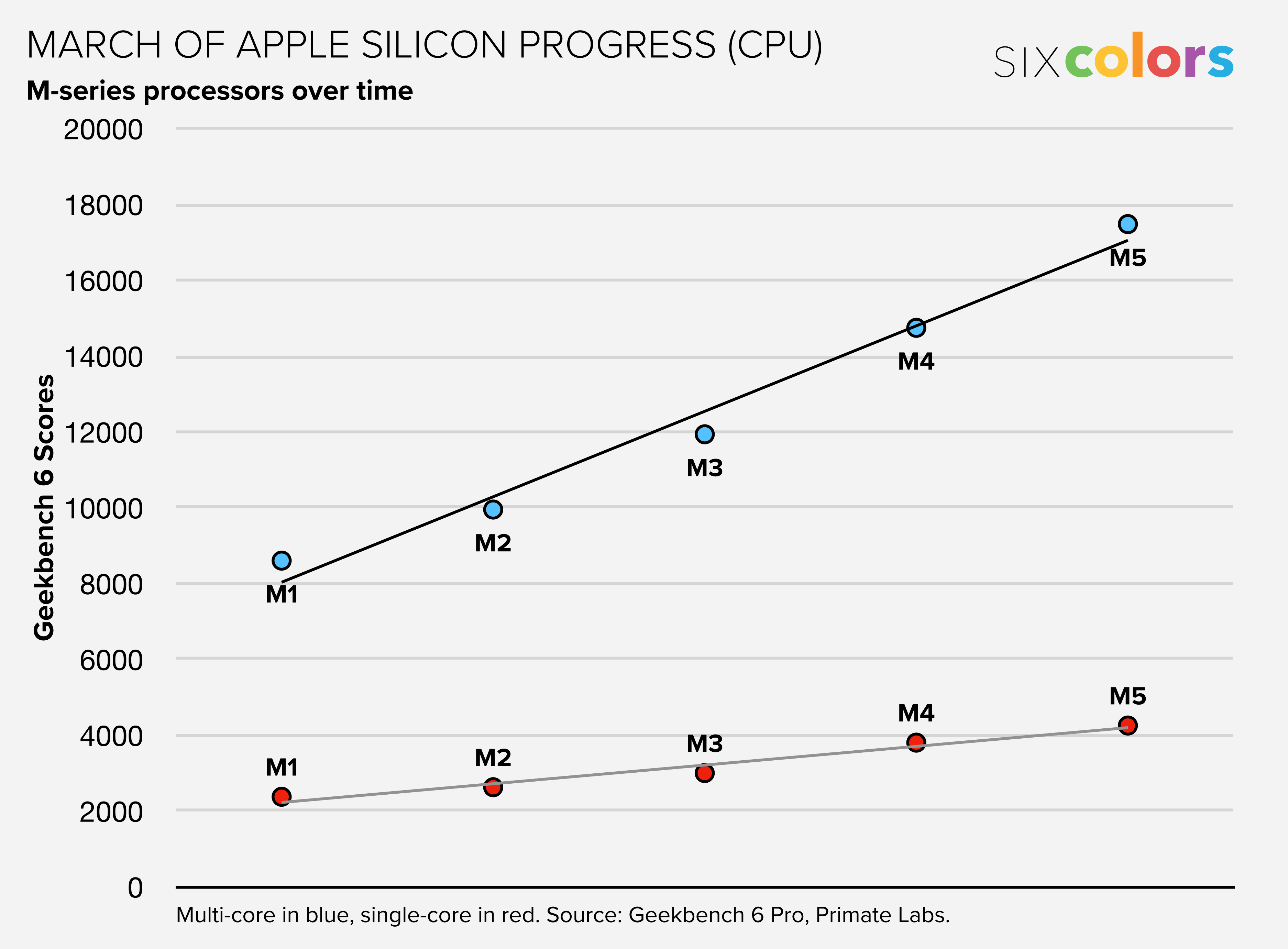
It’s nearly impossible to isolate the rise in the speed of Apple’s two different kinds of CPU cores, and over time, it tweaks one or the other and changes the mix of both, but obviously each individual core gets faster and the gestalt over the entire processor, whether it’s got eight or ten CPU cores, is a more dramatic move upward.
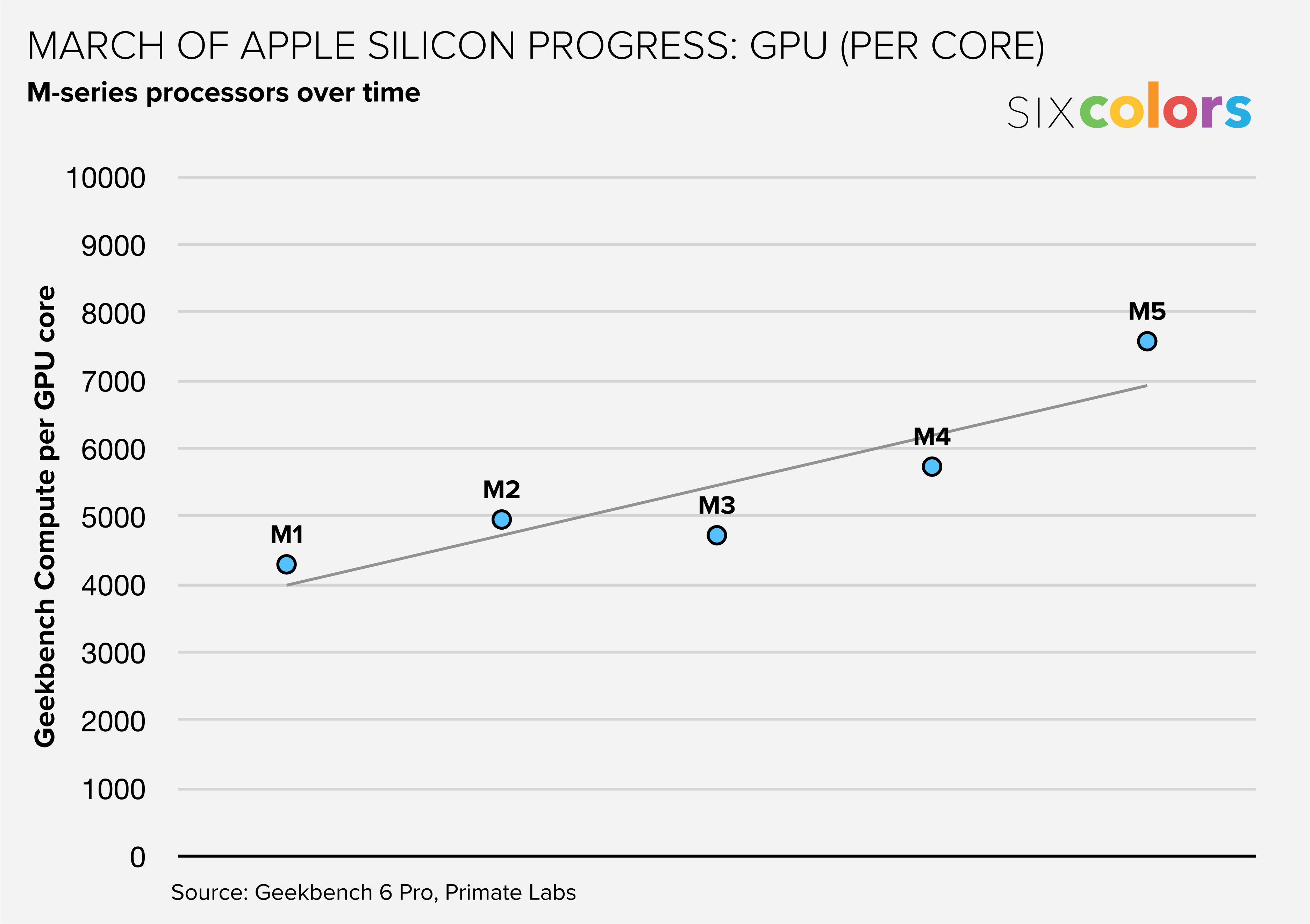
In the second chart, I’ve divided the Geekbench GPU score by the total number of GPU cores on the system to create an isolated view of per-core GPU performance. As with last month’s A19 Pro release, it’s clear that this generation offers a “standard” bump for the CPU, but a more impressive one for the GPU.
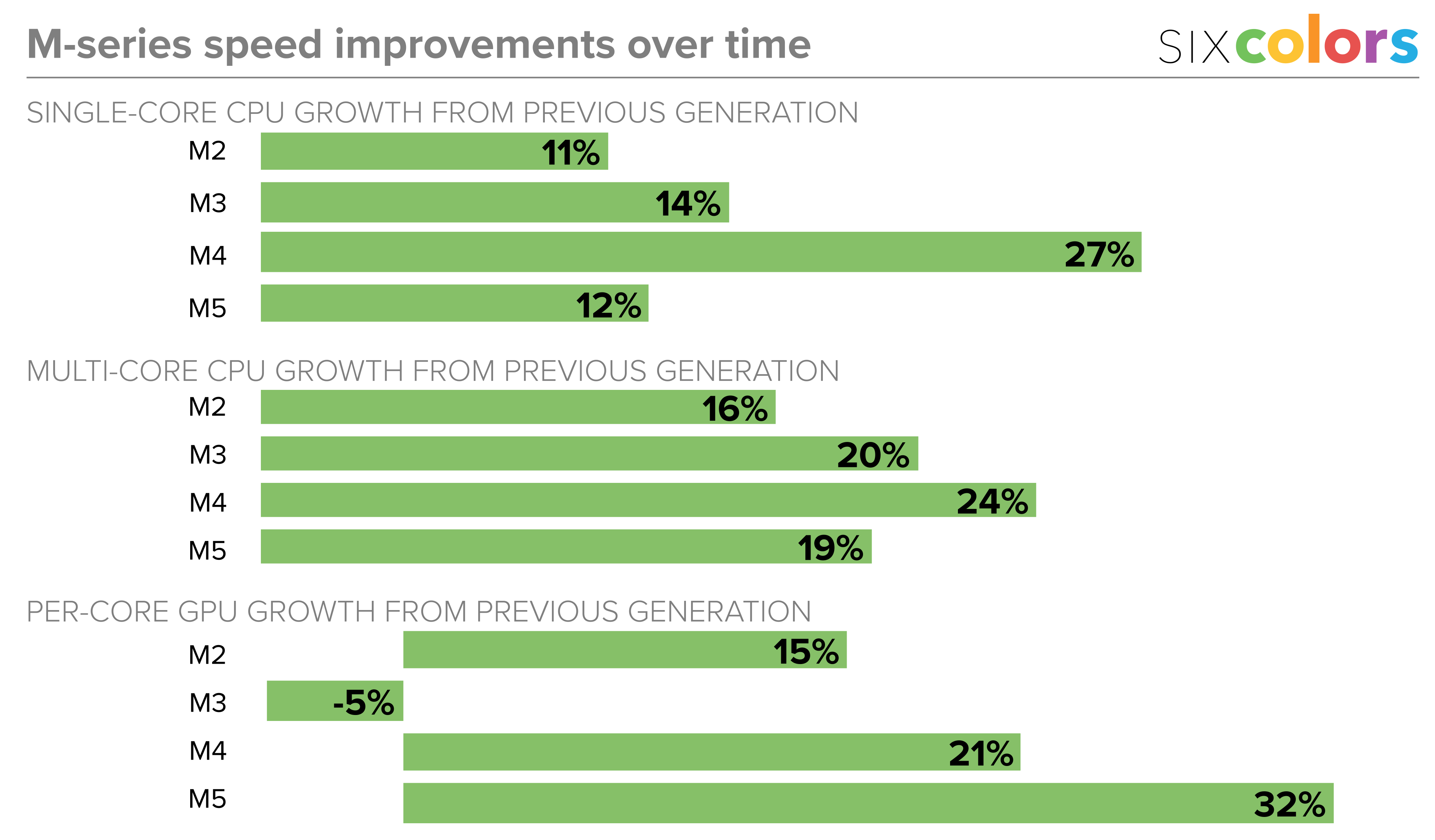
So the very, very broad overview of what the M5 brings is a lot like the overview of the A19: In this generation, the CPU cores got a bit better, and the GPU cores took a much larger jump.

Assuming that M5 Pro and Max chips are in the offing in 2026, loaded with GPU cores, I anticipate some pretty explosive GPU test results. But so far, through five chip generations, Apple has proved to be a bit shifty from generation to generation. It would be wild if it just never released higher-end M chips, wouldn’t it? But not impossible.


We talk about Electron apps and last week’s announcements before getting to the meat of the episode which is, oddly, bagels.


Jason has spent a little while with the new M5 iPad Pro, M5 MacBook Pro, and M5 Vision Pro (with accessories!) and we review them all. Also, Apple’s deal with F1 crosses the finish line.


By Jason Snell

M5 MacBook Pro review: The ultimate computer?

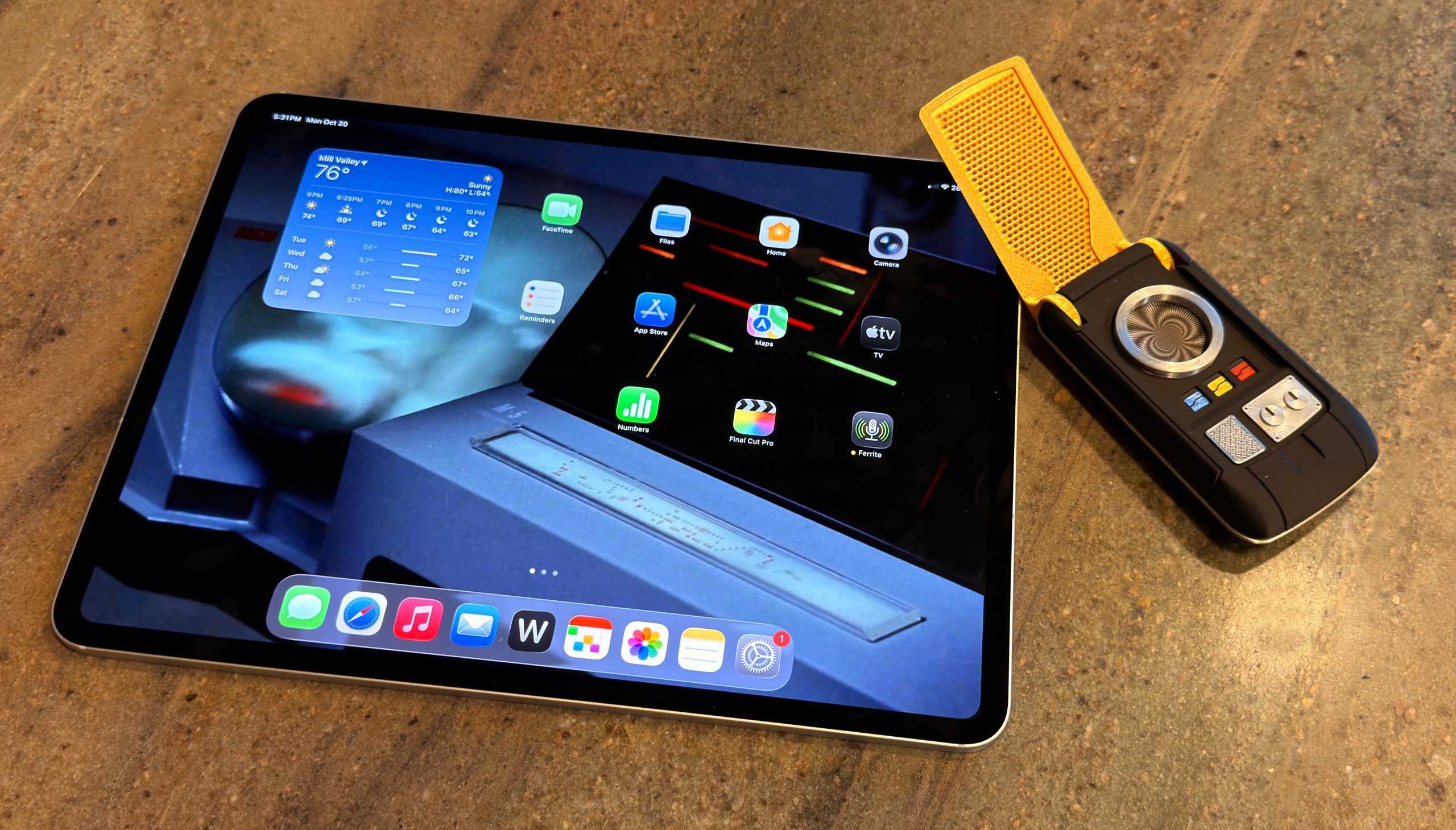
A laptop with a sci-fi scene on the screen next to a blue and black handheld device on a wooden surface. Star Trek references!

The new 14-inch M5 MacBook Pro is very much like its M4 predecessor, in that it’s got all the advantages of being a MacBook Pro, but by using Apple’s lowest-end M5 chip, it’s also the most affordable model.

Except it’s not the lowest-end M5 chip, at least not so far. It’s the only one. Apple has released a single M5 chip and placed it in three products: this laptop, an iPad Pro, and a Vision Pro. We can probably assume that MacBook Pros powered by M5 Pro and M5 Max chips are in the offing, but unlike in the M4 generation, this base-model MacBook Pro is the only Mac on stage at the debut.

Continue reading “M5 MacBook Pro review: The ultimate computer?”…


By Six Colors Staff

M5 Vision Pro, Dual Knit Band, PSVR2 controller review: Apple’s experiment continues

Black virtual reality headset with two screens displaying 'M5' and 'R1.' Features multiple sensors and buttons on the front, set against a black background.

Did the Vision Pro need an update?

On the one hand, no: Apple’s cutting-edge VR computer hasn’t exactly taken the world by storm. It’s a view of the future that, at its current size and price, doesn’t have much of a place in the present.

On the other hand, it turns out that the M2 processor that powered the Vision Pro was underserving some of its advanced hardware. Apple also probably needed to stop making M2 chips, and the M5 is fresh out of the oven. Upgrading the Vision Pro allows the company to keep it around without a major overhaul.

Continue reading “M5 Vision Pro, Dual Knit Band, PSVR2 controller review: Apple’s experiment continues”…


By Jason Snell

M5 iPad Pro review: Promise fulfilled

It’s been ten years since Apple released the first iPad Pro. In 2015, there were already people trying to integrate the five-year-old iPad platform into their working lives, but the wisdom of that choice seemed questionable—at least until Apple validated it by adding a true, professional-level model.

Unfortunately, it’s been a decade of rough sledding. Apple would occasionally feint toward embracing the iPad as a productivity device akin to the Mac, but (with certain exceptions) the experience was just too limited and restrictive.

In the past few years, things have changed. Apple has finally brought its pro media apps, Final Cut Pro and Logic Pro, to the iPad. And with iPadOS 26, Apple has delivered numerous improvements that get the iPad far closer than it has ever been to being a device that can get all sorts of different work done, without the need of a traditional computer as a fallback.

iPadOS 26 especially shines on the M4 iPad Pro, a device with a new, ultra-thin design, and bearing one of the best displays Apple has ever made: a tandem OLED screen with high dynamic range and remarkable brightness and color fidelity.

Into this very different world comes the M5 iPad Pro, which inherits that remarkable design and a much more capable operating system. Pretty nice.

Continue reading “M5 iPad Pro review: Promise fulfilled”…


By Glenn Fleishman

Slam Mac windows shut without saving

Glenn Fleishman, art by Shafer Brown

When I was in college, a friend told me about working a summer job at one of those art stores that sold extremely average factory-produced oil paintings that were designed to fit people’s decor.1 They probably made most of their money from the markup on frames.

The FileMaker Pro database used to manage sales and inventory was finicky. Once, it crashed on my friend, and her boss was not happy about it. He decided she had done the sequence wrong: “You close a window first, then quit a program!” My friend was livid: that was not how Mac programs work then, nor is it how they work now. The app has to manage its windows so that when you choose File > Quit, it properly handles open windows. Though this was nearly 40 years ago, it remains true.

There was a time when you couldn’t trust an app, though, and in that limited sense, my friend’s boss was right: closing all your windows could be more reliable than quitting, because you got to see the file close in a saved fashion. I recall—as do many of you, I’m sure—saving a file or clicking the red close button in the window and clicking Save, and then getting the watch icon or the spinning rainbow circle of doom. You’d wait a long time, hoping that the hidden situation resolved itself and your danged file saved.

Six Colors reader Jason (not our fearless leader, Jason) wrote in with a question2 about the polar opposite:

I often have to open multiple CSV files in Numbers. When I close those documents, I have to hit Delete every time. I tried quitting the app and see [a] warning… But there’s no option to just close them all and forget about them. Back in the day, there used to be a “close all and don’t save” type option, but I can’t find it. I have my Mac set to close windows when I quit an app.

I’m in the same boat, member Jason! Managing logistics for shipping books and Kickstarter campaigns results in a lot of CSVs that I open in Numbers, and for which I don’t need to retain changes. Unfortunately, Apple has moved away from any option that involves losing data. Is that unfortunate? Only in our particular circumstances.

You can disable an option that appears to be related: System Settings > Desktop & Dock > “Ask to keep changes when closing documents.” But it only sounds like what you want. This option, rather, relates to automatically saving files when you close a document: when disabled, supported apps (including all of Apple’s) save changes without a prompt; when enabled, you’re asked if you want to save. But files that haven’t been saved at all are unaffected: you’re still prompted.

The way out of this situation, which I expect is both niche but also affects a reasonable number of Six Colors readers with particular apps, is an automation program, like Keyboard Maestro or BetterTouchTool.

In Keyboard Maestro, you can set a trigger, like “long press Command-Shift-Option-D” (long press helps avoid a single press closing a document). Then add actions: close the window and click the Delete button.

screenshot of macro from Keyboard Maestro showing a sequence in which a keystroke causes the frontmost window to close and then the Delete button to be clicked.
Keyboard Maestro lets you make a straightforward macro that can, in effect, close a window without saving.

For a number of Numbers or other app windows, you can encompass the above with a While loop, setting it to remain active while there’s a Delete button in the foreground. That could be very, very dangerous, so perhaps only for the strong of heart.

[Got a question for the column? You can email glenn@sixcolors.com or use /glenn in our subscriber-only Discord community.]


  1. As opposed to oil paintings of factories (many produced in factories). 
  2. Join Six Colors, and you can shoot me messages directly from the members’ Discord! 

[Glenn Fleishman is a printing and comics historian, Jeopardy champion, and serial Kickstarterer. His latest book, which you can pre-order, is Flong Time, No See. Recent books are Six Centuries of Type & Printing and How Comics Are Made.]


By John Moltz

This Week in Apple: This unit must survive

John Moltz and his conspiracy board. Art by Shafer Brown.

Apple released new M5-based devices this week as Eddy Cue gives us a wink and a nod about Apple TV. AI continues to do… whatever this is.

Release the presses!

As was widely predicted in the days leading up to the event—like saying “Just watch, Chad’s bringing a box of store-bought cookies to the potluck again.”—Apple announced new hardware this week via press releases.

Apple put brand spanking new M5 chips in the MacBook Pro, iPad Pro and—oh, look!—even the Vision Pro. A chip that may take over your starship is certainly very exciting but these enhanced speeds are a little bumpy. All of these devices are largely the same as their previous iterations, with just some minor non-processor enhancements.

The Vision Pro, for example, comes with a new Dual Knit Band, which sounds like a Scottish folk music group.

“Laddies and jeeeentlewomen, The Stinky Haggis is proud tah prahzent… DUAL KNIT BAND!”…

This is a post limited to Six Colors members.


By Dan Moren

Apple strikes five year deal for Formula 1 rights

Image of three Formula 1 race cars in motion with the F1 and Apple TV logos above them.

As widely expected (and teased by none other than Eddy Cue), Apple announced on Friday that it’s zoomed into a five-year deal with Formula 1 to be the exclusive United States broadcaster of the racing circuit. Previously, ESPN had rights to air races in the U.S.

Apple’s coverage is starting-line-to-checkered-flag, including everything from practice to the Grands Prix and will be available to all Apple TV1 subscribers. Practices and some races will also be available for free to all in the app.

And Apple being Apple, this deal goes well beyond simply showing the races and instead across all of the company’s properties. There will be live updates in the Apple Sports app, of course, including Live Activities and “a designated widget” for the Home Screen, but also integrations in Apple News, Apple Maps, Apple Music, and even Apple Fitness+.2 (What of Apple Invites? Will you be able to quickly organize your watch parties?!)

As for F1 TV Premium, the circuit’s own subscription service, it’s not going anywhere—at least for the moment. Instead, it’ll be available only via a subscription to Apple TV. If you’ve already got such a subscription, you get F1 TV Premium as part of the package. (It’s not immediately clear if that means the races will be in the app, or you’ll simply log in to the F1 TV Premium app with your Apple account.)

More details are still to come, according to Apple, including more on how the races will be produced and all the integration details.

Though I’m not an F1 aficionado, I do find myself wondering about exactly how far Apple will go here. Five years is a goodly amount of time, and it’s possible that what this product looks like in year one of that deal is very different from what it looks like in year five. Will Apple spend the time putting its own stamp on the entire production, as it has with other sporting forays like Friday Night Baseball and Major League Soccer? This deal is certainly closer to the latter, if not quite the “wall-to-wall” terms that the company aspires to—after all, these rights are only for the U.S., not worldwide.


  1. By which I assume they mean the vibrant new identity of Apple TV+. 
  2. That plus is looking a little lonely there. 

[Dan Moren is the East Coast Bureau Chief of Six Colors, as well as an author, podcaster, and two-time Jeopardy! champion. You can find him on Mastodon at @dmoren@zeppelin.flights or reach him by email at dan@sixcolors.com. His next novel, the sci-fi adventure Eternity's Tomb, will be released in November 2026.]


Don’t call it “chargergate”

Perhaps you’ve heard the tempest in a wall wart over Apple not including a charger in the MacBook Pro in Europe. While some have been quick to blame this on EU regulation, it’s a little more complex than that. Nick Heer does an admirable job unpacking this whole brouhaha:

First of all, the dollar is not the currency in any of these countries. Second, the charger in European countries is €65, which is more like $76 right now. Third, Apple is allowed to bundle an A.C. adapter, it just needs to offer an option to not include it. Fourth, and most important, is that the new MacBook Pro is less expensive in nearly every region in which the A.C. adapter is now a configure-to-order option — even after adding the adapter.

There’s plenty of cynicism to go around here: some want to point fingers at Apple for cheaping out. Others want to blame Europe for silly and onerous rules. As it turns out, neither of those is really true.

Nick’s larger point is that it’s worthwhile—and, more importantly, incumbent upon—those of us who write about these things to take the time to get all the details.

Or, as a prominent football coach once said—be curious, not judgmental.1


  1. The show attributes this quote to Walt Whitman who, alas, never wrote those words

Hulu goes worldwide, Apple drops the plus and explores a relationship with Formula 1, the Lakers get immersive, the NBA is everywhere all at once, and our TV Picks.


Phil Schiller donates $9 million to New England Aquarium

Truman Dickerson writing at The Boston Globe:

The New England Aquarium received a $9 million philanthropic donation – the largest private gift in its 56-year history – to expand a lab that helps companies be more “environmentally responsible,” aquarium officials announced Wednesday.

The gift was provided by Phil Schiller, an Apple executive, and his wife, Kim Gassett-Schiller – both of whom are prominent philanthropists with standing gifts out to several Massachusetts institutions, including Schiller’s alma mater, Boston College, and Salem State University, where Kim Gassett-Schiller graduated in 1983.

The New England Aquarium is a time-honored institution in the Boston area; I’ve been visiting for as long as I can remember, and I just took my kid there at the end of the summer.1 It’s really a marvelous place.

As to why Phil and his wife chose the aquarium, apparently he worked there as a teen in the 1970s.

“My time working and volunteering at the New England Aquarium as a high school student reinforced a love for the ocean that has stayed with me for decades,” Schiller said in the release.

Now the only remaining important question is whether they will name a penguin “Phil.”


  1. As some sharp-eyed readers have noticed, the aquarium in my recent Galactic Cold War short story “Tapper’s Day Off” was inspired by the aquarium. 

Apple’s M5 updates and whether we use AI locally, media that’s brought us joy recently, whether the Vision Pro update changes our minds, and the Apple services and products we would rename.


Apple wants “to own a sport end to end”

A TV screen displays a soccer match between Miami and New York City with a player in a pink jersey. Below, live match schedules are shown. A tablet and smartphone display additional sports content and settings.
Apple owns MLS broadcasting “end to end.”

Apple SVP Eddy Cue was the guest on this week’s episode of The Town (Apple Podcasts, Overcast) with Matt Belloni. The whole interview, which is focused on Apple’s TV and film ambitions, is worth your time, but I want to focus on what Cue responded when Belloni1 asked him about sports rights:

MLS is closer to what we wanted to do, which is we’d like to own a sport end to end, so that we can offer customers what we do today, which is you don’t have to worry about blackouts, you don’t worry about how to watch, we can do picture-in-picture, we can do all kinds of things that every sports fan wants. I know what I want when I’m watching all these other sports.

Taking little rights here and there across all these different sports just doesn’t deliver that. And so that’s not an area that we’ve been interested in…. I can tell you, we are not, we have not been in the bidding process to take chunks of sports.

Again, I don’t know what Apple’s working on with Formula 1, but Cue’s statement makes it clear that Apple’s ambition, for any sport, is to own the whole thing. 2

Not only does this make me think that Apple’s F1 rights will include everything currently provided by both ESPN and the F1 TV streaming product, but it makes me think that this is a testing ground for Apple to perfect its coverage of F1 in the United States and then begin buying up rights to the sport in additional countries around the world, with the possibility that eventually it’ll own F1 everywhere.

That’s an enormous long-term goal for an extremely popular international sport, but Apple certainly has the money and the ambition to try to make it happen.


  1. A fellow Cal fan. Go Bears! 
  2. Earlier in the interview, Cue frames Apple’s deal with MLB as more of an experiment and learning experience. 

By Dan Moren

The iPad Pro gets the M5 treatment

iPad Pro M5 in Magic Keyboard case.

Is the M5 iPad Pro the ultimate computer? We’ll find out soon enough! Apple announced the latest update to its pro level tablet today, bringing performance improvements and new networking chips.

Like the M5 MacBook Pro and M5 Vision Pro, the iPad Pro boasts improvements like Neural Accelerators for the GPU that help juice up its AI performance, for all you crazy kids doing AI on your iPads.

But perhaps the most interesting news from the new models is the integration of Apple’s own networking hardware, including the N1 chips first introduced on this year’s iPhone line, bringing support for Wi-Fi 7 and Bluetooth 6 to the tablets. But the iPad Pro also gets Apple’s C1X cellular modem chip, introduced in the iPhone Air. Apple says its chip provides 50 percent faster cellular data performance as well as increasing efficiency over the C1 chip that launched earlier this year in the iPhone 16e; according to Apple that also means 30 percent less power usage than the M4 iPad Pro’s cellular modem.

Other than the new processor and networking chips, the specs of the M5 iPad Pro remain largely identical to its predecessor, including its accessory support, physical dimensions and weight, color options (space black and silver, naturally), and 10-hour battery life for surfing the web on Wi-Fi or watching video. The M5 model, however, does support fast charging of up to 50 percent in 30 minutes with Apple’s 40W Dynamic Power Adapter with 60W Max or other compatible adapter.

It’s also worth noting that, like the M4 iPad Pro, there is a distinction between the M5 processor on the 256GB/512GB models, which features a binned 9-core CPU, compared to the 10-core CPU on the 1TB or 2TB models.

The 11-inch iPad Pro starts at $999 for the 11-inch model and $1299 for the 13-inch model, both with 256GB standard. Cellular connectivity is available for $200 more, with a nano-texture glass option available on only the more expensive 1TB or 2TB models for an additional $100. Pre-orders are available today, and start arriving on October 22.

Updated to clarify nano-texture pricing and availability.

[Dan Moren is the East Coast Bureau Chief of Six Colors, as well as an author, podcaster, and two-time Jeopardy! champion. You can find him on Mastodon at @dmoren@zeppelin.flights or reach him by email at dan@sixcolors.com. His next novel, the sci-fi adventure Eternity's Tomb, will be released in November 2026.]


By Dan Moren

The MacBook Pro with M5 is alive

MacBook Pro screen displaying email composition with calendar and widgets.

Continuing the company’s cavalcade of M5-related announcements, Apple today announced the new 14-inch MacBook Pro powered by its latest processor.

But hold on, you might say, aren’t there more MacBook Pros than just the one? Well, yes, but it seems that—as rumored—the M5 Pro and M5 Max processors are not yet ready for primetime, so today’s announcement is just the base-level MacBook.

Apple says its new M5 processor brings significant performance improvements to the MacBook Pro, including 3.5x the AI1 performance, thanks to new Neural Accelerators built into the GPU cores, much like on the latest generation of iPhones. (No surprise there, as the A19 Pro cores that power the iPhone Air and iPhone 17 Pro are from the same processor family.) The company also touts a faster CPU, revamped Neural Engines, and more memory bandwidth (153GB/s compared to 120GB/s on the M4 model), all of which contribute to its performance gains over its predecessor.

According to the company, the new MacBook Pro also features faster SSD performance thanks to newer storage technology, which also enables an upgrade option for 4TB of storage (at an additional eye-watering $1,200).

Specs otherwise remain unchanged from the M4 model, from the 10-core CPU/10-core GPU configuration down to the physical dimensions and weight, battery life, and colors: your basic Silver and Space Black.2 Like its predecessor, the M5 MacBook Pro starts at $1,599.


  1. If you had “Apple brags about AI performance” on your bingo card, I’m sad to say you can stack all your chips there. That’s how bingo works, right? 
  2. This despite a teaser video yesterday from Apple marketing honcho Greg Joswiak that seemed to suggest a blue model might be incoming. 

[Dan Moren is the East Coast Bureau Chief of Six Colors, as well as an author, podcaster, and two-time Jeopardy! champion. You can find him on Mastodon at @dmoren@zeppelin.flights or reach him by email at dan@sixcolors.com. His next novel, the sci-fi adventure Eternity's Tomb, will be released in November 2026.]


By Dan Moren

Apple launches M5 powered Vision Pro with new Dual Knit Band

a woman wearing a virtual reality headset with a white strap and a black front panel

Now see this: Apple today announced the first major revamp to the Vision Pro, bringing its brand new M5 processor to the device, along with a new band.

While the overall design of the device doesn’t change, the new M5, built on a 3nm process, brings better performance to the headset. According to Apple, the M5 can render 10 percent more pixels on the Vision Pro’s OLED displays, improving the sharpness of text; the new processor also supports a 120Hz refresh rate when viewing their physical surroundings, reducing motion blur, which should help make the pass-through mode more seamless.

Apple also cites improved battery life with this new version, sporting up to two and a half hours of general usage on a charge (up from two hours for the M2-powered version) and three hours of video playback (up from two and a half hours for the M2 version). Those savings appear to be related to the processor itself, since the Apple cites the different times for the models in the Apple Vision Pro Battery listing.

The new Dual Knit Band, included with the M5-powered Vision Pro, looks like a mix between the original Vision Pro’s two straps, the Solo Knit Band and the Dual Loop Band. It has the style of the Knit Band, boasting the 3D-knitted fabric on both lower and upper bands. The lower band also includes embedded tungsten inserts, designed to provide a counterweight to the Vision Pro’s own weight. Apple says this will provide better comfort and balance. It’ll be available in small, medium, and large sizes and is compatible with the M2 Vision Pro; it’s up for purchase on its own for $99.

There’s also some additional clarity around two previously announced Vision Pro accessories. The Logitech Muse, a 3D-enabled digital pencil device, is now available for preorder from both Logitech and Apple for $129.95.

Apple will also, as promised, be selling Sony’s PlayStation VR2 Sense controller and Controller Charging Station, supported by visionOS 26. It’ll cost $249.95 and be available on November 11.

The new Vision Pro will be available starting on October 22, with preorders up now for customers in Australia, Canada, France, Germany, Hong Kong, Japan, the UAE, the UK, and the U.S.; mainland China and Singapore pre-orders start on Friday.

Those hoping for a price change will be disappointed: it still starts at $3,499 with storage tiers in 256GB, 512GB, and 1TB at the same prices as before. In addition to the new Dual Knit Band, it includes the same Light Seal, pair of Light Seal Cushions, cover, polishing cloth, battery, and USB-C cable. However it also includes Apple’s recently announced 40W Dynamic Power Adapter with 60W Max, though it seems like an expensive way to get that if you want it.

[Dan Moren is the East Coast Bureau Chief of Six Colors, as well as an author, podcaster, and two-time Jeopardy! champion. You can find him on Mastodon at @dmoren@zeppelin.flights or reach him by email at dan@sixcolors.com. His next novel, the sci-fi adventure Eternity's Tomb, will be released in November 2026.]


While we waited for Apple’s announcements this week we talked about the company dropping the “+” from Apple TV+ and discontinuing Clips, Lex has some complaints about being a developer and we advocate for more app stores.


Search Six Colors