It was an odd fall keynote for Apple. As expected, revisions of the iPhone and Apple Watch took the spotlight, but there were relatively few surprises overall, many of the details having leaked ahead of time, and a large amount of time spent on the company’s environmental initiatives and innovative materials.
As always, I combed through Apple’s website and press releases afterwards, to dig up any details that might not have made the cut of the roughly hour and twenty-minute presentation and there was…surprisingly few additional tidbits to find.
iPhone
The iPhone 15 Pro contains a Thread radio, a wireless connectivity standard used in smart home tech. Previously it’s only been available in the HomePod, HomePod mini, and Apple TV 4K. In its press release, Apple describes it as “opening up future opportunities for Home app integrations”, though at present, it sounds like it’s not doing anything.
Satellite coverage—both Emergency SOS and Roadside Assistance—is available for two years free with any iPhone 15 activation. (Presumably iPhone 14 Pro owners who had previous coverage will continue to get it for free when they upgrade. The support document on Apple’s site isn’t live as of this writing.
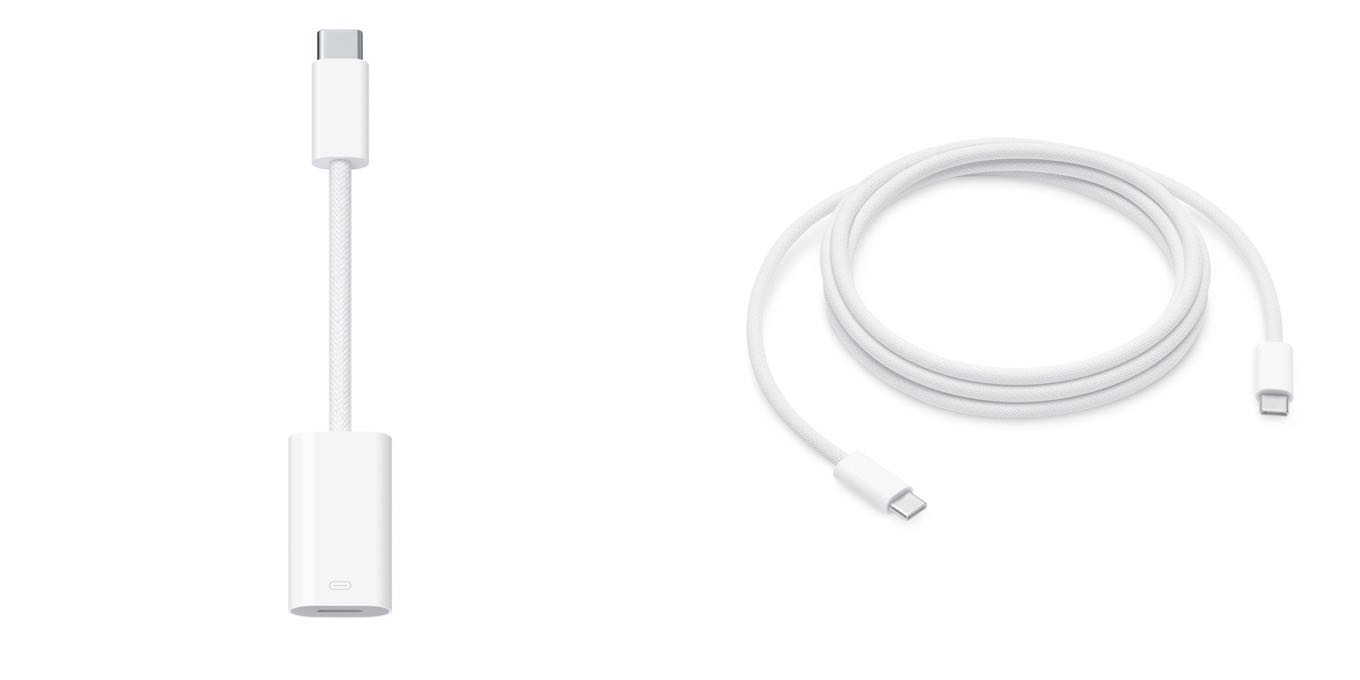
In addition to AirPods, the Apple Watch can also charge from the iPhone 15s. Apple only mentions those devices, though presumably anything with a USB-C connection should be able to? Apple says the USB-C cable included with the iPhone “is compatible with AirPods Pro (2nd generation) with MagSafe Charging Case (USB‑C).”
A footnote on the Action button notes that the Translate option will not be available until “later this year.”
Unsurprisingly, the new Precision Finding features Apple showed off only works with devices with the new second-generation Ultra Wideband chip.1
Apple’s 20W USB-C adapter (sold separately, naturally) will charge an iPhone 15 to about 50% in roughly 30 minutes.
AirPods Pro
The old (left) and new (right) copy on the second-generation AirPods Pro page.
The new second-generation AirPods Pro USB-C charging case is apparently not available separately, which seems to be because these AirPods Pro are actually a slightly newer model. Apple cites a new IP54 rating for earbuds and case, adding additional dust resistance, as well as a new Lossless Audio with ultra-low latency specifically for use with Apple Vision Pro—a feature that does not appear to be coming to the existing second-generation AirPods Pro.
Timing and prices
Pre-orders of new iPhones start at 8am Eastern/5am Pacific on Friday, September 15.
iOS/iPadOS 17, watchOS 10, and tvOS 17 launch Monday, September 18. macOS Sonoma launches Tuesday, September 26.
The new iCloud+ plans Apple unveiled will cost $29.99 per month for the 6TB storage option and $59.99 per month for 12TB.
Which Apple appears to be very careful not to call the U2. ↩
[Dan Moren is the East Coast Bureau Chief of Six Colors, as well as an author, podcaster, and two-time Jeopardy! champion. You can find him on Mastodon at @dmoren@zeppelin.flights or reach him by email at dan@sixcolors.com. His next novel, the sci-fi adventure Eternity's Tomb, will be released in November 2026.]
Thunderbolt 5 will deliver 80 gigabits per second (Gbps) of bi-directional bandwidth, and with Bandwidth Boost it will provide up to 120 Gbps for the best display experience. These improvements will provide up to three times more bandwidth than the best existing connectivity solution, providing outstanding display and data connections.
In short: it’s a lot faster, allows for flexible use of bandwidth if certain types of usage needs more, and can provide up to 240W of power.
Thunderbolt 5 will still use the same USB-C style connector, and maintain backwards compatibility with Thunderbolt 4. Which is great, though it also means you increasingly never quite know what you’re going to get when you plug in a cable.
Intel says that Thunderbolt 5 controllers will be available next year, so the earliest Apple devices you’re likely to see these on are probably M3 Macs—and even the earliest of those are probably a little bit too far along at this point.
Ian King and Mark Gurman of Bloomberg report that Apple is extending its deal with Qualcomm for cellular chips for three more years:
Though the new contract extends until 2026, Apple could still start using its own modem before then. The company has been planning to gradually roll out the component.
In fact, Qualcomm is only projecting that it will have a 20% share of the business when the 2026 iPhone launches. Still, the company used similar wording with the original agreement, suggesting that it could be a conservative forecast.
Apple’s been working to replace Qualcomm’s modems in its devices since 2018, and purchased Intel’s chip division to aid in the effort in 2019. Originally Apple expected to phase out Qualcomm’s modems in favor of ones designed at Apple by, well, now or early next year. But now that window has been moved outward.
Anything could happen, but Qualcomm’s disclosure that 2026 iPhones would only be fractionally covered by Qualcomm suggests that Apple’s expecting to ship some devices with its own chips before the term ends. I would expect it to be a careful ramp up, perhaps over multiple years, since the iPhone’s cellular connection is one that Apple can’t afford to screw up. I’d expect we’ll see Apple cellular modems in iPads and perhaps the iPhone SE (and dare I suggest MacBooks?) before they appear in mainline iPhones.
In the meantime, Qualcomm gets several more years of high profile business, as well as a bit of a glow from being the leader in a high-tech sphere that even Apple hasn’t managed to crack—at least, not yet.
Who wants cheap MacBooks and USB-C iPhones?! Everyone. Apple sets things on the spin cycle and the UK government seems stuck on a roundabout.
Wish fulfillment
This week saw a rumor about a low-cost MacBook make the rounds. This brings to mind the buzz that Apple was going to release a “netbook” before it introduced the original MacBook Air.
“Here’s your ‘netbook’. It has one USB port and it costs $1,800. Enjoy.”
Apple’s revenue has been relatively flat for the last year and a half. What makes anyone think it would introduce anything low-cost, particularly to compete with Chromebooks?
Meanwhile, a survey out this week says that as much as 44 percent of Android users would be tempted to switch to the iPhone if it goes to USB-C! Sight unseen! Wow! Don’t tell me anything else about it, just give me that sweet, sweet USB-C!
Look, while there probably are some people who will switch because of a connector they are not all that likely to use very often, surveys of buying intentions are largely meaningless. Honestly, surveys of any intentions are probably meaningless.
“This is the year I’m finally gonna get in shape!”
[12 months later]
“[belch] OK, that didn’t happen.”
If USB-C checks off that final box for a few connector pedants, well, welcome to the iPhone. That’s not how Apple designs phones, though.
Protesting Too Much 2: The Re-Protesting
Another week, another story about how Apple is totally into AI, y’all! Like, so much AI goin’ on up in this hizzous. Yeah, dawg.
(Look, I know that’s not a cool way to try to talk cool, I just imagine Apple thinks it’s a cool way to try to talk cool.)
According to The Information, Apple spent ONE HUNDRED MILLION DOLLARS for GPT-4! Sure, that’s a lot of money for most people, but actually not all people. It’s not really that much for companies, though, particularly Apple. I did the math and Apple makes that much in revenue in less than three hours. That’s one viewing of Oppenheimer’s worth of commitment. I mean, that’s a long movie, but still.
Meanwhile, despite stories indicating Apple’s developer sessions with Vision Pro were not well attended, Apple would like you to know that everyone is hella excited about the Vision Pro!
(Yeah, they’re still doing that cool talking thing. So embarrassing.)
The company has seen “extremely high, three-digit customer satisfaction for the labs that we’ve run so far,” says Prescott, using a creative way to imply universally positive feedback.
Like 898 percent customer satisfaction. So many customers, so much sat.
Apple also said downloads of the SDK had exceeded the company’s expectations, which may be true but is obviously not verifiable. Just take their word for it.
Anarchy in the UK
It was a wild week in the United Kingdom. First we heard that the government had backed off on its intention to bust end-to-end encryption open like a piñata full of crime instead of candy.
This news sadly upset proponents of the legislation. I really feel for them because they’re probably already so distraught over things like all the horrible shows on TV right now, the music the kids listen to these days, the way youngsters wear their pants, that awful Dungeons & Dragons game…
Richard Collard, head of child safety online policy at the National Society for the Prevention of Cruelty to Children, said: “Our polling shows the UK public overwhelmingly support measures to tackle child abuse in end-to-end encrypted environments.
Ah, yes, circumventing end-to-end encryption. Definitely on the list of things the public fully understands the implications of. Like Brexit.
“Tech firms can show industry leadership by listening to the public and investing in technology that protects both the safety and privacy rights of all users.”
“Dammit, don’t tell me it’s impossible, I wanna ride a unicorn!”
Privacy groups were all letting out a sigh of relief, but there’s just a small problem here. Who exactly said the government was backing down?
In a statement to the House of Lords on Wednesday afternoon, junior arts and heritage minister Lord Stephen Parkinson sought to mark an eleventh-hour effort to end a stand-off with tech companies…
“Junior arts and heritage minister.” Now, I may not be at all familiar with how British politics works, but that doesn’t sound like an authoritative source on a bill covering encrypted personal messaging.
And, wouldn’t you know it, the Minister for Technology says it’s all codswallop! Follygaggery! Slackjawldery!
“We haven’t changed the bill at all,” [Technology minister Michelle Donelan] told Times Radio.
“It’s on a computer and we don’t know how! Something about the cloud? I don’t know. I stopped listening after that.”
Donelan told reporters further work to develop the technology was needed, adding that government-funded research had shown it was possible, however she did not offer evidence to back her claim.
This is some real parents=saying-“Do it because we said so!” energy. Despite their protestations, this either ends with the bill getting changed or some real effing around and finding out.
[John Moltz is a Six Colors contributor. You can find him on Mastodon at Mastodon.social/@moltz and he sells items with references you might get on Cotton Bureau.]
I’ve been planning to set up a second workspace in my house, and the biggest stumbling block has been figuring out what display to place on the desk. I’ve got an Apple Studio Display on my primary desk, and since it was preceded by an iMac Pro and a 5K iMac, I’ve really gotten used to having a 27-inch screen with 5K resolution.
But that Apple Studio Display costs $1599, which is a lot. The LG UltraFine lists at $1299, and I can find it for under $1000 on Amazon, but I’ve also heard from many friends and readers that it’s got mediocre build quality and some reliability issues.
Samsung decided to take its own crack at the Apple-friendly 27-inch 5K monitor format with its new ViewFinity S9 display, which lists at the same $1599 price as Apple’s display but offers a bunch of different features that potentially make it a better buy. So I bought one and took it for a spin.
Depending on what your needs are, the ViewFinity S9 might be a much better option than the Apple display. It’s certainly a legitimate competitor to Apple’s display in a market that’s thin on the ground. But Samsung’s display is also saddled with a bunch of quirks that leave me unconvinced that most Apple-using buyers would choose it over Apple’s display at the same price.
Design decisions
The ViewFinity S9’s physical design is clearly influenced by Apple’s minimalist approach. It’s rectangular with very small bezels, clad in silver (some metal, some plastic), with the only Samsung branding on the back of the display where you don’t have to look at it. It’s using the same familiar 27-inch IPS 5120-by-2880-pixel panel I’ve had on my desk for years. If you put one of these on your desk, it would not stick out like a sore thumb compared to all the Apple hardware that surrounds it. (Well… except for the sensor housing that sticks out of the bottom of the display, but more on that in a moment.)
The Samsung display comes with a Thunderbolt 4 port, three USB-C (2.0) ports, and a mini DisplayPort input, which is also on par with Apple’s display. But the ViewFinity S9 hardware lags behind Apple’s display in quite a few areas. First off, it doesn’t plug into a wall—instead, it plugs into a large, heavy black power brick. And while I’ve grown a little jaded about Apple’s boasting about the multi-speaker audio arrays in its laptops and displays, I was not prepared for the lousy, tinny sound that came out of the ViewFinity S9’s speakers. (I guess that’s why it’s not called HearFinity…)
Samsung’s magnet-attach webcam (top) can’t tilt over the edge far enough to frame me properly at my desk (bottom).
One of the knocks on the Apple display is that the company chose a wide-screen camera with Center Stage for its webcam, resulting in a lower-quality picture than many people expected. Samsung does this differently, including a 4K webcam that attaches magnetically to the back of the display, where there’s a set of pins that carry USB via an included adapter. It’s a perfectly fine webcam, but because it’s mounted on the back of the display, it barely peeks above the top of the display. While the camera can extend upward slightly and tilt down, my head was still at the very bottom of the frame—and there’s no real way to adjust it beyond that. With third-party software, I was able to zoom in and make it look a little better, but at that point, it looked worse than the Studio Display’s webcam. (Turns out this stuff is harder than it looks.)
While the two displays have the same base price, the fact is that the $1599 Samsung display is more ergonomically versatile than the Apple display at the same price. Samsung’s default base is both tilt and height adjustable—it even lets you rotate the display 90 degrees. If you want a tilt and height adjustable Studio Display, Apple will charge you $1999.
There’s more. The ViewFinity comes with a glare-resistant coating by default; if you want Apple’s glare-reduced model, that’ll be $1899 (without the adjustable stand) or $2299 (with it). These days, I don’t sit with my back to a window, so I don’t really need that glare reduction, but back in my corporate days, I frequently had a window right behind me, and having an anti-glare screen was a necessity.
This gets to the core of the decision-making process when weighing the ViewFinity S9 versus the Studio Display. If you’re not content with a non-adjustable stand (or using a VESA mount, since Apple doesn’t charge extra to not include a stand), or if you need an anti-glare screen, the Samsung display will cost appreciably less than Apple’s model. The question is, do the weird quirks of owning a Samsung display outweigh that price difference?
Smart TV features: bonus or burden?
Here’s the thing about the ViewFinity S9: It’s not just a standalone display—it’s a Samsung Smart TV with all the features and quirks that come along with that status. If you think it’s weird that the Apple Studio Display runs iOS under the covers, think about the idea of your display running Samsung’s Tizen OS and requiring software updates via a menu interface driven by the included infrared remote control. If you are seeking a simple, dumb display, run away.
I’m not going to review the Smart TV features on the ViewFinity S9, though I will say that I found the remote’s button layout confusing. Out of the box, it didn’t work quite right, so I had to dive into the menus to properly set it to use the right settings as a Mac display.
When you put your Mac to sleep or shut it down, a bright blue screen appears, warning you that the display will enter standby mode in 45 seconds. It’s jarring, and if there’s a way to turn that feature off, I couldn’t find it. When the display’s in standby mode, it will spring back into action the moment you start up or wake up your Mac. (If you choose to turn the display off, however, you’ll need to turn it back on when you wake or boot your Mac.)
The moment I connected to my home Wi-Fi, things got weirder. The TV suddenly popped up a live TV guide, apparently fed from Samsung-mediated streaming stations. I could install various apps. I also had to agree to a bunch of Samsung privacy policies, and when I tried to find out where to turn off or opt out of all tracking features, I couldn’t do it from the device. Instead, Samsung referred me to a website that didn’t really make any sense.
The entire process was unpleasant and made me uneasy about what the display was actually going to be able to monitor and send back to Samsung. As a result, after I updated the display’s firmware, I just turned off the Wi-Fi.
That’s unfortunate, since the display does support AirPlay—and without Wi-Fi, there’s no AirPlay. However, when the Wi-Fi was on, I did test the AirPlay functionality. My movie looked like a soap opera because motion smoothing was turned on by default. I tried to turn it off, but every remote press disconnected the AirPlay. I finally managed to turn off that setting using the physical power button on the back of the display, right above the back of the infrared receiver housing. (Yes, the Samsung display does have a power button—putting it one up on Apple—though it’s more of a multi-function rocker switch that navigates menu items.)
If you aren’t concerned about Samsung’s privacy policies and want a 27-inch computer display that can double as a smart TV, here it is! There are probably better options out there, but if you’ve got severely limited space (like a college dorm room), the ViewFinity S9 can pull double duty.
Back to the drawing board
If I were only in the market for a base-model Apple Studio Display, I wouldn’t opt for the Samsung display at the same price. Since I don’t want the Smart TV features, they just get in the way, and (surprise, surprise) Apple does a better job of integrating its own display into the Mac interface.
Samsung really missed an opportunity to price this display closer to LG’s model than to Apple’s. The ViewFinity S9 only becomes a serious competitor to Apple’s display if you want an adjustable stand, need your display to be resistant to glare, or both. Frankly, I don’t like the idea of spending even $1599 on a display, but I certainly wouldn’t want to spend $1899 or $1999 or $2299 on one.
As for the ViewFinity S9 and my second workspace? Nope. I’m going to keep looking. I’m returning the Samsung.
We’re conserving energy before Apple’s fall season kicks off next Tuesday. Meanwhile, Jason has had a revelation about his Mac use thanks to Mac Analyst Stephen Hackett.
My thanks to Kolide for sponsoring Six Colors again this week.
AI is a hot topic in lots of businesses, but most companies still haven’t come up
with policies to manage AI usage—and employees are potentially handing over all sorts of sensitive data to tools that may or may not be trustworthy.
Browser extensions that offer AI features, but steal user data, are everywhere. That’s why many companies—including Apple—have banned their employees from using large-language models. And that’s just one potential attack surface.
Kolide lets IT and security teams write checks that detect device compliance issues, and have started creating checks for malicious (or dubious) AI-based tools. Here’s a video about how Kolide can help companies enforce device compliance.
Does the battle between Disney and Charter augur the end of the cable business model as we know it? Is the entertainment industry going bankrupt slowly, then all at once? It’s time for an all-Sports Corner episode of Downstream!
Dearly beloved, we are gathered here to day to bid goodbye to a titan of technology, a revolutionary amongst rebels, a connoisseur of connections, taken from us too—well, perhaps not too soon. I speak, of course, of our friend and colleague: the Lightning cable.
There are those who will say that such a send-off is premature, but the writing is on the wall. When Apple unveils its latest iPhone next week, the expectation is that the venerable Lightning port will be supplanted by one of its eternal rivals: USB-C.
But let us not simply mourn what is being taken from us: let us instead remember and celebrate what Lightning did with its life, the joy and happiness it brought to an entire ecosystem. Its presence will not soon be forgotten.
Google’s legacy as it turns 25, the websites we still visit manually, our preferred text editors, and what we’d miss most switching our smartphone platforms.
On Tuesday Aaron Lee and Eifeh Strom of Digitimes reported that Apple is “reportedly developing a low-cost MacBook series to compete with Chromebook models in the education sector that could be released as early as the second half of 2024, according to industry sources.”
The story goes on:
Sources said Apple will likely launch a new product line for its low-cost MacBooks to differentiate it from the existing MacBook Air and Pro lines. The outer appearance will still use a metal casing but made of different materials. The unit price of the mechanical components will be lower, allowing for a more affordable price aimed at the education market, similar to the positioning of Chromebooks.
If I had a dime for every “Apple’s going to release a low-end product to compete with other low-end devices” rumor, I’d have a hefty bank account by now. And you can find plenty of stories debunking this report as “sketchy.” At the risk of giving this report more credulity than it deserves, let me try to understand what this report might actually mean.
It seems to me that this is based on a rumor in the supply chain, in which Apple is investigating the development of a cheaper laptop. The whole angle about education and Chromebooks strikes me as speculation heaped on the bare rumor in order to make a clearer narrative for the report.
Let me supply an alternative one. The modern Apple strategy is to re-use older technologies to create more affordable products: the iPhone SE and the low-end iPad are just two of those examples. The M1 MacBook Air still being sold alongside the M2 model is perhaps the best example on the Mac side.
Why does the M1 MacBook Air exist? Because Apple wants to have a product available at a (relatively) low price point: currently it’s $899 for education and $999 for everyone else. That’s not a price the M2 model could hit and keep Apple’s traditionally high profit margins.
Now let’s imagine a world with a M3 MacBook Air in it. Does Apple discontinue the M2 model, or push it down into the $999 range? Does Apple discontinue the M1 Air at that point? In the Intel era I’d have answered yes, but the Apple silicon era is something different. The truth is, even now, the M1 is more than enough for most potential Mac users.
Just as a thought experiment, consider what Apple might do if it was planning to import the iPhone SE strategy to the Mac. It would take some older, but still quite capable technologies—say, everything that makes up an M1 Mac. The device’s parts are carefully scrutinized with an eye toward eliminating cost wherever possible, without sacrificing a basic Apple level of quality.
The product I’m describing might just be the M1 MacBook Air, discounted further and further. But it’s not impossible that Apple might instead choose to design a new M1 or M2 laptop that’s not saddled with some of the more pricey parts chosen for the MacBook Air back in 2020.
That’s not a Chromebook competitor, necessarily, but it would be a way for Apple to build a “new” MacBook that could compete with Windows laptops in the sub-$800 range. I’m not saying that it’s likely, but it seems like the most reasonable explanation if the Digitimes report is at all correct.
Jason and Myke preview what will happen at next week’s Apple event. What new features will the new iPhones have? How will the Apple Watch transform? And which one of us will harness the heart of a champion, Lionel Messi style, and score the winning goal?
The iPhone 15 Pro colors challenge the definition of a spectrum. Just as well, as you probably won’t be able to get one. And Apple pulls the plug on a storied app.
New iPhone cases and their recommended wine pairings
Apple has announced its iPhone event for this year. Titled “Wonderlust” and featuring an Apple logo dissolving into probably very expensive particles of some kind, the event will take place September 12, as was foretold in prophecy. What will be unveiled? Rumor has it we will see new Watches, both Ultra and non, new phones and new, higher price points! Very exciting. And the colors! Oh, the colors. If you haven’t seen the purported pictures of them, well, you’re in for a… “treat” is not the right word. York Peppermint Patties are a “treat”. This is more like “something that is technically edible”. You’re in for that. Like a bare celery stick. Actually, one of them looks like the color name could be “bare celery stick”. Just a lovely, not-at-all-mouth-watering hint of green. Like someone whispered “green” at you from across a noisy warehouse.
This year you won’t even be able to cover up your blandly colored iPhone with a leather case, at least not from Apple, as rumors indicate the company will be shipping vegan cases instead.
I guess people were eating them? Takes all kinds.
The new cases will be made of woven fabric. Important note, however:
This phone is also rumored to possibly be rechristened the iPhone 15 Ultra, which does roll off the tongue a little easier than “iPhone 15 Pro Max”. “Pro Max” has always sounded like a new 4K tier for a streaming service or something that came with a lengthy list of potential side effects but you should totally ask your doctor about anyway.
Call it whatever you want, just don’t expect to be able to lay hands on one.
According to Kuo, the iPhone 15 Pro Max was the “last project to kick off,” meaning that its mass production schedule is lagging behind the other iPhone 15 models.
Why would Apple start making what is expected to be its most popular device last? Buttons.
The analyst particularly points to Apple’s cancellation of the solid-state button project as the biggest factor here.
The Solid State Button Project is my favorite early 2000s alternative band name and a feature I look forward to some day angrily trying to get to reboot my iPhone when it locks up.
Trailers trashed
Pour out a $8 large Coke and $10 bag of popcorn for the Trailers app. Once the place to go for ruining upcoming movies in about two minutes, Apple has decommissioned the app, instead directing people to the Apple TV app. Likewise, trailers.apple.com redirects to a trailers page on tv.apple.com.
This might not seem like a big deal, but it is the end of an era. Back in the days of QuickTime Pro, Apple’s page would allow you to easily download trailers to your Mac, which was a consideration if you had a slow internet connection (I may be imagining it, but I have a memory of downloading the trailer for The Phantom Menace from that page). As a showcase for QuickTime technology, the trailers were all encoded in Mac-friendly formats at a time when that was a concern. Over the years, however, YouTube overtook the page and app as the place to view trailers first, and video standards became more ubiquitous, obviating the need for an Apple-centric page.
Cue the montage, play a slow, sad version of “Say Goodbye To Hollywood”, fade to black.
[John Moltz is a Six Colors contributor. You can find him on Mastodon at Mastodon.social/@moltz and he sells items with references you might get on Cotton Bureau.]
Since 2019, the Relay FM Community has raised over $2.2M for St. Jude. With your support this year, we’ll be one step closer to that day when no child dies from cancer. One cure closer. One child closer. This month and every month: Let’s cure childhood cancer. Together.
iPhone prep and iPad travel
The Apple event is official and we offer measured iPhone anticipation, and Jason gives up on pushing the iPad envelope for now.
Today, 404 Media reported on a letter sent on August 10 to the US Copyright Office by Ryland Hawkins of Author Services Inc. The company, its website and letterhead say, represents the “literary, theatrical, and musical works of L. Ron Hubbard, the late founder of Scientology. Author Services, according to records archived via the WayBackMachine, is owned by the Church of Spiritual Technology, which describes itself as a church within Scientology.
[…]
The Scientology-tied group seeks an amendment to the exemption so that it doesn’t apply to software-powered devices that can only be purchased by someone with particular qualifications or training or that use software “governed by a license agreement negotiated and executed” before purchase.
Why would Scientologists object to right to repair? Those familiar with the organization might also be aware of the “E-meter”, a device that Scientologists claim can read people’s emotional state, which is used in “audits” of its members.1
The right to repair law could open up a door for people to disassemble E-meters and publish their findings showing what most critics already believe: that they don’t do anything at all. More to the point, law would potentially protect the people doing that disassembly by not letting Scientology hide behind the idea of proprietary technology.
And also as a ploy to try and draw in new members. I remember seeing Scientologists offering free readings in BART stations in San Francisco. ↩